

Liquidity optimization is the process of ensuring a company can access, move, and deploy cash efficiently across entities, currencies, and time horizons while minimizing idle balances and funding costs. It's not the same as watching a dashboard. It's an active discipline.
This article is written for corporate treasurers, CFOs, and finance leaders managing multi-entity or multi-currency operations. For these teams, liquidity optimization isn't optional — it's central to financial resilience, cost control, and regulatory compliance in an environment where rate volatility and cross-border complexity punish anyone moving too slowly.
The trouble is that "liquidity optimization" gets thrown around loosely, often without a structured process behind it. Below, we break down a five-step framework, the factors that determine how well it works, and the mistakes that derail even well-intentioned treasury teams.
Key Takeaways
- Liquidity optimization maximizes cash efficiency without idle funds or shortfall risk
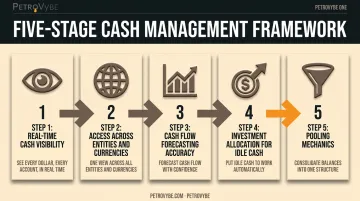
- Five sequential steps drive results: visibility, access, forecasting, allocation, and pooling
- Rate swings and multi-currency operations make a structured process essential
- Common failures: treating optimization as one-time and over-concentrating cash in one instrument
- Treasury management systems, notional pooling, and diversified vehicles support stronger execution
What Is Liquidity Optimization and Why It Matters for Treasurers
Liquidity optimization is the strategic process of maximizing the efficiency and availability of cash while making sure every obligation gets met, without parking excess balances that earn nothing. It's a portfolio decision applied to cash itself.
That's different from liquidity management, which is the day-to-day discipline of monitoring balances, initiating transfers, and confirming enough cash sits in the right account to cover today's payments. Management keeps the lights on. Optimization asks a harder question: is this cash working as hard as it could be?
The Cost of Getting This Wrong
Most companies don't lack cash. They lack structure around it. PwC's Working Capital Study 25/26 analyzed more than 17,000 listed companies and found global days sales outstanding climbing from 47.3 days in 2015 to 50.0 days in 2024. Up to €1.84 trillion in excess working capital could be freed up for reinvestment.
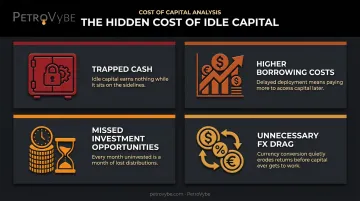
Without a deliberate liquidity structure, treasury teams run into predictable problems:
- Trapped cash sitting in subsidiary accounts that can't be accessed without triggering tax or regulatory friction
- Higher borrowing costs from drawing on credit lines while surplus cash sits unused elsewhere in the group
- Missed investment opportunities as idle balances earn near-zero yield in operating accounts
- Unnecessary FX drag from converting currencies reactively instead of netting exposures across entities
None of these problems fix themselves. They compound quietly until a liquidity crunch, a failed audit, a credit downgrade, or a board question forces the issue.
The Five Steps to Optimize Corporate Liquidity
These five steps build sequentially. Visibility enables access. Access enables forecasting decisions. Forecasting informs investment choices. Pooling mechanics tie the entire structure together for efficiency.
Not every company needs all five steps at full sophistication. A single-entity domestic business might stop at strong forecasting. A multinational with 40 subsidiaries needs the full stack, including in-house banking and notional pooling. Scale and complexity should dictate depth, not a generic checklist.
Step 1: Strengthen Real-Time Cash Visibility
Prior-day balance reporting used to be good enough. It isn't anymore. Treasurers need real-time visibility across every bank account, entity, and currency, including awareness of which banks are holding company cash and how concentrated that counterparty exposure has become.
Practical steps that move the needle:
- Consolidate banking relationships to reduce the number of accounts requiring reconciliation
- Implement multi-bank reporting or API connections so balances update continuously instead of overnight
- Rationalize dormant or redundant accounts that create blind spots and administrative drag
Many treasury teams still stitch together visibility from spreadsheets and manual downloads, particularly organizations that grew through acquisition. Every account added without a corresponding visibility upgrade is another blind spot waiting to cause a forecasting error or a missed funding deadline.
Step 2: Improve Access to Liquidity Across Entities and Currencies
Visibility tells you where the cash is. It doesn't move it. Liquidity has to be positioned where and when it's needed, on a just-in-time basis, or treasury ends up borrowing externally while surplus cash sits untouched three time zones away.
Three tactics matter most:
- Build global liquidity structures connected to key markets so cash can move between entities without manual intervention
- Map tax and regulatory constraints on cross-border cash movement before you need to move money urgently, not after
- Secure backup credit lines as a contingency measure for markets where cash can't move freely
Larger organizations often layer in-house banking or overlay structures on top of this, centralizing multi-bank pools and closing funding gaps that would otherwise require external borrowing.
Step 3: Sharpen Cash Flow Forecasting Accuracy
Forecasting accuracy underpins every other decision in this framework. Get it wrong, and investment allocation becomes guesswork, pooling structures move the wrong amounts, and treasury spends its time reacting instead of planning.
Improving forecast accuracy comes down to a few disciplined habits:
- Connect regularly with regional and functional teams who see cash movements before finance does
- Revisit forecasting assumptions on a set cadence rather than letting them go stale
- Prioritize critical payments — payroll, tax, and debt service — that carry zero tolerance for error
Automation is closing the gap between good and great forecasting. According to Ripple Treasury's cash flow forecasting platform, automated forecasting can cut manual tasks and improve accuracy by more than 30% compared to traditional methods. Results vary by organization, but the direction is consistent: less manual assembly, fewer errors, faster scenario planning.
Step 4: Optimize Investment Allocation for Idle Cash
Once cash is visible and accessible, the question becomes what to do with what's left over. The goal is to balance risk, yield, and availability, not to let surplus sit in a low-yield operating account by default.
The rate environment changes this calculus constantly. As of July 2026, the effective federal funds rate sat at 3.63%, with the Crane 100 Money Fund Index averaging a 3.46% annualized 7-day yield, a meaningfully different picture than the near-5% yields treasurers saw a couple of years earlier.
When policy rates fall, the incentive to extend duration into term deposits or diversify into other instruments increases, because overnight balances no longer carry the same yield advantage.
That yield compression is also prompting some finance leaders to look past the treasury function entirely, at capital that's confirmed excess to every operational and contingency need. For genuinely surplus, non-operational capital, some treasurers and high-income finance leaders look beyond traditional money market funds and term deposits. One example: PetroVybe's natural gas development model, which offers accredited investors upfront intangible drilling cost (IDC) tax deductions against active income alongside long-term diversification through direct participation in Texas-based natural gas projects.
This kind of allocation is not a cash management tool. It requires a substantial minimum investment (commonly cited around $100,000), accredited investor status, and a multi-year hold period before distributions begin.
That caveat matters more than the opportunity itself: duration and liquidity needs must be matched to the investment type. Cash needed for payroll next quarter has no business in a ten-year hold structure. Less-liquid allocations should only ever draw on capital that's confirmed, verified, and truly excess, reviewed against operating needs before a single dollar moves.
Step 5: Use Pooling Mechanics to Maximize Liquidity Efficiency
Pooling mechanics tie the first four steps together. Notional pooling offsets debit and credit balances across entities for interest calculation purposes without physically moving cash, reducing external borrowing and interest costs group-wide. Physical cash concentration goes further, automatically sweeping balances into a central account.
Automated, globally connected platforms handle the reconciliation work that used to consume treasury analyst hours, freeing that time for higher-value analysis instead of manual matching.
Virtual accounts add another layer of efficiency. Rather than opening a new physical account for every subsidiary or business line, virtual accounts track funding requirements as identifying sub-accounts under one physical account, avoiding complex overdraft structures while still giving each entity a clear, reportable position.
Key Factors That Affect Liquidity Optimization Success
Execution quality depends on more than the five steps themselves. A handful of underlying factors determine whether a liquidity program actually delivers:
- Data quality and timeliness across ERP and banking systems — forecast and decision accuracy is only as good as the data feeding it
- Interest rate environment and FX volatility, which constantly shift the risk-yield-availability calculus for surplus cash
- System dependencies, including multi-bank connectivity, treasury management systems, and API integrations that either enable or bottleneck real-time visibility
- Organizational scale and structure: more entities, currencies, and jurisdictions increase the case for pooling or in-house banking
- Regulatory and tax constraints on cross-border cash movement, including instruments that carry favorable tax treatment that can influence where surplus liquidity gets deployed
Scale Determines Which Factors Matter Most
Companies with more than $10 billion in revenue are far more likely to run an in-house bank or payment factory than smaller peers, simply because the complexity justifies the infrastructure. Smaller organizations don't need the same architecture, but they still need to know which of these five factors applies to them before investing in tools they may not require.
Common Mistakes and Pitfalls in Liquidity Optimization
Even well-resourced treasury teams fall into predictable traps.
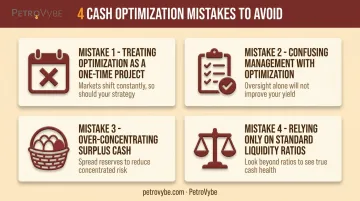
Treating optimization as a one-time project. A liquidity structure built two years ago doesn't account for last year's acquisition, this year's rate cuts, or next quarter's new subsidiary. This is an ongoing discipline, not a project with an end date.
Confusing management with optimization. Monitoring balances daily feels productive, but it isn't the same as strategically maximizing returns and efficiency. Teams that stop at management under-invest in forecasting tools and cross-border structuring.
Over-concentrating surplus cash. Parking everything in a single money market fund or with a single counterparty feels simple. It also increases risk exposure instead of reducing it.
Relying only on standard liquidity ratios. Current and quick ratios provide a snapshot, not a stress test. Without scenario-specific stress testing, a company can look liquid on paper while facing a real shortfall the moment one major customer pays late or one credit line gets pulled.
Conclusion
Liquidity optimization isn't a single fix. It's a continuous discipline spanning visibility, access, forecasting, investment allocation, and pooling mechanics — five steps that build on each other and require regular revisiting as the business changes.
Treasurers who master this framework reduce funding costs, improve resilience, and free up capital for strategic use. That includes, for genuinely surplus capital, diversified and tax-efficient options that traditional cash management tools don't offer.
There's no universal playbook here. The right combination of tactics depends on company scale, risk tolerance, and prevailing market conditions. A domestic mid-market company and a 40-entity multinational will land on very different structures, and both can be optimized, as long as the process stays deliberate rather than accidental.
Frequently Asked Questions
What is liquidity optimization?
Liquidity optimization is the strategic process of maximizing cash efficiency, availability, and returns while ensuring every obligation gets met. It goes beyond monitoring balances to actively structuring cash for maximum utility.
How do you improve liquidity?
Improve receivables collection, extend payment terms where reasonable, and sharpen cash flow forecasting accuracy. Centralizing cash through pooling structures also reduces the need for external borrowing.
What are the three types of liquidity?
Accounting liquidity measures short-term obligation coverage using current, quick, and cash ratios. Market liquidity reflects how fast an asset sells without moving its price, and funding liquidity measures access to capital when obligations come due.
What tools help treasurers optimize liquidity in real time?
Treasury management systems, multi-bank API connectivity, and automated forecasting or pooling platforms give treasurers real-time visibility and control. These tools replace manual, prior-day reporting with continuous data feeds.
How often should a company reassess its liquidity strategy?
Review liquidity policy at least annually, with ad hoc reassessment triggered by rate changes, M&A activity, or market stress. Monthly counterparty and duration reviews are common practice among larger treasury teams.
What's the difference between liquidity management and liquidity optimization?
Management is the ongoing, day-to-day monitoring of cash positions and balances. Optimization is the strategic layer on top: maximizing efficiency, returns, and access across that same liquidity.