

This distinction matters most to CPAs, financial analysts, and accredited investors sizing up joint ventures or partnership structures. The method you apply changes reported goodwill, consolidated revenue, leverage ratios, and how "control" gets measured versus mere "influence."
This guide breaks down both methods, where each applies, and a decision framework for picking the right one. Ownership percentage, roughly 20%-50% versus over 50%, is your starting point, but it's not the whole story.
Key Takeaways
- Equity method: used for 20%-50% ownership stakes, recorded as a single investment line
- Acquisition method: applies with control (50%+ ownership), requiring full consolidation under ASC 805 or IFRS 3
- Equity method tracks the investor's proportional share of profit, loss, and dividends; acquisition method merges entire financial statements
- The correct choice directly affects goodwill, EPS, and debt-to-equity ratios
- Oil and gas partnership and working-interest investors must identify which method applies to their specific reporting entity
Equity Method vs. Acquisition Method: Quick Comparison
Here's the side-by-side view CPAs and analysts reference most often before getting into the mechanics.
| Factor | Equity Method | Acquisition Method |
|---|---|---|
| Ownership threshold | 20%-50%, significant influence without control | Typically over 50%, control achieved |
| Financial statement treatment | Single line item ("Investment in Associate") | Full consolidation of assets, liabilities, revenue, expenses |
| Goodwill recognition | Embedded in investment account, not shown separately | Recognized explicitly, tested for impairment |
| Governing standards | ASC 323 (US GAAP), IAS 28 (IFRS) | ASC 805 (US GAAP), IFRS 3 |
| Ratio impact | Minimal effect on debt-to-equity | Can materially increase total assets and liabilities |
One caveat: the 20%-50% and >50% thresholds are shorthand, not bright-line rules. Both standards push preparers to look past the ownership percentage and assess actual control:
- ASC 323 presumes significant influence at 20% or more of voting stock, unless evidence says otherwise
- IFRS 3 directs acquirers to assess substantive control rights, not just a share count
- Board seats, veto rights, and contractual control provisions can shift the conclusion either way
What is the Equity Method?
The equity method applies when an investor holds significant influence over another company but stops short of control. FASB requires it once ownership crosses roughly the 20% mark, though the real test involves several qualitative indicators under ASC 323-10-15-6:
- Board representation
- Participation in policy-making decisions
- Material intra-entity transactions
- Interchange of managerial personnel
- Technological dependency between the two companies
No single factor decides it alone. Deloitte's roadmap on significant influence notes that even a 15% stake can trigger equity treatment if the investor has a board seat and material dealings with the investee.
How the Accounting Actually Works
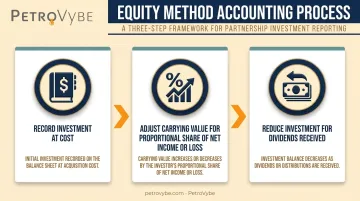
The mechanics are straightforward once you see them in sequence:
- Record at cost when the investment is first acquired
- Adjust the carrying value each period for your proportional share of the investee's net income or loss
- Reduce the investment for any dividends received, since these count as a return of capital, not income
Any basis difference between what you paid and your share of the investee's book equity gets folded into the investment account itself. This is sometimes called "equity method goodwill." It's never broken out as a separate goodwill line and isn't tested under ASC 350. Instead, the entire investment balance gets reviewed for impairment under ASC 323.
One operational nuance: if your ownership increases and you newly qualify for equity treatment, ASU 2016-07 requires you to apply the method prospectively from that date. There's no retroactive restatement of prior periods.
The practical benefit here is real. The equity method keeps you from "over-consolidating" assets and liabilities you don't actually control, giving stakeholders a cleaner read on your true economic interest.
Use Cases of the Equity Method
This treatment shows up constantly in:
- Joint ventures and unincorporated partnerships
- LLCs with shared governance
- Minority equity stakes in strategic partners
It's especially common in telecommunications, pharmaceuticals, financial services, and energy. In oil and gas specifically, non-operating partners in joint development agreements often hold meaningful influence without operational control, a structure that echoes equity-method logic even when the underlying interest isn't a share of stock.
Coca-Cola's 2024 Form 10-K offers a clean real-world illustration. The company reported equity method investments of $18.087 billion at year-end, down from $19.671 billion in 2023, with equity income of $1.770 billion flowing through net income. Dividends received from these investees totaled $968 million.
None of the investees' individual assets or revenue get added line by line to Coca-Cola's balance sheet, just the net investment and the income pickup. That's the whole point of the method: influence without inflation.
What is the Acquisition Method?
The acquisition method is the standard treatment when one company gains control over another, typically defined as more than 50% of voting rights, though contractual control rights can override a strict percentage count. ASC 805 governs it in the US, and IFRS 3 governs it internationally.
The Core Mechanics
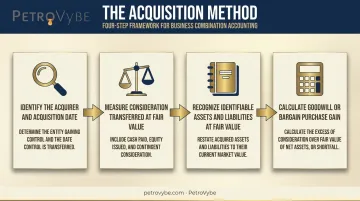
Applying the acquisition method involves four steps:
- Identify the acquirer and pinpoint the acquisition date
- Measure consideration transferred at fair value
- Recognize identifiable assets and liabilities of the acquiree at fair value
- Calculate goodwill or a bargain purchase gain
The full goodwill formula is: consideration transferred, plus any non-controlling interest, plus the fair value of any previously held interest, minus the fair value of identifiable net assets acquired. The simpler "consideration minus net assets" version only works cleanly for a 100% acquisition with no prior stake.
When the math goes negative, meaning identifiable net assets exceed what was paid, the company must first double-check its measurements. If the gap holds up, it's recorded immediately as a bargain purchase gain in earnings.
If less than 100% is acquired, the remaining stake shows up as non-controlling interest (NCI). US GAAP requires NCI at acquisition-date fair value; IFRS allows an election between fair value and a proportionate share of net assets.
The upside of full consolidation: stakeholders get a comprehensive view of the combined entity, which supports more thorough post-merger analysis than a single-line investment ever could.
Use Cases of the Acquisition Method
This method dominates:
- Mergers and majority-stake acquisitions
- Private equity buyouts intended for full integration
- Roll-up strategies across fragmented industries
- Strategic acquisitions in healthcare, energy, and tech
Microsoft's acquisition of Activision Blizzard, completed October 13, 2023, shows the scale of impact. The $75.408 billion purchase price resulted in a preliminary allocation of $50.969 billion in goodwill and $21.969 billion in identifiable intangibles.
From the acquisition date through June 30, 2024, Activision contributed $5.729 billion in revenue to Microsoft's consolidated statements, along with a reported operating loss of $1.362 billion driven partly by purchase-accounting effects. That's the acquisition method in action: entire financial statements merge, and goodwill becomes a permanent balance sheet fixture subject to impairment testing.
Which Method Should You Use? Decision Framework and Real-World Example
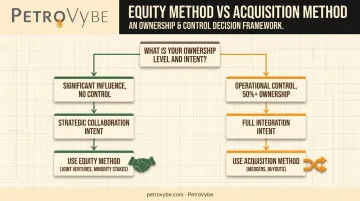
Choosing the right method comes down to four questions:
- What percentage of ownership do you actually hold?
- Do you have real operational control, or just influence?
- Are you represented on the board or in policy decisions?
- Is your long-term intent to collaborate, or to fully integrate?
If your goal is strategic influence without operational burden, the equity method fits: think joint ventures and minority partnerships. If your goal is full integration and control, the acquisition method applies.
A Real-World Example for Accredited Investors
Direct working-interest or limited partnership positions in oil and gas development projects illustrate this well. PetroVybe structures its accredited investor offerings as limited partnership units, where investors contribute capital and receive a proportional share of results without operational control or board authority over drilling decisions.
That distinction matters when you're reading your own paperwork. A PetroVybe investor's K-1 shows individual line items:
- Capital contribution
- Ending capital account balance
- Allocable share of ordinary income or loss
- Intangible drilling cost (IDC) deduction, typically 60%-80% of invested capital
None of that appears on a fully consolidated corporate financial statement, where all partner interests get aggregated into total equity and entity-level net income.
The accounting distinction protects investors from a common misread. A limited partner isn't looking at a consolidated balance sheet with the project's total assets and liabilities baked in.
They're looking at their own proportional slice, reported the way equity-method-style partnership accounting works: individualized, pass-through, and tax-relevant rather than balance-sheet-heavy.
If you're weighing a passive, tax-advantaged structure against a controlling acquisition, match the accounting treatment to your actual level of influence before you interpret the numbers.
Readers exploring direct, passive access to oil and gas development can review PetroVybe's investment structure for accredited investors. It comes with real tax advantages, none of the consolidation complexity of a controlling acquisition, and a clear look at how K-1 reporting works in practice.
Conclusion
Neither method is inherently better. The right choice depends entirely on the degree of control or influence involved, as defined by ASC 323 and ASC 805 in the US, or IAS 28 and IFRS 3 under IFRS.
Getting it right protects the accuracy of goodwill, EPS, and leverage ratios on the reporting side. For investors, this distinction matters just as much: understanding which method applies to your position lets you correctly interpret the financial statements and tax documents tied to your investment, whether that's a consolidated 10-K or a K-1 from a natural gas development partnership like PetroVybe's.
Frequently Asked Questions
What is the difference between equity method and acquisition method?
The equity method applies when an investor has significant influence (20%-50% ownership) without control, recording a single-line investment. The acquisition method applies when control is achieved (typically over 50%), requiring full consolidation of assets, liabilities, and goodwill.
Can you explain the equity method in a simple way?
The investor records the investment at cost, then adjusts that value up or down by its proportional share of the investee's profits or losses. Dividends received reduce the investment balance rather than counting as income.
What does acquisition method mean?
It is the accounting process used when one company gains control of another. The acquirer combines both companies' financial statements and recognizes goodwill for any premium paid over the fair value of net assets.
When can you use the equity method?
It applies when an investor holds roughly 20%-50% of voting shares, or otherwise demonstrates significant influence through board representation, policy involvement, or material intercompany transactions.
Does the acquisition method always result in goodwill?
No. Goodwill is only recognized when consideration paid exceeds the fair value of net identifiable assets. If the reverse is true, a bargain purchase gain is recorded instead.
What happens if ownership changes from an equity method stake to a controlling interest?
Once ownership crosses the control threshold, the investor switches to the acquisition method. The prior stake is remeasured at acquisition-date fair value, with any resulting gain or loss recognized as part of a step acquisition.