
Many investors chase returns without asking what risk they're actually taking on. That gap in understanding leads to panic selling during downturns, portfolios stuffed into a single asset class, or missed opportunities in higher-growth alternatives that could have balanced things out.
This guide breaks down what investment risk actually means, the six major types you'll encounter, how to figure out your own risk level, and practical ways to manage risk — including through alternative assets like natural gas development.
Key Takeaways
- Investment risk is the gap between expected and actual returns, including the chance of losing your principal.
- Six core risk types exist: market, business, credit/default, liquidity, inflation, and interest rate risk.
- Your "right" risk level depends on time horizon, income, goals, and personal capacity for loss — not a universal formula.
- Diversification manages risk but never eliminates it; some investors add alternative assets to reduce exposure further.
What Is Investment Risk?
Investment risk is the degree of uncertainty about whether you'll actually achieve the return you expect, including the possibility that you lose part or all of your invested capital. Investor.gov frames it plainly: risk is the potential for financial loss inherent in any investment decision, and every investment carries some amount of it.
That uncertainty is directly tied to potential reward. This is known as the risk-return tradeoff: investors generally demand higher potential returns to compensate for taking on greater uncertainty. A U.S. Treasury bill offers modest, near-guaranteed returns. A speculative growth stock might double in value or lose half of it within a single year.
Investment Risk in Simple Terms
Think of it like rock climbing. An indoor climbing gym has padded floors, harnesses, and controlled routes: low risk, with a narrow range of outcomes. Climbing an actual outdoor rock face introduces variables you can't control: weather, loose rock, unpredictable holds. The potential reward (the experience, the achievement) is greater, but so is the range of what could go wrong.
Risk tolerance works the same way. What feels like a controlled climb to one investor feels like scaling a cliff face to another. Neither is wrong; it's personal.
The Risk-Return Relationship
Financial professionals often use the risk-free rate of return as a baseline for measuring everything else. Short-term U.S. Treasury bills serve this purpose because they're backed by the federal government. As of July 2026, 13-week Treasury bills carried a 3.82% coupon-equivalent rate, while 52-week bills sat at 4.03%.
Every riskier investment gets measured against that floor. Here's the catch, though: higher risk doesn't guarantee higher returns. It only widens the range of possible outcomes, both the upside and the downside. A stock or alternative asset with more risk could outperform Treasury bills significantly, or it could underperform them badly. Risk expands possibility; it doesn't promise profit.
What Are the Six Types of Investment Risk?
Dozens of specific risk factors exist across markets, but nearly all of them roll up into six broad categories. Understanding each one helps you see exactly what you're exposed to before you commit capital.
Market Risk
Market risk is the risk of loss tied to factors affecting the entire market: recessions, geopolitical shocks, or broad interest rate shifts. FINRA classifies this as systematic risk, distinct from risks tied to a single company. The key limitation here: market risk generally can't be diversified away. If the broader market drops, most traditional assets tend to fall together.
Business Risk
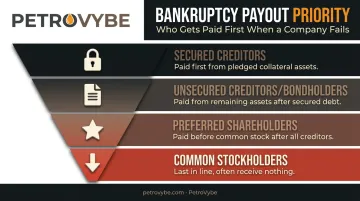
Business risk is the chance that a company or venture fails to generate enough revenue to stay operational. If that happens, there's a strict payout hierarchy in bankruptcy:
- Secured creditors get paid first from collateral.
- Unsecured creditors, including bondholders, come next.
- Preferred shareholders are paid before common shareholders.
- Common stockholders are last in line, often receiving nothing.
This hierarchy is why equity investors typically demand higher returns than bondholders in the same company.
Credit/Default Risk
Credit risk is the possibility that a borrower or bond issuer fails to make interest or principal payments. Credit rating agencies like S&P separate bonds into two broad tiers: investment grade (BBB- and above), which carries lower default risk and lower yield, and high-yield or "junk" bonds (BB+ and below), which carry higher default risk and higher yield to compensate.
The gap between these categories isn't theoretical. S&P's 2023 study found a 0% default rate among investment-grade issuers compared to 3.7% among speculative-grade issuers, a meaningful spread that shows exactly why junk bonds pay more.
Liquidity Risk
Liquidity risk is the risk of being unable to sell an investment quickly without accepting a steep discount. Real estate, private placements, and other alternative investments often carry higher liquidity risk than publicly traded stocks, but investors accept that tradeoff in exchange for potentially stronger returns or unique diversification benefits.
Inflation Risk
Inflation steadily erodes purchasing power, and it hits fixed-income and cash holdings hardest. The Bureau of Labor Statistics found that a dollar in 2022 held about 92.6 cents worth of purchasing power compared to 2021. A savings account paying 1% interest during a year of 5% inflation isn't safe; it's losing real value every month.
Interest Rate Risk
Interest rate risk applies mainly to bonds. The SEC explains it directly: when market interest rates rise, prices of existing fixed-rate bonds fall, because newer bonds offer better yields. The reverse holds true when rates drop. Longer-maturity bonds and lower-coupon bonds tend to feel this effect more sharply than shorter or higher-coupon ones.
What Should Your Investment Risk Level Be?
There's no universal "correct" risk level. It depends on your time horizon, income stability, financial goals, and how you personally react to seeing your portfolio drop 20% in a bad quarter.
Time Horizon and Investment Goals
Longer time horizons generally support higher-risk, higher-return positioning, since there's more time to recover from a downturn. Someone investing for retirement 25 years out can typically absorb more short-term volatility than someone saving for a home purchase next year.
- 10+ year horizon: More room for growth-oriented, higher-volatility positions.
- 3-10 year horizon: A blended approach, balancing growth and stability.
- Under 3 years: Conservative allocations that prioritize capital preservation.
Income, Capacity for Loss, and Tax Situation
Time horizon is only one input. Your income and tax exposure shape the other half of the equation. Capacity for loss is the amount of capital you can risk without it affecting your day-to-day lifestyle. This is distinct from risk tolerance, which is more about psychological comfort. The CFA Institute treats these as separate inputs: one measures your financial ability to absorb a loss, the other your willingness to do so.
High-income earners carrying a heavy tax burden often have more capacity to explore higher-risk, higher-reward alternatives, particularly ones that also offer tax efficiency.
Oil and gas development partnerships are one example. Intangible Drilling Cost (IDC) deductions can offset active income, such as W-2 wages or capital gains, not just passive income, which real estate depreciation typically cannot do.
Assessing Your Personal Risk Tolerance
Before allocating a dollar, get a clear read on your own tolerance. A few practical options:
- Use a risk tolerance questionnaire, such as the resources available through Investor.gov.
- Talk with a financial or investment professional who can stress-test your goals against your actual comfort with volatility.
- Revisit the assessment periodically, since risk tolerance shifts as income, age, and goals change.
How to Manage and Diversify Investment Risk
Diversification is the most effective risk management tool available, but it has limits worth understanding clearly.
Spreading capital across asset classes, sectors, and geographies reduces unsystematic risk, the risk tied to a single company or industry. FINRA notes that diversification meaningfully reduces the odds of a major loss caused by overconcentration in one security or sector.
What diversification can't do is protect you from systematic risk. Investor.gov is direct about this: diversification cannot guarantee your portfolio avoids losses when the entire market drops. Stocks, bonds, and even most real estate tend to move together during broad downturns, which limits how much protection traditional diversification actually provides.
Why Alternative Assets Change the Equation
This is why many accredited investors add alternative assets whose risk drivers aren't tied to stock market sentiment. Natural gas and oil development is one example: a tangible asset class driven by geology, commodity pricing, and physical demand fundamentals rather than daily market swings.
One demand driver reshaping this space right now: AI infrastructure. Natural gas already supplies nearly half of U.S. electricity generation, and data center power demand is projected to roughly double by 2030. That's a demand curve running on physical electricity needs, not investor sentiment.
PetroVybe's flagship project, PetroVybe ONE, operates in this space out of Lavaca County, Texas. Key structural details include:
- $100,000 minimum investment, open to accredited investors only.
- Up to 94% first-year tax deduction against active income achieved by 2024 partners, driven primarily by IDC deductions.
- 10-year target MOIC of 2.2x-5.8x with a target IRR near 26%, though these are forward-looking projections tied to commodity pricing and production performance.

Mitigating Business and Operational Risk
Those return targets depend heavily on how well the underlying business risk is managed, which comes down to technical expertise and independent validation rather than guesswork. PetroVybe's proved reserves, for example, are valued at $48 million (PV-09) by a licensed third-party engineering firm, separate from the company's own internal estimates.
The team's Chief Geophysicist, Michael Stamatedes, brings a documented 75.2% well-success rate across a 48-year career, well above the industry peer average, which typically sits below 40%. That track record directly feeds into the decline curve calculations that determine expected production and, ultimately, investor returns.
None of this eliminates risk. Liquidity risk remains real: first distributions are projected 2-3 years out, and capital stays locked in during that development phase. But third-party validation and an experienced technical team are concrete ways to reduce the business and operational risk layered on top of the underlying commodity risk.
Frequently Asked Questions
What is investment risk in simple terms?
Investment risk is the chance that an investment's actual return will differ from what you expected — including the possibility of losing some or all of your money. Every investment carries some version of it.
What are the six types of investment risk?
The six major categories are market, business, credit/default, liquidity, inflation, and interest rate risk. Most specific risk factors fall under one of these six umbrellas.
What should my investment risk level be?
It depends on your time horizon, income stability, financial goals, and personal comfort with volatility. A risk tolerance questionnaire or a conversation with a financial professional can help clarify where you stand.
Can investment risk be eliminated completely?
No. Risk can be managed and reduced through strategies like diversification and matching investments to your time horizon, but it can never be fully eliminated. Even cash loses value to inflation.
What is considered the safest type of investment?
Government-backed securities like U.S. Treasury bills and FDIC-insured bank deposits are the lowest-risk options. They also tend to offer the lowest returns, reflecting that tradeoff.
How does diversification help manage investment risk?
Diversification spreads capital across uncorrelated assets, so a loss in one area can be offset by gains in another. It reduces concentration risk but cannot fully protect against a market-wide downturn.