
The good news: 2026 offers more monthly-income options than ever, from insured bank products to private energy partnerships built for tax efficiency. This guide breaks down seven vetted strategies, ranked from safest and most liquid to higher-yield and less accessible, so you can build a mix that fits your goals.
Key Takeaways
- HYSAs, MMAs, and CDs offer FDIC-insured monthly interest, though yields stay capped
- Bond funds, dividend stocks, and REITs pay higher yields but add market risk
- High earners can pair traditional income with tax-advantaged options like natural gas development
- Combining 2-3 strategies smooths rate cycles and cuts reliance on one income source
Overview of Earning Monthly Interest in 2026
Earning monthly interest means converting a lump sum of capital into a recurring cash payout instead of waiting years for a single return. It's the difference between planting one seed and harvesting a garden every month.
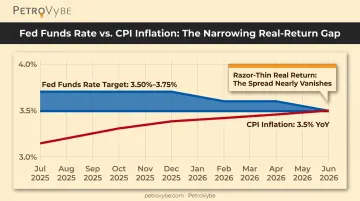
The rate backdrop matters here. The Federal Reserve has held its target range at 3.50%-3.75%, with projections pointing toward roughly 3.8% by year-end 2026.
Meanwhile, June CPI came in at 3.5% year over year. Cash parked at low rates is barely keeping pace with rising prices, let alone getting ahead of them.
That gap is pushing savers to look beyond basic checking accounts. The strategies below run the spectrum from insured and liquid to higher-yield and illiquid, so you can match the right tool to the right goal.
Top 7 Strategies to Earn Monthly Interest in 2026
This ranking weighs safety, liquidity, yield potential, and accessibility, useful whether you're building an emergency fund or managing a seven-figure portfolio.
1. High-Yield Savings Accounts (HYSA)
Online banks pay more than traditional branches because they skip the overhead of physical locations. Interest accrues daily and gets credited to your account monthly, making HYSAs a natural fit for emergency funds or short-term savings goals.
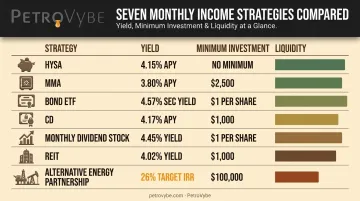
As of July 2026, Forbright Bank topped the list at 4.15% APY, with no minimum opening deposit required. On a $20,000 deposit, that works out to $830 in annual interest, or about $69 per month.
Deposits are protected up to $250,000 per depositor, per bank, per ownership category through FDIC insurance. That safety net makes HYSAs the starting point for most monthly-income strategies.
2. Money Market Accounts (MMAs)
MMAs blend savings-account safety with added flexibility, often including check-writing or debit card access. Banks invest the underlying deposits in short-term, low-risk securities, which lets them offer competitive rates while keeping your funds federally insured.
Top MMA rates reached up to 3.80% APY in July 2026. On a $25,000 balance, that's $950 in annual interest, or about $79 per month.
A bank MMA isn't the same as a money market mutual fund. The former is FDIC-insured; the latter is a pooled investment vehicle that can lose value. If checkwriting access matters to you alongside monthly interest, MMAs are worth a look.
3. Bonds and Bond Funds That Pay Monthly Interest
Individual Treasury notes pay interest every six months, not monthly. If you want a true monthly cash flow, bond ETFs are the better tool since they pool interest from hundreds of holdings and distribute it on a monthly schedule.
Vanguard's Total Bond Market ETF (BND) currently shows a 4.57% SEC yield, while iShares' National Muni Bond ETF (MUB) sits around 3.42% SEC yield. On a $50,000 investment in BND, that's roughly $2,285 in annual income, or about $190 per month.
Bond fund distributions aren't guaranteed. NAV moves with interest rate changes, and payouts fluctuate with portfolio turnover, defaults, and expenses. Treat SEC yield as a snapshot, not a promise.
4. Certificates of Deposit (CDs) With Monthly Payouts
A CD locks your rate for a fixed term in exchange for limited access to your funds before maturity. Some issuers let you take interest as a monthly cash disbursement instead of letting it compound, which suits investors who want predictable income without market exposure.
The national average 1-year CD APY sits around 2.00%, but top listed rates reach up to 4.17%. On a $30,000 12-month CD at 4.17%, that's $1,251 in annual interest, or about $104 per month if disbursed rather than compounded.
Confirm with your issuer whether monthly interest is a cash payout or simply compounded monthly, since the two produce very different results if you're relying on that income.
5. Monthly Dividend-Paying Stocks and ETFs
Certain REITs, business development companies (BDCs), and covered-call ETFs distribute dividends monthly instead of quarterly. Realty Income, for example, shows a trailing dividend yield of 4.45% and has built its brand around monthly payouts to shareholders.
On a $40,000 position at that yield, annual dividend income comes to $1,780, or about $148 per month.
The tradeoff is real. BDCs use leverage, which magnifies both gains and losses, and dividend cuts happen when earnings soften. These vehicles offer income plus potential price appreciation, but neither is guaranteed the way bank interest is.
6. Real Estate Income (REITs and Crowdfunding Platforms)
Publicly traded REITs pass through rental income to shareholders, with the FTSE Nareit All REITs index showing a 4.02% dividend yield as of mid-2026. Crowdfunding platforms offer similar exposure to private real estate deals, often with monthly or quarterly distributions tied to property performance.
On a $35,000 REIT allocation at 4.02%, annual income comes to $1,407, or roughly $117 per month.
Rate sensitivity is often overstated. REITs actually posted positive total returns in 78% of months when Treasury yields rose between 1992 and 2025, since stronger economic growth can lift rents and occupancy alongside financing costs. Still, distributions can be cut, and some payouts include return of capital rather than pure operating income.
7. Alternative & Tax-Advantaged Income Investments (For Accredited Investors)
High-income earners facing large W-2 or capital gains tax bills often look past conventional bank and market products entirely. Private energy development is one path that pairs long-term distributions with significant upfront tax deductions, something none of the previous six strategies offer.
PetroVybe is a private Texas natural gas development company giving accredited investors direct access to early-stage gas assets across South Texas and the Gulf Coast Basin.
Partners who joined in 2024 and 2025 received 91% and 94% first-year tax deductions against active income, respectively. Those deductions stem from Intangible Drilling Costs (IDC), which can offset W-2 earnings and capital gains rather than being restricted to passive income like most real estate write-offs.
The structure targets a 10-year MOIC of roughly 2.2x-5.8x and an IRR near 26%, with Monthly Passive Distributions projected to peak above $10,000 per unit during peak production.
That said, distributions typically don't start for 2-3 years while wells are developed. The $100,000 minimum, illiquidity, and commodity-price exposure make this a longer-horizon complement rather than a primary monthly-income tool.
How to Choose the Right Monthly Income Strategy
The most common mistake: chasing the highest advertised yield without checking what you're giving up to get it. A 4.15% HYSA and a 26% target IRR from a private energy partnership solve completely different problems.
Before committing capital, weigh these factors:
- Insurance protection - FDIC/NCUA coverage applies only to bank products, not bonds, REITs, or private placements
- Minimum investment - HYSAs often require $0-$100; private energy partnerships like PetroVybe require $100,000+
- Payout consistency - bank rates are variable but principal-safe; dividend and bond payouts can be cut
- Tax treatment - ordinary interest, qualified dividends, and IDC deductions are taxed (or deducted) very differently
Match the strategy to your actual timeline: stick with insured deposits if you need the cash within six months. If you're building long-term, tax-efficient wealth and can comfortably wait years for peak payouts, alternative assets earn their place in the mix.
Conclusion
No single account or asset class covers every need. The strongest monthly income plans typically layer two or three of these strategies, balancing liquidity for near-term needs against yield and tax efficiency for long-term goals.
Rates, tax rules, and personal circumstances shift every year, so revisit your mix annually rather than setting it once and forgetting it.
Beyond these seven strategies, accredited investors carrying a heavy tax burden and looking to pair passive income with meaningful deductions may find PetroVybe's natural gas development opportunities worth exploring as part of a diversified income and wealth-building plan.
Frequently Asked Questions
What investment pays interest monthly?
HYSAs, money market accounts, monthly-paying bonds and CDs, monthly dividend stocks/ETFs, and REITs all commonly pay monthly. Payout frequency varies by issuer, so always confirm terms before investing.
How much money do I need to make $1,000 a month in interest?
At a 3% annual yield, you'd need $400,000; at 4%, $300,000; at 5%, $240,000. These figures are pre-tax estimates and assume the rate holds steady.
Is monthly interest income taxable?
Yes, most bank interest and dividends count as taxable ordinary or qualified income in the year received. Some alternative investments, like natural gas development, offer offsetting deductions instead.
What is the safest way to earn monthly interest on my money?
FDIC or NCUA-insured products like HYSAs, MMAs, and CDs are the lowest-risk options, protecting up to $250,000 per depositor. The tradeoff is a lower yield ceiling than market-based alternatives.
Can I lose money with monthly income investments?
Bank products are principal-protected within insurance limits. Bonds, stocks, REITs, and alternative investments carry market, credit, or illiquidity risk and can lose value.
Are alternative investments like natural gas development considered monthly income options?
Not exactly. They typically pay periodic distributions and aim for strong long-term returns rather than fixed monthly interest, making them a complement to traditional income strategies, not a replacement.