Asset monetization gets discussed as a macro policy lever, something governments announce in press releases. But the real payoff shows up at the asset level: how a toll road, a pipeline, or a producing well field performs once new capital and new operators enter the picture. This article breaks down what asset monetization actually means, why it matters across public infrastructure and private energy development, and how to capture its full value instead of treating it as a one-and-done transaction.
Key Takeaways
- Asset monetization unlocks capital from existing assets without selling ownership outright
- Core monetization gains include capital efficiency, operational efficiency, and diversified investor access
- Toll road and transmission line funding logic now extends to brownfield gas development
- Value compounds only with a visible pipeline, third-party validation, and KPI tracking
- Skipping monetization leaves capital trapped while better-capitalized competitors move faster
What Is Asset Monetization?
Strip away the policy language, and asset monetization is simple: it's unlocking economic value from assets you already own, without selling them outright. Instead of a straight sale, the owner enters a structured partnership, a lease, a concession, or an investment vehicle. This arrangement hands operational rights and revenue streams to a private partner for a defined period.
Where does this show up in practice?
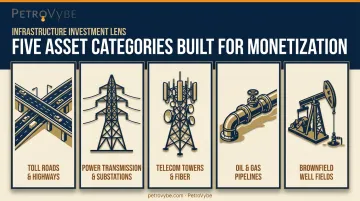
- Toll roads and highway concessions
- Power transmission lines and substations
- Telecom towers and fiber networks
- Oil and gas pipelines
- Brownfield oil & gas leasehold and producing assets
What happens next matters most. Proceeds fund new development, operators bring efficiency, and capital keeps moving instead of sitting locked inside an asset that's already built and already producing. Asset monetization functions as an ongoing funding mechanism that keeps capital working forward.
Key Advantages of Asset Monetization
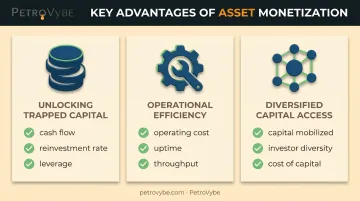
The advantages below map to numbers that both government finance teams and private capital allocators already track: cash flow, cost of capital, utilization rates, and reinvestment pace. Three stand out.
Advantage 1: Unlocking Trapped Capital From Existing Assets
Brownfield assets (roads, pipelines, aging well fields) hold value that stays invisible until someone structures a deal around it. A highway that's fully built and tolling drivers every day still represents locked-up capital if the agency that built it can't touch that future revenue today.
How it works: Leasing arrangements, concession agreements, or structured partnerships convert years of future cash flow into upfront or recurring proceeds now, while the original owner keeps long-term ownership or participation rights.
The scale can be substantial. India's National Highways Authority raised INR 9,682 crore (roughly $1.16 billion) from a single Toll-Operate-Transfer bundle in FY2019, according to NHAI's asset monetization strategy report. That capital went directly into new highway development, not into general reserves.
Released capital gets redeployed into new builds or reinvested into existing assets, without adding new debt or diluting equity. That matters because it shortens capital cycles and cuts dependency on constrained public or corporate balance sheets.
KPIs impacted: cash flow, capital efficiency, reinvestment rate, balance sheet leverage.
This advantage matters most in capital-constrained environments, and especially in fast-growing demand sectors like power infrastructure racing to keep pace with AI-driven electricity growth.
Advantage 2: Tapping Private-Sector Operational Efficiency
Governments and legacy operators are often the ones who build assets, but they're not always the ones best equipped to run them for decades. Aging transmission networks and mature well fields need dedicated technical expertise, not just ownership.
Structured partnerships shift operations and maintenance to specialized private operators under contractual KPIs and concession terms. The private partner takes on uptime targets, cost controls, and output benchmarks, then gets paid based on hitting them.
Australia's Productivity Commission found regulated asset bases at state-owned electricity distributors running 2.5 to 5 standard errors above private-network cost forecasts, with total factor productivity at one state utility falling 17-24% over an eight-year stretch. The Commission flagged that topography, asset age, and reliability rules can all skew comparisons. That caveat doesn't erase the finding: a real efficiency gap can and does exist.
Efficiency gains, when they materialize, show up as lower operating costs, better uptime, and faster decision-making with less operational risk sitting on one entity's books.
KPIs impacted: operating cost, utilization and uptime, throughput, failure and error rates.
This advantage carries the most weight for aging, technically complex, or specialized assets (think mature well fields or transmission networks) where dedicated expertise changes outcomes.
Advantage 3: Creating Access to Diversified, Long-Term Capital
Public monetization structures (InvITs, REITs, direct structured partnerships) open the door to institutional and accredited private capital that sits well beyond traditional public budgets or bank debt. Pooled or direct-partnership vehicles let investors take a real position in cash-flowing infrastructure or energy assets, not just a bond or a stock ticker.
This diversifies who funds growth and reduces dependence on strained public budgets or a single lender's balance sheet. Private energy developers apply the identical logic to brownfield natural gas assets.
PetroVybe gives accredited investors direct, entry-point access to natural gas development in South Texas and the Gulf Coast Basin through PetroVybe ONE, a project already producing and scaling rather than a future promise. Partners get in at the point where value is created, backed by a $48 million proved reserves valuation (PV-09) from a licensed third-party engineering firm.
The structure pairs asset-level value creation with upfront tax efficiency. Through the Intangible Drilling Cost deduction, a provision that, unlike most real estate deductions, applies against active income, 2024 partners received a 94% tax deduction against W-2 earnings and capital gains, a figure that held at 91% for 2025 partners.
This mirrors public asset monetization's core principle exactly: structured partnership over outright sale, with long-term upside retained by the capital provider rather than handed away in a transaction.
KPIs impacted: capital mobilized, investor base diversity, cost of capital.
This advantage proves most valuable where capital needs are accelerating faster than public funding can scale, power generation tied to rising electricity demand being the clearest example.
What Happens When Asset Monetization Is Missing or Ignored
Skip monetization, and the costs don't stay theoretical. They show up in balance sheets and operations reports within a few budget cycles.
- Idle or underutilized assets sit as dead capital instead of generating revenue for reinvestment
- Infrastructure and energy development gaps widen as agencies and operators over-rely on constrained public or corporate funding
- Deferred maintenance accelerates asset degradation, turning cheap fixes into expensive rebuilds
- Private-sector expertise and capital go untapped, even when it's sitting right there, ready to deploy
- Growth shifts to better-capitalized competitors, regions, or operators who moved first
None of these are hypothetical. Each one compounds the longer a cash-flowing asset sits idle instead of working for its owner.
How to Get the Most Value From Asset Monetization
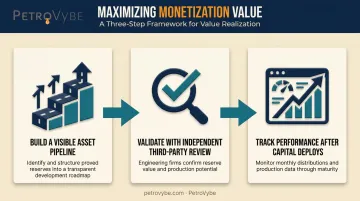
A single monetization deal is a transaction. A program is a strategy. Value compounds only when monetization runs through a visible, repeatable pipeline instead of one-off deals negotiated in isolation.
Build a Visible Asset Pipeline
India's National Monetisation Pipeline illustrates the model at scale. It defines:
- Multi-year monetization targets across sectors
- Eligible asset classes established upfront
- Phased timelines for asset release
- Central government monitoring throughout execution
A published pipeline gives investors the clarity to plan due diligence and capital allocation well ahead of any single deal closing. That visibility sets up the next requirement: proof investors can verify independently.
Validate With Independent, Third-Party Review
Information asymmetry kills deals and erodes investor confidence. Independent engineering and geological review closes that gap. PetroVybe backs its projects with third-party reserve valuations and a veteran geophysical team, led by a Chief Geophysicist with a 75.2% career hit rate on well location selection against an industry average below 40%. That's the kind of validation that reduces guesswork on both sides of a transaction.
Track Performance After Capital Deploys
Monetization isn't finished when the check clears. Ongoing KPI tracking (cash flow, utilization, output per asset) determines whether gains compound or fade. PetroVybe's asset intelligence function monitors production and operational metrics continuously after capital deploys, treating performance monitoring as a permanent discipline rather than a closing formality.
Conclusion
Asset monetization differs from privatization, and it isn't a one-time sale. Success depends on unlocking capital, writing clear contractual terms, and holding operators to consistent performance standards, whether that's a toll road, a transmission line, or a producing gas field.
The advantages only compound when monetization runs as a program: a visible pipeline paired with independent validation, plus ongoing performance tracking, not a single transaction treated as the finish line. That discipline applies equally to a national highway authority and a private natural gas developer.
Power demand keeps climbing. Public budgets keep straining. Disciplined asset monetization, public or private, is one of the most direct paths to closing that gap before it widens further.
Frequently Asked Questions
What is asset monetization?
Asset monetization unlocks value from an existing asset through a partnership, lease, or concession, without transferring ownership. The original owner retains long-term rights while a private partner operates the asset and generates proceeds.
What is the difference between asset monetization and privatization?
Monetization transfers operational rights for a defined period, and the asset reverts to the original owner when the contract ends. Privatization permanently transfers ownership and management control to a private buyer.
What are examples of asset monetization?
Common examples include Toll-Operate-Transfer road concessions, power transmission InvITs, and brownfield oil & gas leasehold development like PetroVybe's natural gas projects in South Texas.
Is asset monetization the same as disinvestment?
No. Disinvestment involves selling government equity or ownership stakes, while monetization is a temporary, revenue-generating partnership that keeps ownership with the original owner.
What are the risks of asset monetization?
Key risks include valuation uncertainty, rigid long-term terms, and weak governance that lets performance slip after the deal closes. Third-party validation and transparent reporting reduce most of these risks.
How can private investors participate in asset monetization opportunities?
Public infrastructure investors typically use vehicles like InvITs or REITs. Accredited investors can also access direct structured partnerships in private energy development, such as PetroVybe's programs in South Texas and the Gulf Coast Basin.