
The 5 Stages of Wealth framework fixes that. It maps how your money moves from being earned through labor to working independently on your behalf. This guide applies to anyone building wealth, but it's especially useful for high-income earners and people with growing investable assets who want to know exactly what move to make next.
Below, we break down each stage, the math behind the key transition points, the mistakes that keep people stuck, and how strategic investment choices can shorten the path to the finish line.
Key Takeaways
- The 5 stages progress from Cash Flow Positive to Financial Independence, shifting from earned income to investment returns
- Most Americans remain stuck in the earliest stage due to ongoing cash-flow strain
- Compounding accelerates sharply once specific savings and net-worth thresholds are crossed, not gradually over time
- Tax-efficient, income-generating assets can meaningfully shorten the path from Stage 3 to Stage 5 for high earners
What Are the 5 Stages of Wealth?
The 5 Stages of Wealth is a framework describing your financial journey based on the relationship between income, consistent saving, and investment returns over time. It works as a diagnostic tool you can apply immediately.
The goal is simple: help you self-diagnose your current financial position and identify the single next action that matters most, instead of chasing generic advice that doesn't match where you actually are.
Note: This "stages" model differs from the related "5 Levels of Wealth" concept popularized in personal finance media, including Tony Robbins' MONEY: Master the Game. That model measures net worth and lifestyle milestones; this one tracks the mechanics behind them.
| Framework | Focus | What It Measures |
|---|---|---|
| Stages | Mechanics | How income, saving, and investing interact over time |
| Levels | Outcomes | Net worth milestones like financial security and freedom |
The 5 Stages of Wealth Explained
Each stage represents a shift in whether your wealth grows primarily from active income or from invested capital compounding on its own. Movement between stages depends on three levers working together:
- Savings rate: how much of your income you actually keep and invest
- Income growth: raises, promotions, side income, or business growth
- Investment return: the rate your invested capital compounds at, and how tax-efficiently it's held
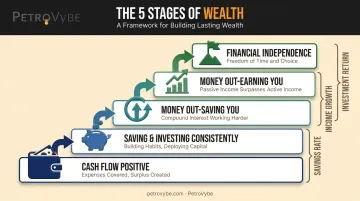
Stage 1: Cash Flow Positive
This stage begins the moment your income consistently exceeds your expenses. It sounds basic, but it's the foundation everything else is built on.
It's also where a lot of people get stuck. The Federal Reserve's 2024 Survey of Household Economics found that 17% of U.S. adults didn't pay all their bills in full in the month before the survey, and 13% couldn't cover a hypothetical $400 emergency expense by any means.
Two levers move you forward here:
- Cut expenses: lower fixed costs, renegotiate recurring bills, eliminate lifestyle spending that doesn't add value
- Increase income: negotiate a raise, add a side income stream, or switch to a higher-paying role
The danger at this stage: lifestyle inflation. Every raise that gets absorbed by a bigger apartment or a nicer car resets your progress back to zero.
Stage 2: Saving and Investing Consistently
Once you're cash flow positive, Stage 2 is about building the habit of saving and investing on autopilot, typically through tax-advantaged accounts like 401(k)s and IRAs.
For someone earning $85,000 and saving 15% of their income, that's roughly $12,750 flowing into retirement accounts every year, rain or shine.
This stage isn't glamorous. There's no dramatic moment where your net worth jumps. It's just automatic contributions, month after month, while the habit hardens into routine.
But it's critical. Discipline built here is what lets compounding do the heavy lifting later. Skip this stage or treat it casually, and every later stage takes longer to reach.
Stage 3: Your Money Starts Out-Saving You
This is the first real inflection point: the moment your annual investment returns exceed the amount you personally contribute each year.
Here's a simple illustration. Say you contribute $20,000 a year to your portfolio, and your investments average a 7% annual return. Your money starts out-saving you once your portfolio reaches roughly $286,000; at that point, a 7% return generates more than $20,000 on its own.
The market has historically supported returns in this range. Fidelity reports that the S&P 500 has averaged about a 10% annual return since 1957, though returns vary significantly year to year and past performance doesn't guarantee future results.
Crossing this threshold doesn't feel dramatic in the moment. But it's the first sign that compounding, not your paycheck, is starting to carry real weight.
Stage 4: Your Money Out-Earns You
Stage 4 is a bigger jump: your investment returns now exceed your entire annual income. Your capital has effectively become a second income stream, one that doesn't require you to show up to work.
At this level, traditional stock and bond allocations start showing their limits. Two problems emerge:
- Tax drag: capital gains and dividend taxes eat into returns that are already taxed once when earned
- Volatility: a portfolio large enough to out-earn your income is also large enough that a 20% market drop hurts
This is typically where diversification into more tax-efficient, cash-flow-generating assets becomes relevant, not as a replacement for stocks and bonds, but as a complement that reduces both tax exposure and correlation to public markets.
Stage 5: Financial Independence
Stage 5 is the destination: your portfolio can sustain your lifestyle indefinitely without active income.
The standard math here comes from the 4% rule, originating in financial planner William Bengen's 1994 research on historical withdrawal rates. Multiply your annual expenses by 25, and you get the portfolio size needed to support that spending level, assuming a 4% first-year withdrawal rate adjusted for inflation.
So if you spend $80,000 a year, you'd need roughly $2 million invested to be financially independent under this model.
How many people feel they've actually arrived? An Empower survey covered by CNBC found that 76% of Americans said they felt financially independent, though this reflects self-reported sentiment, not a verified count of portfolios large enough to cover expenses.
Key Factors That Influence How Fast You Move Through the Stages
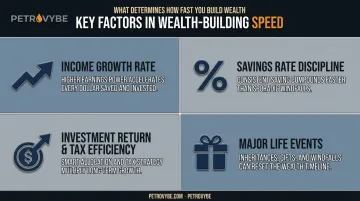
Progress through the stages isn't linear, and it isn't the same for everyone. Four factors do most of the work:
- Income growth rate: raises, promotions, side income, or a career pivot into a higher-paying field can compress years off your timeline
- Savings rate discipline: resisting lifestyle inflation as income rises keeps more capital compounding instead of funding a bigger lifestyle
- Investment return and tax efficiency: the assets you choose, and how they're taxed, directly affect how fast Stage 3 turns into Stage 4
- Major life events: an inheritance, a business sale, or an unexpected windfall can shift someone between stages abruptly, sometimes skipping the gradual climb entirely
Common Mistakes That Keep People Stuck
Most people who feel stuck have simply misdiagnosed their situation. Watch for these four traps:
- Assuming stages are tied to age. A 28-year-old with high savings discipline can outpace a 45-year-old who never left Stage 2. Age is irrelevant; behavior and savings rate aren't.
- Underestimating taxes on active income. Ordinary income tax rates slow the Stage 2-to-Stage 3 transition more than most people realize, since every dollar taxed before investing is a dollar that isn't compounding.
- Confusing paper net worth with real cash flow. A house that's appreciated in value doesn't pay your bills. Real progress means assets that can actually sustain a lifestyle, not just look good on a net-worth spreadsheet.
- Failing to diversify beyond stocks and bonds. Once contributions alone stop being your main growth driver, sticking exclusively to traditional market assets can leave real tax efficiency on the table. Direct investments in tangible assets, such as oil and gas development projects, can offer both diversification and tax advantages traditional portfolios often lack.
How to Accelerate Your Progress Through the Later Stages
Traditional 401(k) and brokerage strategies work well in Stages 1 and 2. Contribute consistently, get the tax deferral, let the market do its thing. But for high-income earners pushing toward Stage 3 and beyond, those same vehicles start losing efficiency. Capital gains taxes and required minimum distributions chip away at returns right when your portfolio is finally big enough to matter.
This is where tax-advantaged alternative assets enter the picture. One example: direct participation in natural gas and oil development, which carries a tax provision most stock and real estate investors never encounter.
Intangible Drilling Cost (IDC) deductions allow investors to deduct a large share of a project's development costs in the year they're incurred. Unlike real estate passive-loss rules, these deductions can offset active W-2 income and capital gains directly, not just passive income.
At PetroVybe, this plays out concretely. Partners who invested in 2024 received a 94% tax deduction against active income, and 2025 partners received 91%, based on the company's own reported project performance.
A $100,000 investment, for context, can generate a deduction in the $60,000-$80,000 range depending on project structure, with roughly 70% typically usable in year one.
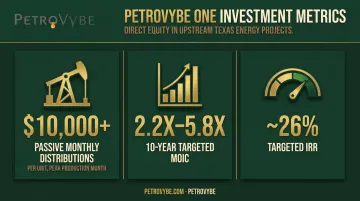
Beyond the deduction, projects like PetroVybe ONE are structured to deliver:
- Passive monthly distributions projected to peak above $10,000/month per unit during production
- A 10-year targeted MOIC of roughly 2.2x-5.8x and an IRR near 26%, based on company projections
- Exposure to a tangible, cash-flow-producing asset that isn't correlated to public market swings
This isn't a Stage 1 or 2 strategy. PetroVybe requires a minimum $100,000 investment and mandates accredited investor status: net worth over $1 million excluding your primary residence, or income above $200,000 individually ($300,000 jointly) for the past two years.
It's also structured for investors with a long time horizon and low near-term cash-flow needs, given the multi-year hold period before distributions ramp up.
In other words: this fits people already solid in Stages 3 and 4, looking to accelerate toward Stage 5, not replace the habits that got them there.
Conclusion
The 5 Stages of Wealth trace a single journey: from earning income through labor to letting capital compound on its own. Knowing your current stage matters more than following one-size-fits-all advice. It tells you exactly which lever deserves your attention right now:
- Savings rate
- Income growth
- Investment returns
Getting to Stage 5 takes the foundational discipline built in Stages 1 through 3, combined with smarter, more tax-efficient investment choices as your income and assets grow. Vehicles like PetroVybe's natural gas development partnerships, built for accredited investors, reflect this shift, pairing meaningful tax deductions with long-term passive income.
Frequently Asked Questions
What are the 5 stages of wealth?
The five stages are Cash Flow Positive, Saving and Investing Consistently, Your Money Out-Saving You, Your Money Out-Earning You, and Financial Independence. Each marks a shift in whether income or invested capital drives your wealth growth.
What net worth is considered financially independent?
Using the 4% rule, multiply your annual expenses by 25 to find your target portfolio size. Someone spending $100,000 a year would need roughly $2.5 million invested to sustain that lifestyle without active income.
How long does it take to move through all 5 stages of wealth?
There's no fixed timeline. It depends heavily on your income growth, savings rate, and investment returns, plus any major windfalls like an inheritance or business sale.
What's the difference between the "5 stages of wealth" and the "5 levels of wealth"?
Stages track the cash-flow and compounding mechanics behind your finances. Levels, popularized in books like Tony Robbins' MONEY, track net worth and lifestyle milestones instead.
Can you skip stages while building wealth?
A major windfall, like an inheritance or business sale, can make it look like you skipped stages. But sustainable long-term progress still depends on the same underlying savings and investment habits.
What types of investments can help accelerate financial independence?
Tax-advantaged, income-generating alternative assets, such as direct participation in oil and gas development projects, can complement traditional retirement accounts. For accredited investors, these structures can offset active income with sizable tax deductions while adding a new income stream.