

Introduction
Picture a business owner in her late 40s. She's got a stock portfolio, two rental properties, and equity in the company she built. On paper, she's worth several million dollars.
But every April, she writes a painful check to the IRS. Her real estate is illiquid. Her portfolio looks a lot like everyone else's 401(k), just bigger.
This is common. Many high earners accumulate assets faster than they build a strategy to protect them.
Net worth management is the fix: an ongoing, coordinated process of growing, protecting, and optimizing total wealth, not a one-time financial plan or a budgeting spreadsheet.
This guide covers what matters most:
- The wealth tiers that shape your strategy
- The five core pillars every serious plan needs
- How the ultra-wealthy diversify beyond traditional markets
- Why alternative assets like natural gas development are earning a place in modern portfolios
Key Takeaways
- Net worth management coordinates investments, taxes, estate planning, risk, and philanthropy into one strategy.
- Planning complexity increases sharply once liquid assets cross $1M, $5M, and $30M thresholds.
- High-net-worth portfolios allocate roughly 9.1% to alternative investments, according to Cerulli.
- Direct energy development pairs tax deductions with passive income, increasingly relevant amid AI-driven electricity demand.
- Third-party verification—engineering reports and regulatory licenses—separates credible operators from marketing claims.
What Is Net Worth Management?
Net worth management is an umbrella term. It covers investment management, tax planning, estate and legacy planning, risk management, and philanthropic strategy, working together rather than in isolated silos.
A financial advisor who only picks stocks isn't managing your net worth. Someone coordinating your portfolio, your tax exposure, your estate documents, and your liability protection at the same time is.
Net Worth vs. Investable Assets
These terms get used interchangeably, but they measure different things.
Net worth includes everything you own: your home, business equity, retirement accounts, and personal property, minus liabilities. Investable (or liquid) assets, by contrast, exclude your primary residence and typically exclude collectibles and consumer durables.
Why does this distinction matter? Advanced strategies, such as concentrated stock diversification or alternative asset allocation, depend on liquid capital you can actually deploy. A $4 million net worth with $3 million tied up in your home and business looks very different from $4 million in a brokerage account.
The Three Wealth Tiers and What They Mean for Strategy
Wealth research firms generally group investors into three bands based on investable assets:
| Tier | Investable Assets | Typical Planning Focus |
|---|---|---|
| High-Net-Worth (HNW) | $1M+ | Tax-efficient investing, retirement optimization |
| Very-High-Net-Worth (VHNW) | $5M+ | Concentrated stock management, early alternative allocation |
| Ultra-High-Net-Worth (UHNW) | $30M+ | Private markets, multigenerational estate structures |
As clients cross each threshold, strategy shifts from basic retirement and tax planning toward concentrated position management, direct alternative investments, and multigenerational estate structures.
This isn't a niche concern. The global HNWI population grew 5.1% to 22.8 million people in 2023, with aggregate wealth climbing to $86.8 trillion. More households are crossing into these brackets every year, and most arrive without a strategy built for the complexity that comes with it.
The Core Pillars of Net Worth Management
Think of these five disciplines as the operating system for significant wealth. Run one without the others, and the whole system underperforms.
- Investment management: Structuring a portfolio across asset classes to balance growth, income, and risk against long-term goals. This is about allocation strategy, not stock-picking.
- Tax planning and optimization: Tax-loss harvesting, strategic asset location, and deduction planning that reduce the drag of federal and state taxes on both active and passive income.
- Estate and legacy planning: Trusts, gifting strategies, and succession plans that transfer wealth efficiently while minimizing estate tax exposure.
- Risk management and asset protection: Insurance, legal entity structures, and diversification designed to shield wealth from market swings, lawsuits, and concentrated position risk.
- Philanthropic planning: Donor-advised funds and private foundations that align charitable values with tax efficiency.

Neglecting any pillar carries a real cost:
| Pillar Neglected | Consequence |
|---|---|
| Tax planning | Investment gains erode faster than they should |
| Estate planning | Up to a third of portfolio value lost to unnecessary estate taxes |
These five pieces have to move together.
How High-Net-Worth Investors Diversify Beyond Stocks, Bonds, and Real Estate
Once liquid assets grow, wealthy investors typically stop relying solely on public markets. They start looking at private markets and direct asset ownership instead.
This isn't a fringe trend. Cerulli's research on HNW investors found that average alternatives allocation among households with $5M+ in investable assets rose to 9.1% in 2022, up from 7.7% just two years earlier. That includes:
- Private equity and private credit
- Direct investments and co-investments
- Private real estate
- Hedge funds
Despite this growing appetite, individual investors remain far behind institutions in accessing these assets. They currently hold about half of global investable assets but control only around 16% of alternative-fund AUM, a gap that signals opportunity, not a target allocation to chase blindly.
What's driving the shift? Wealthy families increasingly want direct stakes in operating businesses, real assets, and resource development projects, the same category of investments historically reserved for institutions and insiders. Natural gas and oil development sits squarely in this category.
Why Natural Gas Development Belongs in a Modern Net Worth Strategy
Hard-asset alternatives offer something public stocks can't: tax efficiency paired with inflation-resistant, passive cash flow. Natural gas and oil development is one of the clearest examples, especially with electricity demand from AI data centers accelerating.
The Department of Energy projects data centers could consume 6.7% to 12.0% of total U.S. electricity by 2028, up from roughly 4.4% in 2023. Natural gas already supplies more than 40% of U.S. data-center electricity and is projected to add the largest share of new generation capacity through 2030. This growth is driven by measurable infrastructure spending, not speculation.
The Tax Advantage: Intangible Drilling Cost (IDC) Deductions
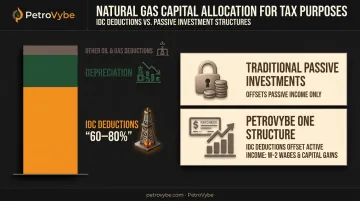
Intangible Drilling Costs, covered under IRC Section 263(c), let investors elect to expense qualifying drilling and development costs rather than capitalize them over time. This matters because, unlike most passive tax shelters, qualifying working-interest structures allow these deductions to offset active income, including W-2 earnings and capital gains, not just passive income.
This marks a meaningful structural difference from real estate, where passive-loss rules typically restrict deductions to passive income alone.
PetroVybe's own investor track record illustrates the scale involved. Partners in the company's natural gas development projects have achieved tax deductions of up to 94% and 91% against ordinary income in recent years.
These results stem primarily from IDC deductions, which typically represent 60-80% of invested capital, layered with depreciation and other oil and gas-specific deductions.
Eligibility depends on ownership structure, basis, and at-risk limitations, so individual tax circumstances always matter. A CPA or tax attorney should review any specific situation before assuming a deduction applies.
Passive Income, MOIC, and Long-Term Growth
Beyond the upfront deduction, natural gas development is underwritten to generate ongoing passive cash flow plus a potential cash exit at the end of a defined hold period.
PetroVybe's ONE project, for instance, targets a 10-year MOIC range of roughly 2.2x to 5.8x and a 10-year IRR of approximately 26%, with monthly passive distributions projected to peak above $10,000 during full production.
Numbers like these only mean something if they're independently verifiable. Look for:
- Third-party engineering reports: PetroVybe's proved reserves have been valued at $48 million (PV-09) by a licensed independent engineering firm.
- Verified investor reviews: PetroVybe holds a 5.0 overall rating across 8 verified reviews on Invest Clearly, an independent review platform for investment sponsors, with 100% five-star ratings.
- Regulatory licensing: PetroVybe OpCo LLC holds an operator license with the Texas Railroad Commission, publicly searchable alongside individual well API numbers.
PetroVybe backs its projections with independent engineering validation and a public regulatory license, a level of verification most operators can't match.
How to Choose the Right Net Worth Management Partner
Not every advisor or operator deserves your capital, so evaluate these three factors carefully before committing.
- Track record in the specific asset class. A generalist advisor with no direct experience in oil and gas, private equity, or concentrated stock strategies isn't the right fit for that specific allocation. Look for demonstrated success in the exact strategy you're considering.
- Fee and reporting transparency. You should know exactly how returns and risks are shared, and how often you'll receive updates. Quarterly operational updates, K-1 tax documents, and direct access to leadership are reasonable expectations for a serious partner.
- Independent verification. Don't rely on marketing materials alone. Request audited financials, engineering reports, or regulatory filings. Public databases, like the Texas Railroad Commission's operator registry, let you confirm claims yourself rather than taking a sponsor's word for it.
A good partner welcomes this scrutiny. If an operator resists sharing verifiable documentation, that's a red flag worth taking seriously.
Common Net Worth Management Mistakes to Avoid
Even sophisticated investors fall into predictable traps.
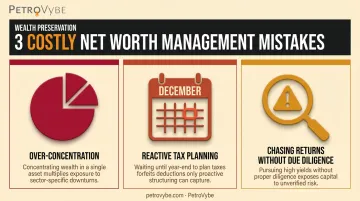
- Over-concentration. Relying too heavily on one asset class, such as employer stock, a rental property, or business equity, leaves you exposed when that market turns.
- Reactive tax planning. Waiting until December to think about taxes means missing opportunities, like IDC deductions, that require a proactive, year-round strategy.
- Chasing returns without due diligence. Jumping into an unfamiliar asset class for attractive projected returns, without vetting the operator's track record or requesting independent verification, is how investors get burned.
None of these mistakes are complicated to avoid, but they require treating wealth management as an ongoing discipline, not an occasional errand. Building a quarterly review into your calendar catches concentration risk and tax opportunities before they become expensive.
Frequently Asked Questions
Who do billionaires use to manage their money?
Billionaires and ultra-wealthy families typically rely on single or multi-family offices, private bankers, and specialized advisors. These teams coordinate investment management, tax, and estate planning while securing direct access to private markets and alternative assets.
What is considered high net worth versus ultra-high net worth?
Roughly $1M+ in liquid assets qualifies as high-net-worth, $5M+ is very-high-net-worth, and $30M+ is ultra-high-net-worth. These figures typically exclude the value of a primary residence.
What is the difference between net worth management and wealth management?
Net worth management is the broader strategic umbrella covering asset growth, protection, and tax efficiency. Wealth management often refers more narrowly to the advisory relationship and investment services provided.
How much money do I need to work with a family office?
Single-family offices are typically most cost-effective above $200M-$250M in investable assets. Multi-family offices offer similar services at lower thresholds by pooling costs across several families.
Can alternative investments like oil and gas help reduce my tax burden?
Yes, in qualifying structures. Certain oil and gas development investments, such as those PetroVybe structures, allow Intangible Drilling Cost deductions against active income, which can meaningfully reduce a high earner's tax liability in the investment year, subject to individual circumstances.
Is passive income from natural gas investments taxed differently than other income?
Often, yes. Natural gas development income can involve depletion allowances and IDC deductions that differ from ordinary passive income treatment. Always consult a tax professional about your specific situation.