
In alternative investing, "reserve" often means something entirely different: a quantified, engineer-certified asset base, like oil and gas still in the ground, that IS the investment rather than a cushion protecting it. Most investors researching this term only know the first meaning, which creates a real problem.
Search "investment reserves" and you'll mostly find generic savings-account advice, even when you're actually evaluating a resource-backed deal where reserves work in a fundamentally different way. This guide covers both meanings: the accounting definition, the resource-based definition, and how natural gas development reserves — including PetroVybe's own certified reserve base — are professionally valued and reported to investors.
Key Takeaways
- "Reserve" carries two meanings: liquid cash cushions and certified asset bases.
- Accounting reserves guard against losses, while resource reserves show an investment's true worth.
- Keep 3-6 months of expenses in a liquid reserve fund for safety.
- Independent engineers verify proved oil and gas reserves through third-party reports.
- Physical reserve assets can compound in value, unlike idle cash sitting unused.
What Is an Investment Reserve? Meaning & Purpose
An investment reserve is capital, cash, or a verified asset base deliberately set aside (not for daily spending) to provide financial security, absorb potential losses, or represent the underlying value backing an investment. That last part matters. For resource-based reserves, that underlying value often defines the entire investment itself, rather than serving as a fallback.
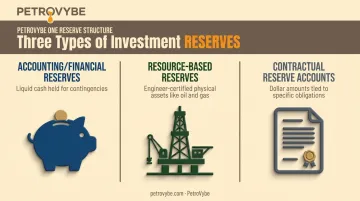
The term spans two very different contexts:
- Accounting/financial reserves — liquid cash held on a balance sheet for contingencies, debt service, or future obligations
- Resource-based reserves — engineer-certified quantities of a physical asset, such as oil, gas, or minerals, that determine what an investment is actually worth. PetroVybe's proved reserves, for example, carry a $48MM PV-09 valuation certified by an independent third-party engineering firm
- Contractual reserve accounts — formally defined dollar amounts tied to specific obligations, such as a debt service reserve account required by a lender in insurance or structured finance deals
Why Reserves Exist in the First Place
Across both contexts, the purpose is the same: stability, risk mitigation, and protecting or building long-term value for the people relying on that asset.
Regulators treat this seriously. The Federal Reserve's Basel III framework, finalized in July 2013, requires banks to hold a minimum 4.5% Common Equity Tier 1 capital ratio plus a 2.5% conservation buffer, specifically because capital acts as a cushion against unanticipated losses and declines in asset values. This capital cushion is mandatory and systemic, embedded directly into how banks operate.
A reserve differs from a generic "fund" in one key way: it's earmarked for a defined purpose and tracked or verified. A cash reserve gets recorded under reserves and surplus on a balance sheet. A resource-based reserve gets certified by an independent, licensed engineering firm. Either way, someone outside the organization can check the number.
Types & Examples of Investment Reserves
Reserves show up at every level of finance, from a household savings account to a sovereign wealth fund. Here's how the concept plays out across contexts.
Cash & Accounting Reserves
Corporations hold contingency, capital, and revenue reserves to cover unexpected costs, fund future expansion, or smooth out earnings volatility. The same principle scales down to your household budget as an emergency fund.
The common benchmark, according to FINRA, is three to six months of living expenses held somewhere liquid enough to access without penalty. Some experts push that further: the FDIC has suggested at least six months for added security.
Investment Fluctuation Reserves
Banks and insurers build fluctuation reserves specifically to absorb mark-to-market losses on their bond and securities portfolios. Regulators encourage this because a sudden rate move can otherwise gut a bank's balance sheet overnight.
India's central bank, for example, has historically directed banks to build an Investment Fluctuation Reserve from realized gains. The target is a set percentage of certain portfolio categories, guarding against a reversal in interest rates.
Government & Sovereign Reserves
At the macro level, governments hold contingency reserves and sovereign wealth funds to insulate national budgets from economic shocks. Stabilization funds exist specifically to smooth out government spending when commodity prices swing wildly.
Consider an oil-exporting nation banking surplus revenue during a price boom. That cushion means it doesn't have to slash spending when prices bust.
Natural Resource / Proved Reserves
This is where the definition shifts entirely. In oil and gas investing, a "reserve" is a quantified, engineer-verified underground asset that forms the actual investment value, not a cushion against losses.
The industry uses three confidence tiers:
- Proved reserves: reasonably certain to be economically recoverable under existing conditions
- Probable reserves: less certain than proved, but likely recoverable
- Possible reserves: the least certain tier, still geologically plausible
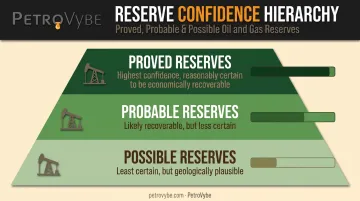
Each tier carries a different statistical confidence level, and only proved reserves get the strictest scrutiny in financial reporting.
PetroVybe's Lavaca County, Texas development illustrates that scrutiny in practice. A licensed third-party engineering firm assigned the project's proved reserves a $48 million PV-09 valuation, the kind of independent verification investors should expect before a "proved" label ever appears in a financial report.
Investment Reserve vs. Savings vs. General Reserve
Is a reserve just savings by another name? Not quite.
Savings is unrestricted money available for any future use, covering anything from a new car to a vacation.Wait
How Oil & Gas Reserves Function as a Real Investment Reserve
Here's where the two definitions of "reserve" collide most directly. In natural gas development, the reserve functions as the investment itself: the proved, third-party-certified volume of hydrocarbons in the ground that determines what the asset is actually worth.
Independent Certification, Not Self-Reporting
PetroVybe's own reserve position illustrates this well. The company's development project in Lavaca County, Texas, carries a $48 million proved reserves valuation, determined by a licensed third-party engineering firm rather than an internal estimate.
That's the difference between a resource reserve and a self-declared cash reserve: nobody has to take PetroVybe's word for the asset's value.
Why This Reserve Compounds Instead of Sitting Static
A traditional cash reserve holds its nominal value and steadily loses purchasing power to inflation. A proved reserve works differently: through active reinvestment (workovers, production optimization, and new drilling), the asset base can grow rather than sit flat.
PetroVybe's own production history reflects this pattern:
- Growth from zero to roughly 1,300 barrels of oil equivalent per day across company operations
- Approximately 400 producing wells across 58,000 acres
- 264 additional development locations identified across the company's Haynesville/Middle Bossier and Wilcox engineering reports
That pipeline of future locations is the reinvestment engine. Cash flow from producing wells gets redirected into new drilling and workovers, which is meant to expand the reserve base rather than let it sit static.
The Tax Dimension Unique to This Reserve Type
There's a mechanism here that a cash reserve simply doesn't offer. Intangible Drilling Cost (IDC) deductions, allowed under IRC Section 263(c), let operators expense qualifying drilling costs (labor, fuel, site preparation) rather than capitalizing them.
For a working interest holder, this loss is typically nonpassive, meaning it can offset active income, including W-2 earnings.
PetroVybe partners have realized first-year tax deductions in the 91-94% range against active income in recent years, a direct result of this IDC mechanism tied to developing the company's certified reserves.
Direct Access for Accredited Investors
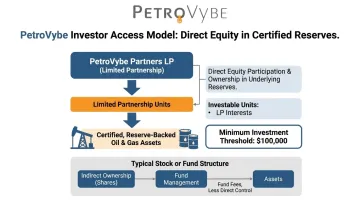
Beyond the tax treatment, access to this reserve works differently too. PetroVybe gives accredited investors direct equity participation in these reserve-backed assets through limited partnership units, starting at a $100,000 minimum investment.
Unlike a stock or fund, this is a direct position in the underlying reserve itself. Independent engineering validation provides a level of transparency a standard cash reserve fund never offers.
How Much Should You Keep in a Reserve Fund?
For individuals, the benchmark hasn't changed much: three to six months of expenses in a liquid account you can access without penalty. Businesses size their reserves differently, based on operational risk exposure and how volatile their revenue tends to be. A seasonal business needs a bigger buffer than one with predictable monthly income.
For alternative or resource-based investment reserves, though, "how much" isn't a fixed cash target. It's a portfolio allocation question.
Consider:
- Dedicating a defined portion of investable capital (not your emergency fund) to tangible, reserve-backed assets
- Using that allocation specifically to hedge inflation and diversify beyond traditional stocks and bonds
- Sizing the allocation based on your liquidity needs, since resource-backed investments like oil and gas partnerships often require 5- to 10-year hold periods
Review your reserve size and allocation periodically. Income changes, tax exposure shifts, and risk tolerance evolves — what made sense five years ago may not fit today.
Advantages & Limitations of Investment Reserves
Reserves, in either form, offer real benefits:
- Financial security during unexpected shortfalls or losses
- Improved creditworthiness or investor confidence, since a verified reserve signals discipline
- Disciplined risk management across both cash and resource-based holdings
But reserves aren't free of trade-offs. Common limitations include:
- Inflation erosion: idle cash loses purchasing power over time — U.S. prices rose roughly 2.7% in the twelve months through December 2025, per the Bureau of Labor Statistics
- Overexposure risk when one reserve type dominates the portfolio, pulling focus away from growth
- Resource-based uncertainty, including commodity price swings and geological unknowns that demand expert evaluation before you commit capital
The practical answer for most investors is pairing both: a traditional liquid reserve for emergencies, plus a smaller allocation to appreciating, reserve-backed assets for long-term growth.
Frequently Asked Questions
What is an investment reserve?
An investment reserve is capital or a verified asset base set aside either for financial security or to represent the underlying value of an investment. The term covers both cash cushions and resource-based holdings like certified oil and gas reserves.
How much should you have in a reserve fund?
Individuals typically target three to six months of living expenses in a liquid account. Businesses size their reserves based on revenue volatility and operational risk rather than a fixed rule.
Is a reserve the same as savings?
Not quite. Savings is unrestricted money for any future use, while a reserve is earmarked for a specific purpose and usually tracked or reported separately.
Can you withdraw from a reserve fund?
Yes, withdrawals are generally permitted, but they're meant to serve the reserve's defined purpose, such as covering emergencies, absorbing losses, or meeting capital calls, rather than routine spending.
What is the difference between a reserve fund and an investment fluctuation reserve?
A general reserve fund covers broad contingencies, while an investment fluctuation reserve specifically absorbs market value losses on a bond or securities portfolio. Banks and insurers use the latter to protect against interest rate swings.
How are oil and gas reserves valued for investment purposes?
Reserves are valued through independent, third-party engineering assessments that estimate recoverable hydrocarbon volumes and discount future cash flows to present value. PetroVybe's Lavaca County project, for instance, carries a $48MM PV-09 valuation certified by a licensed third-party engineering firm. This certification process is what separates a resource-backed reserve from a self-reported cash figure.