

Financial risk management is how you replace that anxiety with a plan. This article breaks down what it actually means, the core types of risk you'll encounter, why the process matters, and the step-by-step framework you can apply whether you're managing a household budget or a seven-figure portfolio.
This isn't just institutional territory. Individual investors building long-term wealth, including those looking at alternative assets outside the usual stock-bond-real estate mix, need the same discipline.
Key Takeaways
- Financial risk management prepares you for uncertainty; it doesn't promise to eliminate it
- Six risk categories, from market to longevity, each requires a tailored mitigation approach
- A four-step cycle—identify, assess, mitigate, monitor—works for personal and investment finances
- Diversifying into tangible, alternative assets helps manage inflation and market risk together
What Is Financial Risk Management?
Financial risk management is the process of identifying, measuring, and addressing the uncertainty tied to financial decisions and investments. The CFA Institute puts it simply: it's about setting your risk tolerance, then measuring, monitoring, and modifying risks to stay aligned with it.
That last part matters. Risk management isn't about dodging every possible downside. It's about balancing potential loss against potential reward.
Risk and Return Are Inseparable
You can't chase higher returns without accepting more uncertainty, and you can't hide in "safe" assets without giving up upside. A 2018 study published in the Journal of Financial Economics analyzed every U.S. common stock from 1926 to 2016 against one-month Treasury bills.
The finding: 57.4% of individual stocks underperformed T-bills over their lifetimes. Just 4% of stocks accounted for all the net wealth the U.S. stock market created.
That's the risk-reward tradeoff in action. The aggregate market rewarded patience and diversification, but a huge share of individual bets lost to a nearly risk-free asset.
Who practices this? Individual investors, financial advisors, corporate FP&A teams, and asset managers overseeing institutional portfolios all run some version of the same process, just at different scales.
What Happens When Risk Management Fails
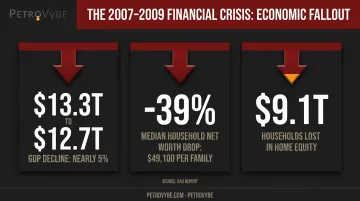
The 2007-2009 financial crisis is the textbook case. According to the Government Accountability Office, the fallout included:
- Real U.S. GDP fell nearly 5%, from $13.3 trillion to $12.7 trillion
- Median household net worth dropped almost 39% (about $49,100 per family)
- Households lost roughly $9.1 trillion in national home equity
Those numbers came from underpriced risk left unmanaged across an entire system. The same principle applies at a personal level: ignore risk, and it eventually collects its due.
Types of Financial Risk Every Investor Should Understand
Financial risk doesn't come in one flavor. Each type below calls for its own mitigation strategy, and most investors face several simultaneously.
| Risk Type | What It Is |
|---|---|
| Market | Value swings from stock prices, interest rates, or economic shifts |
| Inflation | Rising costs eroding purchasing power over time |
| Liquidity | Inability to access cash or sell an asset without a steep discount |
| Longevity | Outliving your retirement savings |
| Credit | A counterparty failing to meet a financial obligation |
| Operational/Personal | Internal system failures, job loss, illness, or disability |
Market and Inflation Risk
Market risk stems from the constant push and pull of stock prices, interest rate changes, and broader economic conditions. It's the risk most people picture when they think about investing. A rate hike, a recession scare, or a sudden earnings miss can all move your portfolio's value in a hurry.
Inflation risk moves less visibly but just as steadily. The Bureau of Labor Statistics reported CPI-U rose 2.9% over the 12 months ending December 2024, meaning cash sitting idle - or earning less than that rate - loses real value every year. FINRA calls this "purchasing-power risk" for good reason: even conservative, insured investments can fail to keep pace with rising living costs.
Liquidity and Longevity Risk
Liquidity risk is the danger of being unable to convert an asset into cash quickly without taking a significant hit on price. Real estate, private equity stakes, and certain bonds all carry this risk. The asset isn't worthless; you simply can't reach your money when you need it most.
Longevity risk carries a similar mismatch between perception and reality: outliving your retirement savings. A Society of Actuaries survey found 54% of retirees underestimated their own life expectancy compared to the population average, leaving many without enough saved for the years ahead.
Credit, Operational, and Personal Risk
Three more categories round out the picture:
- Credit risk: A borrower or counterparty fails to repay what's owed
- Operational risk: Internal process or system failures, whether at a bank, a business, or in your own financial recordkeeping
- Personal risk: Job loss, illness, or disability that disrupts income and derails a financial plan
Why Financial Risk Management Matters: Key Benefits
Good risk management doesn't just protect you from losses. It changes how you make decisions in the first place.
That shift shows up in a few concrete ways:
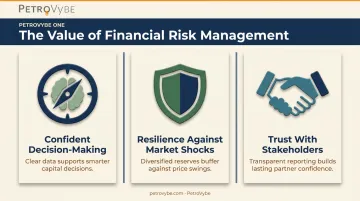
- Confident, clear-eyed decision-making: When you understand the actual risk-reward tradeoff of a choice, you stop reacting emotionally to headlines and make decisions based on your goals and tolerance, not fear or FOMO.
- Resilience against market shocks: A well-managed financial plan bends during downturns instead of breaking. Diversification across asset classes helps cushion the blow when any single market hits turbulence.
- Trust with stakeholders: Showing a business partner, spouse, or advisor that you've mapped out the downside, not just the upside, builds confidence and earns their commitment.
Diversifying Beyond the Traditional Mix
Stocks, bonds, and real estate have long been the default diversification toolkit, but they share overlapping risks, especially inflation exposure and market correlation. This is why some accredited investors are looking at tangible, tax-advantaged alternatives.
Direct participation in natural gas development, for example, offers exposure to a physical, producing asset rather than a paper instrument tied to market sentiment.
PetroVybe structures its projects this way. Accredited investors take a direct stake in upstream energy development, gaining the tax efficiencies and passive income potential that come with owning the asset itself rather than a fund that tracks it.
The Financial Risk Management Process: A Step-by-Step Framework
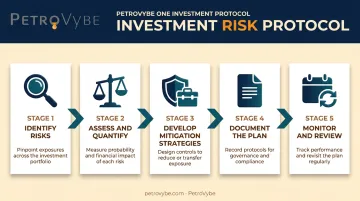
The CFP Board's seven-step planning process boils down to five practical stages anyone can follow.
Identify potential risks. Review your income sources, investments, health situation, market trends, and any regulatory changes that could affect your goals. Be specific: vague worry doesn't count as identification.
Assess and quantify each risk. Rate the likelihood and potential impact of each risk you've found. A simple likelihood-times-impact score helps you prioritize; a low-probability, high-impact risk (like disability) often deserves more attention than a high-probability, low-impact one.
Develop and implement mitigation strategies. Match the right tool to the right risk:
- Insurance for personal and liability risks
- Diversification for market and inflation risk, including alternative assets like tax-advantaged energy partnerships that move independently of stock and bond markets
- Liquidity reserves for short-term cash needs
- Hedging instruments for specific market exposures
Document the plan. Write down your goals, the risks you identified, how you rated them, and the strategies you chose. A plan that only lives in your head is hard to track or hand off to an advisor.
Monitor and review regularly. Revisit the plan at least annually, or immediately after a major life event (marriage, job change, inheritance) or market shift. Risk tolerance and exposure both change over time.
Core Risk Management Strategies and Techniques
Once you've identified and assessed your risks, you need a response. The CFA Institute's framework groups responses into four practical categories.
Avoidance
Sometimes the simplest move is sidestepping a risk entirely, choosing safer assets or skipping a high-risk activity altogether. This works well for risks with limited upside relative to their potential downside.
Retention and Reduction
Not every risk is worth avoiding. Retention means accepting smaller risks as a cost of doing business while taking steps to lower their odds or severity:
- Building an emergency fund
- Improving your health
- Maintaining cash reserves
Transfer and Sharing
Insurance, hedging instruments, and certain legal structures let you shift risk to another party in exchange for a premium or fee. This is how homeowners insurance, life insurance, and options contracts all function.
Diversification
Spreading investments across asset classes reduces your dependence on any single market's performance. This increasingly includes alternative, tangible assets alongside traditional holdings.
PetroVybe's projects illustrate this in practice. Proved reserves are validated by independent, third-party engineering assessments rather than relying solely on market pricing. This gives investors a data point that doesn't move in lockstep with equities or bonds.
Frequently Asked Questions
What is the role of risk management in financial planning?
Risk management protects your financial goals by identifying, assessing, and mitigating threats like market downturns, inflation, and unexpected life events before they can derail your plan.
What are the main types and methods of risk management in financial planning?
The main risk types are market, credit, liquidity, inflation, longevity, and personal/operational risk. The core methods for managing them are avoidance, retention, transfer, and diversification.
What are the 4 basic risk management strategies?
The four foundational strategies are avoid, reduce, transfer, and accept (or retain). You match every identified risk to one of these responses based on its likelihood and impact.
How do you create a financial risk management plan?
Define your goals, identify risks, assess their likelihood and impact, choose mitigation strategies, document everything clearly, and review the plan periodically, at least once a year.
Why is diversification important in risk management?
Diversification reduces your reliance on any one asset class's performance. It cushions losses and stabilizes returns because different assets tend to react differently to the same market conditions.
What is the difference between risk management and risk avoidance?
Risk management balances risk against potential reward across your entire plan. Risk avoidance eliminates exposure to a specific risk entirely, often at the cost of missed returns.