Many W-2 professionals and capital gains holders bring in substantial income, yet they lack a structured plan to convert it into lasting, tax-efficient assets. The top 1% of taxpayers pay an average federal income tax rate of 26.09%, according to a 2025 analysis by the Tax Foundation. Add inflation running between 2.6% and 8.0% annually since 2021, and the erosion is real.
This guide breaks down what wealth acquisition actually means, how to assess your readiness, how to build a strategy, and which vehicles (including alternatives beyond stocks and real estate) deserve a look.
Key Takeaways
- Wealth acquisition converts income into appreciating, tax-efficient assets, not idle cash.
- Readiness starts with three checks: accredited status, liquidity, and current tax exposure.
- Natural gas development offers active-income tax deductions unlike 401(k)s or real estate.
- Always verify an operator's track record and third-party validation before committing capital.
What Does "Acquisition of Wealth" Actually Mean?
Acquisition of wealth is the intentional process of accumulating money, property, or other valuable assets over time through income, investment decisions, and strategic planning. It's the opposite of passive accumulation through inheritance, luck, or simply letting a paycheck sit in checking.
This differs from wealth preservation, which focuses on protecting assets you've already built. Most financial guides blur the two together. They shouldn't.
| Dimension | Wealth Acquisition | Wealth Preservation |
|---|---|---|
| Phase | Active growth | Protective |
| Risk tolerance | Higher | Lower |
| Primary focus | Compounding | Capital protection & estate structuring |
Here's what's changed: wealth acquisition today increasingly includes private, non-traditional asset classes that once required institutional connections. Energy development, private equity, and direct working interests in oil and gas projects now sit within reach of accredited individual investors, not just pension funds and family offices.
That shift matters because the traditional stock-bond-real estate trio doesn't offer the tax mechanics or non-correlated growth that private development assets can provide.
Step 1: Assess Your Financial Readiness for a Wealth Acquisition
Jumping into an investment opportunity without a baseline financial picture is how people end up mismatched with risk they can't actually absorb. Readiness assessment comes first, always.
Confirm Your Investor Status and Liquidity
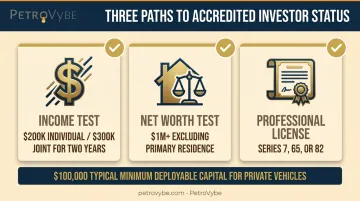
Many private wealth-building opportunities require accredited investor status. Under SEC Regulation D, you qualify if you meet any of these:
- Individual income over $200,000 (or $300,000 jointly) in each of the past two years, with reasonable expectation of the same this year
- Net worth exceeding $1 million, excluding your primary residence
- Series 7, 65, or 82 professional licenses in good standing
This status unlocks access to private markets that the general public can't touch. It's not a small club anymore, either.
SEC staff estimates that qualifying households grew from 1.51 million (1.8% of U.S. households) in 1983 to 24.3 million (18.5%) by 2022, according to the SEC's 2023 review of the accredited investor definition.
Beyond status, calculate your actual deployable liquidity: cash on hand, brokerage balances, and anything accessible from retirement accounts. Most high-value private vehicles, including PetroVybe's oil and gas development partnerships, require $100,000 or more in capital you can commit without disrupting your daily finances.
Understand Your Tax Exposure
Identify where your tax burden actually comes from: W-2 income, capital gains, or business income. This determines which tax-advantaged strategies will move the needle most.
IRS data puts the average federal rate for top earners at 26.09%, a figure that doesn't even include state and payroll taxes. For someone earning $500,000+, the real "tax drag" compounds year over year, steadily shrinking the capital available to reinvest.
Evaluate Your Risk Tolerance and Time Horizon
Wealth acquisition strategies span a spectrum:
- Low-risk, low-reward: bonds, high-yield savings accounts
- Moderate-risk: diversified equity portfolios, REITs
- Higher-risk, higher-reward: private development assets, direct energy investments, early-stage equity
Map your time horizon honestly. A 5-year window calls for different positioning than a 20-year one. Private development projects, for instance, often model returns across 5-year and 10-year windows rather than promising quick liquidity.
Step 2: Build a Strategic Wealth Acquisition Plan
Readiness without a plan is just potential energy. A strategic plan turns that potential into concrete targets.
Define Clear Wealth Goals and Metrics
Skip vague "get rich" intentions. Set specific numbers using two core metrics: MOIC (Multiple on Invested Capital), how many dollars you get back per dollar invested, and IRR (Internal Rate of Return), your annualized rate of return over the hold period.
For alternative asset investments, healthy 10-year targets often land in the 2x–6x MOIC range with IRRs around 20–30%, though every project's projections should be treated as forward-looking estimates, not guarantees.
Diversify Beyond Stocks, Bonds, and Real Estate
Once your MOIC and IRR targets are set, the next question is where that capital should live. Non-correlated assets behave differently than public markets during downturns, which is exactly the point.
According to CAIA's 2000–2019 market correlation analysis, commodities carry a 0.30 correlation with public equity and -0.10 with fixed income, meaningfully lower than private equity's 0.60 correlation with stocks over the same period.
That's the case for adding something like natural gas or NGL development to a portfolio dominated by stocks and rental properties. It doesn't move in lockstep with the S&P 500.
Structure for Maximum Tax Efficiency
This is where direct oil and gas development stands apart from a 401(k) or IRA. Intangible Drilling Cost (IDC) deductions allow investors to write off qualifying drilling expenses.
Under IRS rules, a working interest held directly (or through a structure that doesn't limit liability) is treated as nonpassive. That means the deduction can offset active income, not just passive gains.
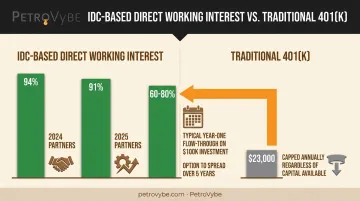
PetroVybe's own results illustrate the mechanics. Partners who joined in 2024 received a 94% tax deduction against active income; 2025 partners saw that figure settle at 91%. On a typical $100,000 investment, roughly 60–80% flows through as IDC deductions in year one, with the option to spread it across five years instead.
Compare that to a 401(k), capped at roughly $23,000 annually regardless of how much capital you actually have to deploy. IDC-based structures scale with your investment size instead.
Step 3: Evaluate and Select the Right Wealth Acquisition Vehicle
Not every opportunity claiming "tax advantages" or "passive income" deserves your capital. This step is about due diligence before you wire a single dollar.
Vet the Operating Team's Track Record
Research the operational history behind any deal. Ask specifically:
- How long has this team operated in the industry?
- What's their documented production or asset-scaling history?
- Can they show EBITDAX growth or comparable performance metrics?
PetroVybe's leadership offers a useful benchmark for what "vetting" should uncover. Chief Geophysicist Michael Stamatedes has a 48-year career with a documented 75.2% success rate on profitable well locations, far exceeding the industry average of under 40%.
President and COO Blaine Yeary previously scaled a $5 billion asset from zero to 35,000 BOEPD over eight years. That's the kind of specific, checkable history a serious operator should be able to produce.
Demand Third-Party Verification and Transparency
Confirm these verification signals before committing capital:
- Independent engineering reports validating reserve estimates (look for PV-9 or PV-10 valuations from a licensed firm)
- Verified investor reviews on platforms requiring proof of accredited status, not anonymous testimonials
- Regulatory licensing, such as a Texas Railroad Commission operator's license, confirmable through public records
Note that SEC rules don't mandate independent reserve audits for every registrant, so the presence of one is a meaningful diligence signal, not a legal requirement everyone meets.
Compare Passive Income Potential and Exit Options
Some vehicles generate recurring cash flow. Others are appreciation-only, meaning you only see returns at sale. Understand which one you're buying into, and what the defined exit strategy looks like.
A project targeting monthly passive distributions during peak production, paired with a clear multi-year hold structure, protects you from strategies that depend entirely on an eventual sale to deliver returns.
Common Mistakes That Derail Wealth Acquisition Plans
Even well-intentioned investors trip over the same errors repeatedly, often costing them years of compounding growth.
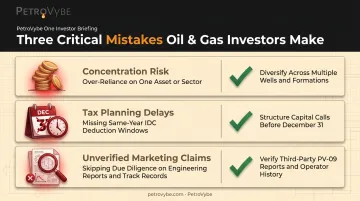
Concentration risk: Putting everything into a single stock, one rental property, or one sector leaves you exposed when that market turns. Diversification across non-correlated assets protects against inflation and downturns, making it non-negotiable for serious wealth builders.
Tax planning delays: IDC (Intangible Drilling Costs) deductions and similar tax-advantaged structures require proactive setup, since IRS rules mandate that qualifying costs be incurred within the same tax year they're claimed. Waiting until December to think about taxes usually means missing the window entirely.
Unverified marketing claims: A polished pitch deck isn't due diligence. Before investing, request:
- Independent engineering or performance reports
- Verified investor references (not curated testimonials)
- Documented leadership track record with specific, checkable numbers
Skipping this step is how investors end up in deals that looked great on a slide and fell apart in reality.
Frequently Asked Questions
What is the meaning of acquisition of wealth?
It's the deliberate, active process of accumulating money, assets, or property through income, investment, and strategic decision-making. This is distinct from passive or inherited wealth, which requires no ongoing effort.
How much money do I need to start a wealth acquisition strategy?
Thresholds vary by vehicle, but many private, accredited-investor-only opportunities, such as PetroVybe's oil and gas development partnerships, require a minimum of $100,000 in deployable liquidity. Public market strategies can start with far less.
What is an accredited investor and why does it matter for wealth acquisition?
An accredited investor meets SEC income ($200K individual/$300K joint) or net worth ($1M+, excluding primary residence) thresholds. This status unlocks access to private deals unavailable to the general public.
What's the difference between wealth acquisition and wealth preservation?
Acquisition is the active growth phase, compounding capital into new assets, while preservation focuses on protecting the wealth you've already built.
Are alternative investments like oil and gas development a good wealth acquisition strategy?
They can offer strong tax efficiency and passive income potential unavailable in traditional accounts. Success depends heavily on vetting the operator's track record and confirming third-party validation, such as an independent engineering report on proved reserves, before investing.
How long does it typically take to build significant wealth through an acquisition strategy?
Most structured strategies, including private development assets, target defined multi-year windows measured by MOIC and IRR benchmarks over a 10-year hold. These are not overnight returns; they require patience and a defined hold period.