

Introduction
You're staring at a profitable income statement, and net income looks solid. But your bank balance doesn't match up, and you're wondering where the money went.
Depreciation is often the culprit, and it's one of the most misunderstood line items in accounting. Some business owners treat it like lost cash, while others dismiss it as an irrelevant paper entry.
Neither view is accurate. Depreciation has no direct effect on cash, yet it changes what you owe in taxes, which absolutely changes your cash position.
This article breaks down exactly how depreciation moves through the income statement, balance sheet, and cash flow statement. We'll also cover why this mechanic matters even more for investors evaluating asset-heavy, tax-advantaged sectors like natural gas development.
Key Takeaways
- Depreciation is a non-cash expense that lowers book value without spending real cash
- It lowers taxable income, which indirectly increases the cash your business retains
- This expense appears differently on the income statement, balance sheet, and cash flow statement
- Straight-line and accelerated methods change when you get tax benefits, not the amount
- Depletion and IDCs work like supercharged depreciation, often front-loading deductions in year one
What Is Depreciation and Why Does It Matter?
Depreciation allocates the cost of a tangible asset, such as equipment or a building, over its estimated useful life instead of expensing the full purchase price immediately. The Financial Accounting Standards Board describes it as a "systematic and rational" allocation process, not an attempt to track an asset's actual market value.
That distinction matters. Depreciation is an estimate, built on assumptions about useful life and salvage value. Two companies buying identical trucks can post different depreciation expenses simply because they assumed different useful lives.
Because it's baked into your accounting system this way, depreciation touches every core financial statement simultaneously:
- Income statement: Reduces reported profit
- Balance sheet: Reduces asset value over time
- Cash flow statement: Gets added back as a non-cash reconciling item
Depreciation vs. Amortization vs. Depletion
These three terms get used interchangeably, and that's a mistake. Each applies to a different type of asset:
- Depreciation – tangible property: equipment, vehicles, buildings
- Amortization – intangible assets with a finite life: patents, trademarks, acquired software
- Depletion – natural resources: oil, gas, timber, minerals
The distinction becomes critical in capital-intensive industries. In oil and gas development, depletion and intangible drilling costs (IDCs) do the heavy lifting instead of standard depreciation, and they work under a completely different set of rules. More on that below.
How Depreciation Flows Through the Cash Flow Statement
Is depreciation a cash flow? No. It's a required reconciling line item, but it's not a movement of actual dollars.
Here's the mechanic. Under the indirect method, the cash flow statement starts with net income and adjusts for items that didn't actually use cash. The SEC's own guidance on the statement of cash flows specifically calls out depreciation as one of these adjustments.
Depreciation reduced net income on the income statement, but no cash left the building. So it gets added back in the operating activities section to correct for that.
The Real Cash Benefit: The Tax Shield
The actual cash impact of depreciation comes from taxes, not the add-back itself. The standard formula, per Corporate Finance Institute's tax shield analysis, is:
Tax savings = Deductible depreciation × Applicable tax rate
Here's a simple walkthrough using a $2,000 increase in depreciation and a 10% tax rate:
- Pretax income drops by $2,000
- Tax expense (and actual cash taxes paid) drops by $200
- Net income falls by $1,800 ($2,000 − $200)
- The $2,000 non-cash depreciation gets added back on the cash flow statement
- Net effect on operating cash flow: +$200 (−$1,800 + $2,000)
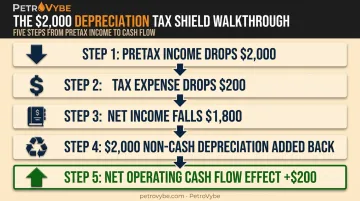
That $200 is the real story. Depreciation itself moved zero dollars. But because it lowered the tax bill, the business kept $200 more cash than it would have without that deduction.
Don't Confuse This With the Asset Purchase
The cash outflow for buying the asset shows up in investing activities, at the time of purchase. Depreciation shows up later, in operating activities, as a non-cash adjustment. They're two separate events on the cash flow statement, years apart in most cases.
Depreciation doesn't increase cash on its own. It preserves cash by shrinking your tax liability.
Depreciation's Effect on the Income Statement and Balance Sheet
On the income statement, depreciation typically sits as an operating expense, though for manufacturing or production assets it can also live inside cost of goods sold. Either way, it reduces gross profit, operating income, and ultimately the taxable income line.
On the balance sheet, accumulated depreciation chips away at the carrying value of property, plant, and equipment (PP&E) year after year. This has a ripple effect:
- Total assets decline as accumulated depreciation grows
- Equity moves in tandem, since assets minus liabilities equals equity
- Return on equity (ROE) shifts as the asset base shrinks
Why Analysts Add It Back: EBITDA and EBITDAX
Because depreciation is a non-cash, estimate-driven expense, analysts often strip it out to see a company's underlying cash-generating power. That's where EBITDA (earnings before interest, taxes, depreciation, and amortization) comes in.
In oil and gas specifically, you'll often see EBITDAX, which also excludes exploration expense. PetroVybe's leadership, for example, drove a 9x year-over-year EBITDAX increase during a past company turnaround—a sign of real operational gains, not just accounting shifts. It's a useful proxy, but it's a non-GAAP measure. Definitions vary by company, so always check what's actually excluded before comparing two firms' numbers side by side.
Depreciation Methods and Their Cash Flow Timing
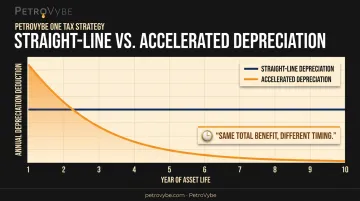
The method you choose changes when you get the tax benefit, not how much total benefit exists over the asset's life.
Straight-Line Depreciation
The simplest approach. Spread the expense evenly across the asset's useful life:
(Cost − Salvage Value) ÷ Useful Life = Annual Depreciation
A $50,000 machine with a $5,000 salvage value and a 10-year life produces $4,500 in depreciation every year, no surprises, no front-loading.
Accelerated Methods
Declining balance and double-declining balance methods push larger deductions into the early years of an asset's life. That means:
- A bigger tax shield sooner
- More cash retained upfront, when it's often most useful for growth or reinvestment
- Smaller deductions (and smaller tax benefits) in later years
The key point: total depreciation and total cash impact over the asset's life are identical under either method. Accelerated depreciation just moves the benefit earlier on the timeline, similar to getting paid sooner rather than later for the same job. PetroVybe's IDC deductions follow this same front-loading logic, often delivering the majority of an investor's total tax benefit in year one alone.
Depreciation, Depletion, and Tax-Advantaged Oil & Gas Investing
Traditional depreciation schedules cost recovery over years, sometimes decades. Oil and gas development plays by different rules entirely, and the difference matters enormously for investors managing a heavy tax burden.
IDCs and Depletion: Supercharged Cost Recovery
Intangible Drilling Costs (IDCs), covering items like labor, fuel, and drilling supplies, can often be deducted in the very first year rather than capitalized and spread out. Depletion works similarly for the value of the resource itself. Together, these tools front-load deductions in a way standard depreciation schedules simply can't match.
The Active Income Advantage
Here's the differentiator most investors miss. Real estate depreciation is generally limited to offsetting passive income only. A qualifying oil and gas working interest, by contrast, isn't classified as a passive activity under IRS passive activity rules, which means IDC deductions can offset:
- W-2 wages
- Capital gains
- Other active, ordinary income
That's a meaningfully different tax planning tool than what most real estate or passive fund structures offer.
What This Looks Like in Practice
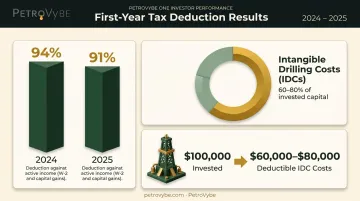
PetroVybe's own partner results illustrate the mechanic. Partners received a 94% first-year tax deduction against active income in 2024, followed by 91% in 2025.
Both figures were driven primarily by IDCs, which typically represent 60-80% of invested capital in new drilling projects. On a $100,000 investment, that translates to roughly $60,000-$80,000 in deductible costs against active income in year one alone.
For high-income W-2 earners, family offices, and accredited investors already diversified across stocks, bonds, and real estate, this is the appeal. The same non-cash accounting principle behind ordinary depreciation, applied through IDCs and depletion, becomes a genuinely different tax lever.
This tax lever plays out directly in PetroVybe's own projects, developed in South Texas and the Gulf Coast Basin, specifically Lavaca County, where proved reserves are independently valued at $48 million (PV-09) by a licensed third-party engineering firm. For accredited investors with at least $100,000 in liquidity looking to explore direct-access natural gas development, these structures could meaningfully offset your specific tax liability this year.
Frequently Asked Questions
How is depreciation shown in the cash flow statement?
Depreciation is added back to net income in the operating activities section under the indirect method. It reduces net income on paper, but since no cash actually leaves the business, the add-back corrects the statement.
Is depreciation considered a cash flow?
No. Depreciation itself isn't a cash movement. It indirectly affects cash flow by lowering taxable income, which reduces the actual cash taxes a business pays.
Does depreciation increase or decrease cash flow?
It doesn't directly change cash flow either way. But by reducing tax liability, it leaves more cash in your business than you'd have without the deduction.
What's the difference between depreciation and amortization?
Depreciation applies to tangible assets like machinery and vehicles. Amortization applies to intangible assets like patents and trademarks. Both spread cost over time, just for different asset types.
How do you calculate depreciation expense?
The simplest method is straight-line: subtract salvage value from the asset's cost, then divide by its useful life. This produces an equal expense amount each year.
Can depreciation-type deductions be used against active income in oil and gas investments?
Yes. Unlike typical passive real estate depreciation, IDC deductions in oil and gas development can offset active income, including W-2 earnings and capital gains. This makes it a distinct tax planning tool for high-income investors.