Knowing exactly where an asset sits in that cycle before you commit capital changes everything. It affects the financing you can get, the risk you're taking on, your tax treatment, and how much return you can realistically expect.
Real estate investors have used this framework for decades. It applies with equal force to alternative asset classes like natural gas development, where the unstabilized phase brings both real risk and tax advantages that disappear once a well matures. This guide breaks down both categories, when each makes sense for your portfolio, and how the concept plays out through a real-world energy example.
Key Takeaways
- Stabilized assets show steady occupancy or production, unlocking cheaper permanent financing
- Unstabilized assets are under construction, in lease-up, or early drilling, carrying more risk and upside
- Financing splits: permanent debt for stabilized deals, bridge capital for unstabilized ones
- Your best fit depends on risk tolerance, time horizon, tax situation, and return targets
Stabilized vs. Unstabilized Assets: Quick Comparison
Before exploring definitions in detail, here's the framework at a glance:
| Factor | Stabilized Assets | Unstabilized Assets |
|---|---|---|
| Occupancy/Production | 90%+ occupancy (program-dependent) or established, consistent output | Below stabilization threshold; still leasing up, under construction, or in early drilling |
| Financing Eligibility | Permanent, lower-rate debt | Bridge, construction, or development capital priced for higher risk |
| Risk & Return | Lower risk, steady but capped returns | Higher risk, greater upside through value creation |
| Tax Treatment | Standard depreciation tied to ongoing operations | Often eligible for accelerated deductions, such as Intangible Drilling Costs in oil and gas |
These aren't rigid categories. They're points on a spectrum, and where an asset falls determines the capital available to it.
What Is a Stabilized Asset?
A stabilized asset has finished its construction or development phase and reached a consistent income level relative to its market. Lenders treat it as investment-grade collateral rather than a work in progress.
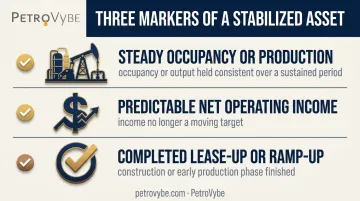
The core markers of stabilization:
- Occupancy or production has held steady over a sustained period
- Net operating income is predictable, not a moving target
- Lease-up, or ramp-up in energy terms, is complete
There's no single universal rule here. Fannie Mae's Small Loan program requires 90% physical occupancy for 90 days on properties with 10 or more units, but that threshold shifts depending on unit count and lender (Fannie Mae Multifamily Guide).
The Appraisal Institute takes a different approach entirely, defining stabilization by whether a property has captured its appropriate share of market demand rather than hitting a fixed number.
What matters practically is the payoff: lower volatility, access to permanent debt at better rates, and a financial plan you can actually build on. This concept extends well beyond apartment buildings. It applies to industrial parks, data centers, and, in energy, to wells with an established and verifiable production history.
Use Cases of Stabilized Assets
Stabilized assets work best as the anchor of a portfolio, the holdings built for capital preservation and dependable passive income rather than aggressive growth.
Where you'll typically find them:
- Multifamily housing with a long occupancy track record
- Industrial warehouses under long-term leases
- Mature, cash-flowing oil and gas wells with proven reserves
The tradeoff shows up clearly in current data. CBRE's Q4 2025 cap rate survey found core multifamily going-in cap rates at 4.75%, with an unlevered IRR target of 7.70%, versus 5.26% and 9.36% for value-add multifamily deals (CBRE Core Multifamily Buyer Sentiment, Q4 2025). Stabilized assets trade upside for certainty. That's the whole point of owning them.
What Is an Unstabilized Asset?
An unstabilized asset is still working toward operational or income maturity. In real estate, that means under construction or in active lease-up. In energy, it means exploration or early development, before a well has an established production history.
Unstabilized assets offer little immediate cash flow. Their appeal lies in what investors get in exchange for accepting more risk:
- A lower entry basis than a fully stabilized asset would command
- Greater potential for value creation as the asset matures
- In sectors like oil and gas, access to significant upfront tax deductions, such as Intangible Drilling Costs, that disappear once a well is fully stabilized
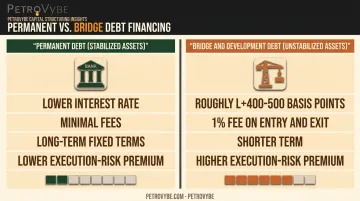
Financing works differently too. Permanent lenders won't touch an asset that hasn't proven itself yet. Unstabilized deals typically rely on bridge loans, construction debt, or direct development capital, and that capital is priced accordingly.
A 2016 CREFC primer put bridge debt at roughly L + 400-500 basis points, plus a 1% fee on both entry and exit, a meaningful premium over permanent financing (CREFC Primer on CRE Debt Products). Pricing has moved since then, but the underlying logic hasn't: unstabilized collateral costs more to finance because it carries execution risk.
Use Cases of Unstabilized Assets
Unstabilized assets are the entry point for capital seeking outsized returns and tax efficiency, not immediate income.
Common examples:
- Ground-up multifamily development in real estate
- Raw land and value-add repositioning projects
- Early-stage natural gas development, the stage where companies like PetroVybe operate across South Texas and the Gulf Coast Basin
As the comparison data above shows, strategies that accept development-stage risk typically underwrite meaningfully higher return targets than stabilized, income-producing deals. That's the reward for taking on lease-up risk, drilling risk, or construction risk before the asset proves itself.
Stabilized vs. Unstabilized: Which Is Right for Your Portfolio?
The decision comes down to four factors:
- Risk tolerance: can you stomach a period of uncertain or zero cash flow?
- Liquidity needs: do you need income now, or can capital stay locked up for years?
- Investment horizon: are you thinking in quarters or in decades?
- Current tax burden: would an upfront deduction meaningfully change your tax picture this year?
If capital preservation and predictable passive income top your list, stabilized assets fit. If you're prioritizing tax efficiency, long-term growth, and higher MOIC or IRR potential, unstabilized assets are where that upside lives.
Real-World Example: Natural Gas Development as an Unstabilized Asset Opportunity
PetroVybe develops early-stage natural gas assets in South Texas and the Gulf Coast Basin, including operations in Lavaca County. It's a useful case study precisely because it shows the unstabilized-to-stabilized journey in action.
That journey speaks directly to a familiar set of investor pain points. High-income investors often face a heavy tax burden, inflation eroding the real value of fixed-income returns, and limited access to institutional-grade development deals that were historically reserved for insiders. Unstabilized natural gas assets address all three at once.
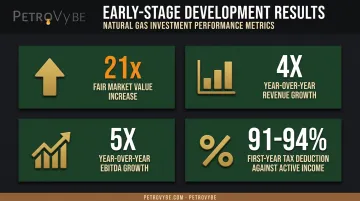
PetroVybe's own trajectory illustrates the shift. The team scaled production from zero to roughly 1,300 BOEPD across approximately 400 wells and 58,000 acres, moving assets progressively from unstabilized to stabilized as drilling and production matured. Along the way:
- 21x Fair Market Value increase on a project
- 4X year-over-year revenue growth
- 5X year-over-year EBITDA growth
- 91-94% first-year tax deduction against active income, including W-2 earnings and capital gains, driven largely by Intangible Drilling Costs
That last point matters more than it might seem. Unlike passive real estate losses, IDC deductions from a working interest can offset active income directly, not just passive income. For a $100,000 investment, that can mean $60,000 to $80,000 in deductible Intangible Drilling Costs alone in year one.
The takeaway: unstabilized natural gas development can offer accredited investors a combination that's genuinely rare, meaningful upfront tax relief plus long-term MOIC potential targeted at 2.2x to 5.8x over a 10-year hold. That's the reward for stepping in before an asset stabilizes.
If you're weighing how a development-stage natural gas position might fit into a tax-efficient, diversified portfolio, PetroVybe's team can help. They'll walk you through where a given project sits in its lifecycle and what that means for your return timeline.
Conclusion
Neither stabilized nor unstabilized assets are universally "better." The right choice depends on whether you're prioritizing steady, lower-risk income or higher-growth, tax-advantaged upside.
This distinction directly affects financing costs, portfolio diversification, tax efficiency, and long-term wealth building. Many sophisticated investors hold both types deliberately.
They use stabilized assets to anchor the portfolio while turning to unstabilized positions, like PetroVybe's early-stage natural gas development projects, to drive growth and manage tax exposure. The lifecycle matters more than the label; know where an asset sits in it before you write the check.
Frequently Asked Questions
What is a stabilized asset in commercial real estate?
A stabilized asset has completed construction or lease-up and reached consistent occupancy, typically around 90% depending on the program, along with predictable net operating income. That consistency is what qualifies it for permanent financing.
What occupancy percentage is generally required for a property to be considered stabilized?
There's no single universal rule. Fannie Mae's Small Loan program cites 90% occupancy for 90 days on larger properties, but other programs and appraisal standards use different thresholds or market-based definitions.
What is the main difference between stabilized and unstabilized cash flow?
Stabilized cash flow is predictable and reliably supports debt service. Unstabilized cash flow is inconsistent or entirely absent during construction, lease-up, or early development.
Can unstabilized assets still be financed?
Yes, but not with permanent debt. Unstabilized assets typically use bridge loans, construction debt, or direct development capital, all priced higher to reflect execution risk.
Are stabilized assets always a lower-risk investment?
Yes, in most cases. Stabilized assets carry lower risk and lower potential returns, while unstabilized assets carry more risk but a meaningfully higher upside if execution goes well.
Does the stabilized vs. unstabilized concept apply outside of real estate?
Yes. The same lifecycle applies to natural gas development, where early-stage wells like those in PetroVybe's Texas projects carry more risk and stronger tax advantages, while producing wells offer steady, lower-risk income.