

That confusion has real consequences. Business owners who mix up the two often mismanage payroll timing or overextend on inventory. Investors who conflate them can misjudge whether a company — especially in capital-intensive sectors like oil and gas development — is actually healthy or just looks that way on paper.
This article breaks down what each term actually means, how they're calculated, where they diverge, and how to apply both when evaluating a business or an investment opportunity.
Key Takeaways
- Working capital is a balance-sheet snapshot: assets minus liabilities, measured right now.
- Cash flow tracks the net movement of money in and out of a business over a defined period.
- Building working capital (more inventory, more receivables) typically reduces near-term cash flow.
- Strong businesses need both metrics working in balance, not just one.
- For accredited investors, these metrics reveal reinvestment discipline and liquidity strength.
Working Capital vs. Cash Flow: Quick Comparison
Here's how the two stack up side by side:
| Category | Working Capital | Cash Flow |
|---|---|---|
| Definition | What's available after covering short-term debts | Total money moving in and out during a set period |
| Formula | Current Assets – Current Liabilities | Total Cash Inflows – Total Cash Outflows |
| Time Frame | Point-in-time snapshot (often viewed on a 12-month basis) | Period-based: monthly, quarterly, or annual |
| What It Signals | Ability to meet short-term obligations | Whether the business is generating or burning money |
Think of working capital as a photograph and cash flow as a video. One captures a moment; the other shows the story unfolding over time. Both matter, but they answer different questions.
What Is Working Capital?
Working capital is the clearest measure of short-term financial health. It answers a simple question: if every current bill came due tomorrow, could the business cover it using what it has on hand?
The formula:
Working Capital = Current Assets – Current Liabilities
Current assets typically include:
- Cash and marketable securities
- Accounts receivable
- Inventory
Current liabilities typically include:
- Accounts payable
- Short-term debt
- Taxes owed
Positive vs. Negative Working Capital
Positive working capital means a company has more short-term assets than obligations: a cushion against unexpected shocks. Negative working capital means liabilities exceed assets, which can signal trouble if sales slow or lenders tighten credit terms.
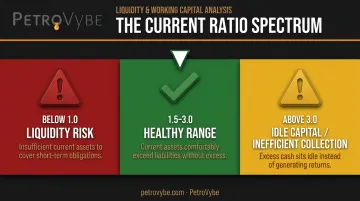
Analysts often use the current ratio (current assets ÷ current liabilities) to contextualize this. CFI notes that a healthy range typically falls between 1.5 and 3.0, though the right benchmark varies significantly by industry. A ratio below 1.0 can suggest vulnerability.
A ratio far above 3.0 isn't automatically a good sign, either. It can mean cash is sitting idle, inventory is piling up, or receivables aren't being collected efficiently. Capital that should be working isn't.
Use Cases of Working Capital
Businesses lean on working capital daily to fund payroll, restock inventory, and cover operating expenses between billing cycles. Capital-intensive industries, including manufacturing, retail, and energy development, depend on working capital discipline because their production and payment cycles stretch out for months, sometimes years.
The stakes are real. A 2025 Federal Reserve survey of 7,653 employer firms found that 56% struggled to pay operating expenses and 51% reported uneven cash flow as ongoing challenges. This reflects how tight working capital margins pressure day-to-day survival.
For oil and gas development specifically, this discipline is non-negotiable. Wells don't produce revenue the day capital gets deployed. A gap exists between spending on leases, drilling, and completions and the first dollar of production income.
What Is Cash Flow?
If working capital is the snapshot, cash flow is the real-time feed. It measures the actual movement of money through a business over a defined period, and it comes in three distinct flavors.
- Operating cash flow: Cash generated by core business activities like production, sales, and collections.
- Investing cash flow: Money spent on or received from long-term assets, such as new equipment or a well acquisition.
- Financing cash flow: Money moving between the company and its capital providers, including debt draws, repayments, equity contributions, and distributions.

Why Profit Doesn't Equal Cash
Here's a distinction that trips up plenty of investors: a company can show a profit on its income statement while its bank account tells a different story. Profits tied up in unpaid receivables or unsold inventory don't put cash in the register. They sit on the balance sheet, waiting to convert.
Positive cash flow means a company can reinvest, pay down debt, or return capital to owners without external help. Negative cash flow means it's burning through reserves or relying on outside financing just to keep operating, a pattern that can't continue indefinitely.
Use Cases of Cash Flow
Investors weigh cash flow trends heavily because it's the clearest signal of whether an asset can sustain itself and grow without constant capital injections. This is exactly why discounted cash flow models remain a core valuation tool across finance.
Oil and gas development is a textbook example. Reinvestment, including drilling new wells, running workovers, and pursuing acquisitions, depends entirely on consistent operating inflows. S&P Global Ratings reported that North American public upstream operators' reinvestment rates climbed from roughly 37% in 2021 to about 50% in 2023. That shift shows how closely production growth tracks cash generation rather than external funding alone.
How Working Capital and Cash Flow Affect Each Other
Here's where the two metrics collide, and it's the part most people get backward.
An increase in working capital typically reduces available cash flow in the short term. Buy more inventory, extend more credit to customers, and cash goes out the door even though your balance sheet looks stronger. A decrease in working capital (collecting receivables faster, drawing down inventory) frees up cash.
The formula that ties them together:
Operating Cash Flow = Operating Income + Non-Cash Expenses – Taxes + Changes in Working Capital
A simple example makes this concrete. Say a company buys $50,000 in inventory using cash. Total current assets stay the same (cash drops, inventory rises by the same amount), so net working capital doesn't move.
But operating cash flow takes a direct $50,000 hit, because that cash left the business during the period. The balance sheet looks unchanged, while the cash flow statement tells the real story.
Applying This to Development-Stage Assets
Oil and gas development illustrates this relationship in sharp relief. PetroVybe's operating model, built around what it calls the PROTECT and SCALE strategy, reinvests operating cash flow into two categories: workovers on existing legacy production (PROTECT) and new drilling identified through geological analysis (SCALE).
Rather than distributing every dollar of cash flow immediately, a portion gets recycled into lease development, drilling, and completion costs. This compounds production and asset value instead of depleting liquidity.

This isn't unique to PetroVybe's approach, but it demonstrates the principle well. Companies that reinvest disciplined cash flow into working capital tend to grow reserve value over time, while those that treat cash flow as a personal ATM often stall out once the existing asset base declines.
Situational guidance:
- Business owners facing seasonal dips or short-term shocks should prioritize working capital management first. It acts as your buffer against immediate disruption.
- Investors evaluating long-term earning potential should prioritize cash flow trends instead. These trends reveal whether the underlying asset can sustain and grow returns.
- Lenders and creditors reviewing short-term risk should focus on working capital ratios first, since they signal near-term repayment capacity.
For accredited investors evaluating an income-generating asset, the combination of reinvested cash flow and third-party validated reserves is the kind of financial discipline worth looking for. It signals a company building for the next decade, not just managing this quarter's numbers.
Conclusion
There's no single "better" metric here. Working capital shows a business's short-term staying power. Cash flow shows its ongoing ability to generate money. Financially sound businesses (and sound investments) need both working in balance, not one propping up a weakness in the other.
Whether you're running a company or evaluating an oil and gas development opportunity, tracking both figures helps you avoid liquidity surprises and spot genuine long-term value creation before you commit capital.
If you're curious how these principles show up in a real development strategy, PetroVybe's project overview walks through how reinvested cash flow and disciplined working capital management support its production growth model for accredited investors.
Frequently Asked Questions
Is cash flow the same as working capital?
No. Cash flow tracks money movement over a period of time, while working capital is a snapshot of short-term liquidity at a single point. One tracks movement, the other measures position.
How does working capital affect cash flow?
Increases in working capital (more inventory or receivables) typically reduce available cash flow because cash gets tied up in those assets. Decreases free up cash for other uses.
What are the three types of cash flow?
Operating cash flow (core business activities), investing cash flow (long-term asset purchases or sales), and financing cash flow (debt, equity, and distributions). Each reveals a different aspect of company activity.
What is considered a healthy working capital ratio?
Analysts commonly cite a range of 1.5 to 3.0 as healthy, though this varies by industry. Too low can signal liquidity risk; too high can indicate idle or inefficiently managed assets.
Can a company have positive cash flow but negative working capital, or vice versa?
Yes. A heavily leveraged company with strong revenue might show negative working capital but positive cash flow. Conversely, a newly funded company might have strong working capital but no operating cash flow yet.
Why should investors care about both metrics when evaluating an opportunity?
Together, they reveal financial discipline and reinvestment strategy, showing whether returns are sustainable rather than just how strong the top-line numbers look. Relying on one alone can hide real risk.