

To help close that gap, many large employer 401(k) plans, including RTX's Savings Plan, now default employees into a Lifetime Income Strategy (LIS): an in-plan option blending growth investing with an insurance-backed income guarantee. Because it's often the default investment, opting in (or out) is a decision worth understanding before it's made for you.
This article breaks down what an LIS actually is, its real trade-offs, and where outside strategies might fit alongside it.
Key Takeaways
- An LIS blends target-date fund growth with an insurance-backed lifetime income guarantee.
- It offers pension-like security but often carries higher fees and less flexibility.
- Fit depends on your risk tolerance, retirement timeline, and tax situation.
- Private, tax-advantaged investments outside your 401(k) can complement, not replace, an LIS decision.
What Is a Lifetime Income Strategy?
A Lifetime Income Strategy is an in-plan, professionally managed investment option that combines growth-oriented investing with an optional insurance component guaranteeing income for life. Think of it as a target-date fund with an annuity feature built in.
These strategies are frequently the Qualified Default Investment Alternative (QDIA) in large employer plans, meaning workers can be enrolled automatically without actively choosing it. RTX's 2024 Form 11-K confirms LIS as the plan's QDIA, and its participant kit describes an insurance component layered onto a familiar target-date structure.
Not all LIS products work the same way. BlackRock's LifePath Paycheck uses an optional annuity purchase starting at age 59½. Prudential's IncomeFlex Target uses a guaranteed withdrawal benefit. Nuveen embeds TIAA's lifetime income directly into its target-date series. The category is common; the mechanics are not identical.
Core Components of a Lifetime Income Strategy
Most LIS designs move through three phases:
- Growth phase - In early career years, the allocation leans heavily into equities, functioning much like a standard target-date fund.
- Risk-reduction phase - A portion of the balance shifts into a "Secure Income" sub-fund insured by group annuity contracts. RTX's design begins this transition at age 48.
- Guaranteed income phase - Participants choose a secure income allocation between 0% and 100% and a target retirement age. The payout locks to the plan's highest account value ever reached, so market gains raise the guarantee but downturns never reduce it.

Benefits of a Lifetime Income Strategy
- Guaranteed income for life, regardless of how markets perform after activation
- Continued growth potential, since funds stay invested rather than being annuitized all at once
- Automatic professional rebalancing, similar to a standard target-date fund, with no active management required
- Retained access to account value in many designs, unlike standalone annuities that often carry surrender penalties
What to Consider Before Choosing a Lifetime Income Strategy
These factors help you weigh guaranteed security against cost, flexibility, and tax complexity before committing.
Risk Tolerance and Need for Certainty
Risk-averse savers who worry about sequence-of-returns risk in retirement tend to benefit most from the insurance component. It also appeals to workers without a traditional pension who want a predictable, paycheck-like income stream rather than managing withdrawals themselves.
Fees and Cost Impact
Fees climb as you approach retirement and shift more assets into the Secure Income Portfolio. Raytheon Technologies' (RTX) 2022 participant kit shows age-based fee illustrations of 0.49%, 0.62%, and 0.72%, while a Prudential IncomeFlex plan-specific fund reported a 1.352% net expense ratio in Q3 2023. These aren't universal numbers, so check your own plan's fee disclosure.
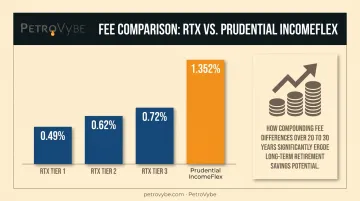
Over 20-30 years, even a 1% fee gap compounds into real money. That cost needs to be weighed against the value of the guarantee itself, not assumed as automatically worth it.
RMDs and NUA Complications
Required minimum distributions still apply once funds sit inside an LIS. IRS rules set the RMD age at 73 for those born 1951-1959, and 75 for those born in 1960 or later. No IRS guidance creates a blanket RMD exemption for LIS balances.
If you hold company stock, Net Unrealized Appreciation (NUA) strategies apply to those shares specifically, not to a target-date or Secure Income Portfolio simply because it sits in the same plan. Combining company stock with LIS elections requires careful plan-specific review.
Control, Portability, and Timing
Three more factors shape how much flexibility you keep once you sign an LIS election:
- Control: Activating the benefit is often irreversible and shifts meaningful control to the insurance provider; beneficiary outcomes vary widely depending on when the benefit was activated.
- Portability: Some balances can't roll directly into an IRA without losing the guarantee, complicating any effort to consolidate accounts at retirement. Confirm your plan's rollover treatment before assuming you can simplify later.
- Timing: There's no universal rule to evaluate an LIS exactly 10-15 years out — schedules vary by provider. RTX's glidepath starts at 48, BlackRock's annuity election opens at 59½, so check your own plan's transition age and fee schedule.
How PetroVybe Can Help
A Lifetime Income Strategy addresses guaranteed income within a 401(k), but it doesn't solve for tax efficiency on active income earned today. That's where accredited investors often look outside employer plans for complementary, tax-advantaged passive income.
PetroVybe offers direct participation in natural gas development projects across South Texas and the Gulf Coast Basin. The structure delivers upfront tax deductions against active income, including W-2 earnings, that a retirement plan simply can't provide.
These direct participation projects offer distinct advantages:
- Intangible drilling cost (IDC) deductions usable against active income, not just passive income, unlike real estate depreciation
- Inflation-resistant passive income from natural gas liquids production
- 10-year target MOIC of 2.2x-5.8x with a 26% IRR
- Third-party engineered reserve validation, including a $48 million PV-09 valuation on the current project

PetroVybe complements, rather than replaces, your 401(k) decisions. It's designed for accredited investors with $100,000+ in liquidity looking to diversify beyond stocks, bonds, and in-plan annuities.
Conclusion
There's no single "right" retirement income option. The goal is finding what fits your risk tolerance, tax situation, and timeline, not chasing whatever's popular or automatically enrolled.
An LIS allocation isn't a set-it-and-forget-it decision either. Revisit it as your retirement age, health, and market conditions shift over time.
Talk to a financial advisor before making changes, and consider a diversified approach that pairs in-plan guaranteed income with outside tax-advantaged investments where they make sense for your situation.
Frequently Asked Questions
What are the pros and cons of a lifetime income annuity?
Pros include guaranteed lifetime payments and protection from market downturns. Cons include higher fees, reduced liquidity, and added complexity around required minimum distributions (RMDs) and estate planning.
What is Dave Ramsey's 8% rule?
This commonly cited rule suggests retirees can withdraw around 8% annually based on historical market averages. Most planners consider it more aggressive than the traditional 4% withdrawal guideline.
What is the $1,000-a-month rule for retirees?
This rule of thumb estimates that for every $1,000 in desired monthly income, a retiree should have roughly $240,000-$300,000 saved, based on a 4-5% withdrawal rate.
Can I lose money in a Lifetime Income Strategy?
Account value can fluctuate with markets before activation. Once you activate the income benefit, guaranteed payments continue regardless of subsequent market performance.
Is a Lifetime Income Strategy the same as a standalone annuity?
Both provide guaranteed income, but in-plan strategies typically offer lower institutional pricing and more flexibility or access to funds than retail standalone annuities.
Can I opt out of my employer's Lifetime Income Strategy?
Most plans let you reduce your Secure Income allocation to 0% or transfer out entirely. Understand exactly what you're giving up before making that call.