Introduction
Picture an investor with a demanding career, a growing family, and capital sitting idle in a savings account. She wants ownership in a business or asset that generates real returns.
What she doesn't want is to run daily operations, manage employees, or field 2 a.m. phone calls. That's passive ownership.
Passive ownership shows up everywhere. Public shareholders buy stock without setting foot in the boardroom. Silent partners back a local restaurant, while limited partners fund real estate deals, private equity funds, or natural gas development projects.
This article defines passive ownership, contrasts it with active ownership, and breaks down the real advantages and risks investors need to weigh before committing capital to this structure.
Key Takeaways
- Passive ownership means holding an equity stake without managing daily operations
- Owners keep limited liability protection and earn income through dividends or capital gains, not salary
- Key benefits include diversification, reduced time commitment, and tax advantages in structures like oil and gas partnerships
- Risks include limited control, dependency on active managers, and potential reporting gaps
What Is Passive Ownership?
Passive ownership describes a stage of business or investment participation where the owner contributes capital or holds equity but doesn't run day-to-day operations. Someone else, whether a general partner, CEO, or operator, handles hiring, vendor relationships, and daily decision-making.
In contrast, active ownership means being in the business daily, making operational calls, managing staff, and often drawing a salary in addition to any profit share.
Passive owners aren't entirely hands-off, though. Most retain voting rights on major decisions requiring shareholder or partner approval, such as selling the company, taking on significant debt, or amending the governing agreement. What they give up is control over routine operations.
This structure exists globally across both simple arrangements (a silent partner in a small business) and complex ones (a multinational trust holding equity through several layers). Owners can be individuals, family trusts, or corporate entities.
Passive vs. Active Shareholders: What's the Difference?
The core distinction comes down to involvement and income source:
| Factor | Passive Shareholder | Active Shareholder |
|---|---|---|
| Involvement | Capital only, no operational role | Materially participates in operations |
| Income | Dividends, distributions, capital gains | Salary plus profit share |
| Liability | Generally limited to investment | Can extend beyond investment in some structures |
| Tax treatment | Subject to passive activity rules | Active income, different loss treatment |
For U.S. taxpayers, the IRS's material participation tests in Publication 925 determine which category an owner falls into. Meeting any one of seven tests, such as working more than 500 hours annually in the business, can shift someone from passive to active tax status regardless of their formal title.
This distinction matters beyond semantics. Passive activity loss rules limit how losses from passive investments offset other income, and passive income can also factor into the Net Investment Income Tax calculation for higher earners.
Common Types of Passive Owners (Four Shareholder Types)
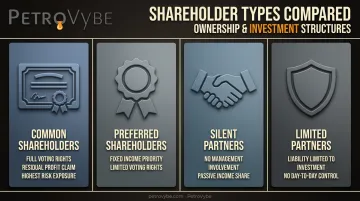
Most passive ownership arrangements fall into one of four categories:
- Common shareholders: Hold residual claims on income and assets, typically vote for board directors, but rarely participate in daily management
- Preferred shareholders: Receive priority on dividends and liquidation proceeds, usually without standard voting rights
- Silent partners: Contribute capital to a private business without taking part in administration, common in small business financing
- Limited partners: Hold limited liability and stay outside governance decisions, typical in the LPs and LLPs used for real estate funds, private equity, and oil and gas development
There's also a legal distinction worth understanding: the difference between a legal owner (the name formally registered on ownership documents) and a beneficial owner (the person who actually enjoys the economic benefits). This separation matters for compliance frameworks tracking Ultimate Beneficial Ownership, which regulators use globally to prevent anonymous control of assets.
Advantages of Passive Ownership
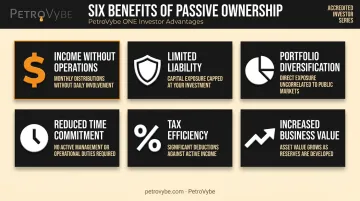
Passive ownership appeals to a specific kind of investor: someone who wants exposure to a business or asset without adding a second job to their calendar. The advantages break down into six categories.
Income without operational responsibility. Passive owners collect distributions and capital gains while keeping their primary career or other ventures running. There's no need to step away from a W-2 job or an existing business to participate.
Limited liability protection. In properly structured LPs and LLCs, passive partners generally cannot be held personally liable for company debts beyond their invested capital. Delaware's LP and LLC statutes, for example, shield limited partners and members from liability solely based on their ownership status, though the specific protections depend on the governing state and partnership agreement.
Portfolio diversification. Passive structures let investors spread capital across industries, geographies, and asset classes without needing a physical presence in each one. A single investor could hold public stock, a silent stake in a restaurant, and an LP interest in a drilling project simultaneously.
Reduced time commitment. This is often the biggest draw for busy professionals, high-income earners, and retirees. There's no second job attached, just quarterly or monthly reporting to review.
Tax efficiency in certain structures. Some passive vehicles offer real tax advantages beyond standard dividend treatment. Oil and gas partnerships, for instance, can pass through deductions like intangible drilling costs (IDCs) and depletion allowances that offset active income for qualifying accredited investors.
At PetroVybe, partners in its 2024 program received tax deductions between 91% and 94% against active income, including W-2 earnings and capital gains. This differs from typical real estate deductions, which are usually restricted to offsetting passive income only.
Increased business value for sellers. Businesses that transition toward passive ownership structures, supported by strong management systems, often become more attractive acquisition targets. Buyers pay a premium when operations don't depend on one owner's daily presence.
Risks and Limitations of Passive Ownership
Passive ownership isn't free of trade-offs. Understanding the downside matters just as much as understanding the benefits.
Limited control over operations. Passive owners generally can't weigh in on hiring decisions, vendor selection, or day-to-day strategy. For investors used to running their own businesses, this can feel uncomfortable, even when the numbers look good on paper.
Transparency and communication gaps. Active managers control what gets reported and how. A passive owner depends entirely on the operator's willingness to share accurate, timely financial information.
Dependency risk. Returns hinge on the skill and integrity of whoever runs the business. A brilliant deal structure means little if the general partner mismanages capital or makes poor operational calls.
Real disputes illustrate this risk. In Matter of Clever Innovations, Inc., a New York court found oppression after a surviving 50% owner excluded his deceased partner's estate from company information. He also moved $280,000 into a new account and ignored requests to discuss a buyout. The court ordered a forced buyout to protect the excluded owner's reasonable expectations.
This case underscores why information rights, distribution terms, and clear buyout provisions belong in any partnership agreement from day one, not added after a dispute erupts.
Partnership disputes aren't the only complication passive owners face. Cross-border compliance burden. Passive owners with interests in foreign entities may face FBAR, FATCA, or Form 8865 filing obligations depending on ownership percentage and asset value. Multi-jurisdictional structures add complexity that domestic-only passive interests don't carry.
Regulators also flag general private-placement risks worth remembering: SEC guidance on Regulation D offerings notes limited disclosure, restricted resale, and the possibility of total loss. Accredited investor status is an eligibility requirement, not a guarantee of suitability or safety.
Common Use Cases for Passive Ownership (Including Oil & Gas Development)
Passive ownership shows up across several familiar structures:
- Real estate investment groups: investors contribute capital while a property manager handles leasing, maintenance, and tenant relations
- Venture capital and private equity funds: limited partners fund deals while a general partner sources, manages, and exits portfolio companies
- Silent partnerships in private companies: entrepreneurs raise financing without surrendering control, and the capital partner stays outside day-to-day decisions
- Trust and asset protection structures: used for privacy, succession planning, and separating legal from beneficial ownership
Oil and Gas Development Partnerships
Natural gas and oil development represents a modern passive ownership use case for accredited investors. Capital funds drilling and production, while a licensed operator manages everything from permitting to well completion.
PetroVybe structures its partnerships this way in south-central Texas, where its operating entity holds an active operator's license with the Texas Railroad Commission. That license, along with publicly filed lease records, gives investors a way to independently verify that development activity is real rather than projected.
The company's flagship project reflects these mechanics: capital contributions fund drilling in Lavaca County, and a third-party engineering firm validated a $48 million proved reserves valuation. Investors then receive monthly passive distributions once production ramps up, without any operational responsibilities themselves.

Due diligence still matters. Before committing capital to any passive structure, verify:
- Confirm the operator's licensing and regulatory standing
- Review third-party engineering or valuation reports backing stated asset values
- Check the management team's track record delivering projected returns to prior partners
- Look for independent reviews or verification badges from platforms outside the company's own marketing
Working with an operator that welcomes this scrutiny, rather than resisting it, helps mitigate the dependency and transparency risks that come with any passive ownership arrangement.
Frequently Asked Questions
Who is a passive shareholder?
A passive shareholder owns an equity interest but isn't involved in company management or employed by the business. They earn returns through dividends, distributions, or capital gains rather than a paycheck.
What is the difference between active and passive shareholders?
Active shareholders manage operations and often draw a salary alongside their ownership stake. Passive shareholders contribute capital and collect income without any operational involvement.
What are the four types of shareholders?
The common categories are common shareholders, preferred shareholders, silent or passive partners, and limited partners. Each differs in voting rights, income priority, and level of involvement.
Does passive ownership include voting rights?
Passive owners typically don't have day-to-day voting power over operations. Most retain rights on major strategic decisions, like a sale or merger, as defined in their shareholder or partnership agreement.
How are passive owners taxed differently from active owners?
Passive income and losses generally follow separate IRS rules, including passive activity loss limitations that restrict how losses offset other income. Oil and gas limited partnerships are an exception, since IDC deductions can apply directly against active income.
Can accredited investors use passive ownership to invest in oil and gas development?
Yes. Accredited investors can hold limited partner interests in oil and gas development projects, gaining production income and tax deductions without any operational duties. PetroVybe structures these partnerships with a $100,000 minimum investment, handling all drilling and production so the investor's role stays fully passive.