

Introduction
Interest income recognition is the accounting process of recording interest earnings in the period they're earned, not necessarily when cash lands in the bank. That single distinction causes misstated earnings, failed audits, and costly compliance headaches for finance teams that get it wrong.
This guide is written for accountants, controllers, auditors, and investors who need to understand how interest gets reported under GAAP and IFRS. Getting it right isn't a nice-to-have. It affects tax reporting, audit outcomes, and whether your financial statements hold up under scrutiny.
Terms like "accrued interest" and "effective interest method" get thrown around constantly in accounting conversations, yet the operational, journal-entry-level mechanics behind them are often misunderstood.
This article breaks down what interest income recognition is, how it works step by step, where it applies, and the mistakes that most commonly derail otherwise solid accounting practices.
Key Takeaways
- Interest income is recognized when earned, not when collected
- The effective interest method applies under both ASC 310 and IFRS 9
- Receivable and revenue amounts post together in a single journal entry
- Recognition stops once collectability turns doubtful (nonaccrual status)
- Accurate recognition keeps financials audit-ready and forecasts reliable
What Is Interest Income Recognition?
Interest income recognition is the process of recording interest earned on loans, bonds, deposits, or interest-bearing receivables in the period it accrues, rather than when payment arrives. It follows the matching principle: revenue gets recognized alongside the period it relates to, regardless of cash timing.
The goal is simple to state, harder to execute: present a true picture of what an interest-bearing asset actually earned during a given period. A bank doesn't wait until a borrower mails a check to say it made money that month. It accrues interest as the loan sits on its books.
This is different from two things people often confuse it with:
- Interest receivable: the balance-sheet asset representing interest earned but not yet collected. It reflects what's owed, not the income itself.
- Cash-basis interest accounting: recording income only when cash arrives, an approach most GAAP and IFRS reporting entities don't use for interest-bearing financial assets.
Under both frameworks, the effective interest method is the prescribed basis for accruing interest, though the mechanics diverge in places. GAAP's guidance under ASC 310-20 requires loan origination fees and direct costs to be deferred and recognized over the life of the loan as an adjustment to yield, rather than booked immediately. ASC 310-20 under Accounting Standards Update 2022-02 makes clear that these fees can't just hit the income statement on day one. They get spread out.
Why Interest Income Recognition Matters in Financial Reporting
ASC 310 (GAAP) and IFRS 9 make this a standards-driven requirement tied directly to the revenue matching principle, not a discretionary bookkeeping choice.
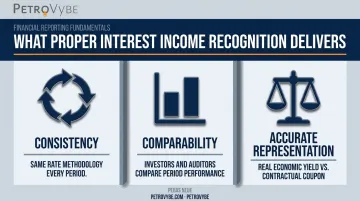
Financial reporting demands three things this process delivers:
- Consistency: the same rate methodology applied across every reporting period
- Comparability: investors and auditors can compare period-over-period earning-asset performance
- Accurate representation: earning assets reflect real economic yield, not just contractual coupon
Without proper recognition, problems compound quickly. Barely performing loans overstate income when interest keeps accruing without adjustment. Improperly deferred fees understate receivables. And recognizing revenue on assets where collection is genuinely in doubt inflates earnings that may never materialize.
A documented 1994 OCC appeal illustrates the stakes: a national bank had applied cash receipts on nonaccrual loans entirely to principal, building a large contra-interest reserve. When collectability had never actually been in doubt, that failure to recognize income was treated as an accounting error requiring a prior-period adjustment and restatement, not a discretionary fix.
How Interest Income Recognition Works (Conceptual Flow)
At a high level, the process has three moving parts: identify the interest-bearing asset, apply the applicable rate over time, and record income as it accrues, whether or not cash has changed hands.
What goes into the calculation:
- Principal balance: the outstanding amount actually earning interest
- Contractual interest rate: nominal/stated rate, or the effective interest rate when fees, premiums, or discounts are involved
- Time period: the accrual window, typically monthly or quarterly
- Adjustments: origination fees, direct costs, premiums, and discounts that shift the yield away from the stated rate
The core transformation is allocating interest income over the asset's term. Under the effective interest method, required by both ASC 310 and IFRS 9.5.4.1, the rate applies to the gross carrying amount rather than the coupon cash received.
IFRS 9 carves out one exception: purchased or originated credit-impaired assets skip this gross-basis treatment. Those get a credit-adjusted rate applied to amortized cost from day one.
The process is controlled through accounting policy elections, periodic impairment assessments, and nonaccrual triggers that activate when collectability is in doubt.
As a result, interest receivable balances grow between payment dates, and interest revenue shows up on the income statement each period. Both figures reconcile once cash arrives.
Here's how that plays out across three steps.
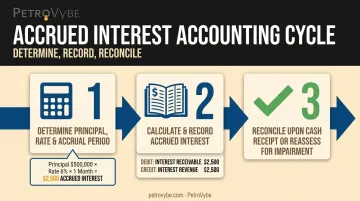
Step 1: Determine the Principal, Rate, and Accrual Period
The entity starts with the outstanding principal, the applicable rate (nominal or effective), and the relevant time period. A $500,000 loan at a 6% annual rate accruing over one month earns $2,500 in interest for that period, before any fee or premium adjustments come into play.
Step 2: Calculate and Record Accrued Interest
The journal entry reflects income earned but not yet collected:
- Debit: Interest Receivable — $2,500
- Credit: Interest Revenue — $2,500
This entry posts at each accrual date, month-end or quarter-end, regardless of whether the borrower has actually paid. Federal Reserve accounting guidance confirms this exact structure: entities debit accrued but uncollected interest to an interest-accrued asset account and credit it to earnings.
Step 3: Reconcile Upon Cash Receipt or Reassess for Impairment
When the borrower pays, the entry flips:
- Debit: Cash
- Credit: Interest Receivable
If collectability becomes doubtful instead, the loan may move to nonaccrual status. At that point, the entity stops recognizing new interest income and reassesses whether previously accrued amounts are still supportable.
Where Interest Income Recognition Applies & Key Factors That Affect It
Interest income recognition isn't limited to bank loans. It applies across a range of instruments:
- Term loans and commercial lending arrangements
- Notes receivable between businesses
- Bonds and other fixed-income securities
- Savings and deposit accounts earning interest for account holders
- Trade receivables carrying interest terms on overdue balances
Recognition occurs at several points in an asset's lifecycle:
- Origination: initial fees and rates get set
- Month-end or quarter-end close: standard accrual entries post
- Modification: renegotiated terms reset the effective rate
- Impairment review: credit risk changes the calculation
The process is recurring by default: accrual happens every period automatically. It becomes condition-based, though, when risk thresholds are triggered. Loan restructuring, a shift in a borrower's credit profile, or missed payments can all flip the process from automatic to reassessed.
Key Factors That Affect Interest Income Recognition
Several variables shape how recognition plays out:
- Inputs: principal amount, contractual rate, and any fees, premiums, or discounts that adjust the effective rate
- Operating conditions: borrower creditworthiness, payment history, and days-past-due status all influence whether accrual continues uninterrupted
- System dependencies: ERP and accounting systems that track amortization schedules and automate journal entries, reducing manual error
- Scale and frequency: the volume of interest-bearing assets and how often interest compounds (monthly vs. quarterly) both add calculation complexity
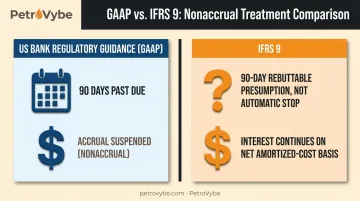
Regulatory treatment also diverges between frameworks, and this matters for any entity reporting under both:
| Framework | Trigger | Interest Treatment |
|---|---|---|
| US bank regulatory guidance | Generally 90 days past due, unless well secured and in collection | Accrual suspended (nonaccrual) |
| IFRS 9 | 90 days is a rebuttable default presumption, not a stop-accrual rule | Interest continues on net amortized-cost basis, per FDIC call report instructions |
This creates real complexity for multinational entities: the same delinquent loan can be treated completely differently depending on which standard applies.
Common Mistakes, Misconceptions & When Standard Recognition May Not Apply
Even experienced finance teams stumble on interest income recognition. The most common issues:
- Assuming recognition means cash in hand. Recording interest income means the amount was earned, not that cash arrived. Confusing accrual with collection is the most frequent error in this area.
- Continuing to accrue on impaired loans. Teams sometimes keep accruing interest on clearly overdue or troubled loans without reassessing collectability, which overstates income and understates risk.
- Mixing up interest income and interest receivable. Interest income lives on the income statement. Interest receivable is the balance-sheet asset. They move together but aren't the same thing.
- Applying accrual by default with no review. Interest that keeps accruing without periodic credit-risk checks quickly overstates income, the clearest sign a process is running on autopilot rather than genuine oversight.
Standard accrual recognition may not be appropriate when:
- A loan is significantly past due and full collection is doubtful
- Collateral value is insufficient to cover the outstanding balance
- A borrower's credit profile has deteriorated enough to trigger nonaccrual policy
In these cases, cash received is applied entirely against principal instead of income; it isn't prorated between the two until the remaining balance is judged fully collectible again.
Conclusion
Interest income recognition comes down to one consistent idea: match earned interest to the period it belongs in, using a standards-driven methodology rather than convenience or cash timing. Whether it's a term loan, a bond, or a savings account, the effective interest method under ASC 310 or IFRS 9 governs how that income gets built onto the books.
Getting this right protects more than a single line item. It supports accurate financial statements, keeps audits from turning into restatements, and gives investors confidence that reported earnings reflect real economic performance rather than optimistic assumptions about collectability.
For investors evaluating traditional interest income, remember that it's taxed as ordinary income with no offsetting deduction. Every dollar earned is exposed to your marginal rate.
That reality pushes some income-focused investors toward alternative structures. PetroVybe's natural gas development projects, for example, offer accredited investors upfront intangible drilling cost deductions that can offset active income, including W-2 wages and capital gains. Partners who joined in 2025 saw a 91% deduction against active income, a different tax profile worth weighing when building a diversified income strategy.
Frequently Asked Questions
When should interest income be recognized?
Interest income should be recognized as it accrues over the period earned, following the effective interest method, regardless of when cash actually arrives. Accrual is suspended if collectability becomes doubtful.
How do you verify interest income?
Verification involves reconciling accrued interest calculations against loan or investment agreements, cross-checking amortization schedules, and confirming that actual cash receipts match recorded interest receivable balances.
What does interest income recognition mean in banking terms?
In banking, it means recording interest earned on loans and advances using the effective interest method. Recognition stops once a loan moves to nonperforming or nonaccrual status.
What is an example of interest income?
A business loan earning interest monthly is a common example. The entity debits interest receivable and credits interest revenue each period the interest accrues, before any cash is collected.
What is the difference between interest income and interest receivable?
Interest income is the earnings recognized on the income statement for the period. Interest receivable is the corresponding uncollected asset sitting on the balance sheet until payment arrives.
Is interest income recognized on a cash or accrual basis?
Under GAAP and IFRS, interest income is generally recognized on an accrual basis using the effective interest method. Cash-basis or nonaccrual treatment applies once collectability is genuinely in doubt.