
Here's the thing: some of history's sharpest financial minds — Einstein, Buffett, Munger, Franklin — all pointed to the exact same idea as the real engine behind lasting wealth. Compounding.
This post rounds up 10 of the most powerful compound interest quotes, explains what each one actually teaches, and shows how these old ideas still apply to building wealth today.
Key Takeaways
- Compound interest turns small, steady contributions into serious wealth over decades.
- Buffett, Munger, and Lynch agree: start early, stay patient, never interrupt the process.
- A single catastrophic loss outweighs market volatility, since any return times zero is zero.
- Compounding applies to any asset, not just stocks, when cash flow gets reinvested.
Why Compound Interest Quotes Matter
Compounding is an exponential concept, and human brains are bad at exponential thinking. That's exactly why these quotes stick — they compress a hard math idea into something memorable enough to change behavior.
The numbers back this up. In the OECD/INFE 2023 International Survey of Adult Financial Literacy, only 42% of adults correctly answered a basic compound interest question involving a five-year savings scenario. Even among people who already own savings or investment products, the correct-answer rate only climbed to 46%.
This gap isn't new. John Maynard Keynes wrote about it back in 1930, noting that modern capital accumulation traces to the 16th century, when "the power of accumulation by compound interest... was re-born and renewed its strength."
He illustrated this with Sir Francis Drake's plunder: a modest sum compounding for centuries until every pound became roughly 100,000 pounds.
That's the value of a good quote. It's a psychological anchor: something to reach for during a market downturn or a slow, unremarkable early year, when compounding is working quietly in the background but doesn't feel like it's working at all.
The 10 Brilliant Compound Interest Quotes That Will Motivate You
These ten lines come from investors, authors, and even a physicist. Some are rock-solid documented quotes. Others are widely circulated but harder to trace to a primary source, and we'll flag those honestly.
Albert Einstein
"Compound interest is the eighth wonder of the world. He who understands it, earns it; he who doesn't, pays it."
This is the most famous compound interest quote in circulation, and it's also the shakiest attribution on this list. Quote Investigator traced the first sentence to an unattributed 1925 advertisement, not to anything Einstein wrote or said.
The message survives anyway, because it's true: understanding basic compounding separates people who build wealth from people who fall into debt paying interest instead of earning it.
Warren Buffett
The reliably documented Buffett line comes from Alice Schroeder's authorized biography, The Snowball: "Life is like a snowball. The important thing is finding wet snow and a really long hill... You've got to be the kind of person that the snow wants to attach itself to."
A shorter version, "My life has been a product of compound interest," circulates widely online but has no located primary source. Either way, the philosophy is the same: Buffett started investing as a teenager and let decades of steady reinvestment do the heavy lifting. Time on the hill mattered more than the size of the starting snowball.
Charlie Munger
Munger's editorial checklist in Poor Charlie's Almanack includes this exact line under the heading "Patience": "Never interrupt it unnecessarily."
A longer sentence about "the power of compound interest and the difficulty of getting it" circulates on social media but doesn't appear in the searchable text of Munger's own book. Still, the confirmed rule is the important one. Munger's point is that understanding compounding is easy; sticking with it through boring years and scary downturns is the hard part.
Peter Lynch
Lynch's Manhattan Indians analogy, from One Up on Wall Street, is fully documented and worth quoting at length:
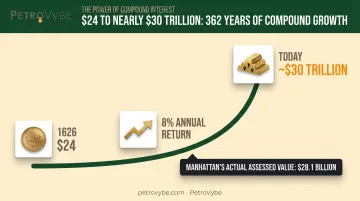
"Consider the Indians of Manhattan, who in 1626 sold all their real estate to a group of immigrants for $24 in trinkets and beads. For 362 years the Indians have been the subjects of cruel jokes because of it — but it turns out they may have made a better deal than the buyers who got the island."
At an assumed 8% annual return, that original $24 compounded for 362 years would total nearly $30 trillion, dwarfing the roughly $28.1 billion assessed value of Manhattan real estate today. A single percentage point, held long enough, rewrites the entire story.
Benjamin Franklin
Franklin's Advice to a Young Tradesman (1748) contains one of the earliest written descriptions of compounding: "Remember that Money is of a prolific generating Nature. Money can beget Money, and its Offspring can beget more, and so on."
The popular paraphrase, "Money makes money, and the money that money makes, makes money," simplifies Franklin's original text but keeps the point intact. This is exponential growth described nearly 300 years before most people had a name for it.
Dave Ramsey
The line "Compound interest is proof that you can get rich slowly" is repeated constantly across personal finance content, though no dated Ramsey book, show transcript, or official post contains that exact sentence. It's worth treating as a paraphrase of his general philosophy rather than a sourced quote.
The takeaway holds regardless: wealth doesn't require big bets or big risk. It requires time, consistency, and the discipline to keep contributing.
Darren Hardy
From The Compound Effect: "The Compound Effect is the principle of reaping huge rewards from a series of small, smart choices."
Hardy takes compounding out of the bank account entirely and applies it to daily habits: the extra 20 minutes of reading, the workout you didn't skip, the dollar you saved instead of spent. Small choices, compounded daily, become a completely different life over a decade.
John C. Bogle
The Vanguard founder's book actually lays out two separate rules: "Time is your friend. Give yourself all the time you can." and "Impulse is your enemy. Eliminate emotion from your investment program."
These get compressed into the popular one-liner "Time is your friend; impulse is your enemy," but Bogle's original wording makes the warning more explicit. Emotional decisions, like panic-selling in a crash or chasing a hot stock, are the single biggest threat to a compounding portfolio.
Benjamin Graham
The circulated quote "The magic of compounding returns is the biggest mathematical discovery of all time" doesn't appear in the searchable text of The Intelligent Investor, and similar "greatest invention" phrasing traces back to anonymous advertising from the 1910s and 1920s, not Graham. Interestingly, "magic of compounding" is verifiably Bogle's phrase, not Graham's.
Misattribution aside, Graham's actual legacy fits the theme: he built value investing on the idea that disciplined, patient capital, held long enough, outperforms speculation.
Robert Breault
"If you understand compound interest, you basically understand the universe."
No book, interview, or verified source for this line exists, and even the name is disputed: the established aphorist spells his name "Robert Brault," and his own archive doesn't contain this quote. Treat it as an unverifiable but philosophically fun observation: exponential growth patterns really do show up everywhere in nature, from cell division to compounding wealth.
Lessons These Quotes Teach About Building Wealth
Strip away the disputed attributions, and five consistent lessons remain.
1. Start early. A smaller amount compounding for 30 years often beats a larger amount compounding for 10. The Rule of 72 shows why:
| Annual Return | Years to Double (72 ÷ rate) |
|---|---|
| 6% | 12 years |
| 8% | 9 years |
| 10% | 7.2 years |
2. Consistency beats timing. Munger's "never interrupt it unnecessarily" rule exists because withdrawals and panic-selling don't just pause compounding; they reset it.
3. Avoid catastrophic losses. Any positive return multiplied by a total loss still equals zero. Protecting principal matters as much as growing it.
4. Reinvestment is the engine. Dividends, interest, or cash flow that gets spent instead of reinvested stops compounding cold.
5. Outrun inflation. Traditional savings accounts often can't do this alone. As of June 2026, the FDIC's national savings deposit rate sat at 0.38%, while 12-month CPI inflation ran at 3.5% — a gap of more than three full percentage points. Parking cash in a standard savings account, in that environment, is a slow loss disguised as safety.
Applying Compound Interest Beyond Traditional Savings
These quotes were mostly coined around stocks and bank accounts, but the underlying mechanic (reinvesting returns to fuel more growth) works on any income-producing asset.
Natural gas development is one example most people never consider. PetroVybe, a Texas-based oil and gas development company, builds its entire growth strategy around what it calls strategic compounding: reinvesting operating cash flow to fund new drilling opportunities while protecting existing production.
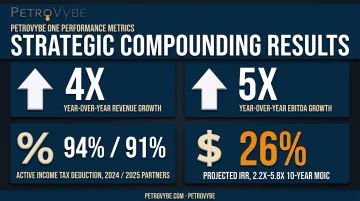
The company's own documented performance reflects this: 4x year-over-year revenue growth and 5x year-over-year EBITDA growth across recent projects, driven by cycling cash back into scaling output rather than distributing it all immediately.
What separates this from typical stock or savings-based compounding is the tax layer stacked on top:
- Partners who invested in 2024 received a 94% tax deduction against active income; 2025 partners received 91%.
- This deduction, built on the Intangible Drilling Cost provision, applies against W-2 income and capital gains, not just passive income, which is unusual compared to real estate.
- PetroVybe ONE projects a 10-year MOIC of roughly 2.2x to 5.8x and an IRR near 26%, alongside monthly passive distributions projected to exceed $10,000 during peak production.
For accredited investors sitting on a heavy tax bill and looking for compounding outside the usual stock-and-savings playbook, that combination (an upfront deduction plus a reinvestment-driven asset) is worth a closer look at petrovybe.com.
Frequently Asked Questions
What is a famous quote about compounding interest?
The most widely cited line is Einstein's "eighth wonder of the world" quote, though its origin traces to an unattributed 1925 ad, not Einstein himself. It remains popular because the message rings true regardless of authorship.
What did Charlie Munger say about compounding?
Munger's confirmed checklist wording is simply "never interrupt it unnecessarily," found in Poor Charlie's Almanack. His broader point: understanding compounding is easy, but staying consistent through it is genuinely hard.
What did Peter Lynch say about compounding?
Lynch used the Manhattan Indians analogy — a $24 sale in 1626 that, compounded at 8% for 362 years, would total nearly $30 trillion versus Manhattan's actual $28.1 billion assessed value today.
What did Albert Einstein say about compounding interest?
The popular version states that those who understand compound interest earn it, while those who don't end up paying it, a memorable framing of financial literacy rather than literal physics. No verified record confirms Einstein actually said it.
Why is compound interest called the eighth wonder of the world?
Because exponential growth, given enough time, produces results that feel almost impossible: a small sum turning into a fortune simply by sitting untouched and reinvested for decades.
How can I apply the power of compounding to my own investments?
Start as early as possible, reinvest returns instead of spending them, and avoid interrupting the process with early withdrawals. Consider income-producing alternative assets, such as oil and gas development partnerships, alongside traditional stocks and savings for added diversification.