

Investors who park everything in a broad index fund can miss outsized moves, like the AI-driven electricity demand now reshaping Energy and Utilities, while also sitting exposed when a single sector rolls over. This guide breaks down what sector investing actually is, the strategies professionals use, the risks worth respecting, and how to pick an approach that fits your goals, including options that go beyond public ETFs and stocks entirely.
Key Takeaways
- Sector investing focuses capital on specific GICS segments rather than spreading it evenly across the market
- Common strategies include sector rotation, thematic investing, tactical allocation, and growth-defensive blending
- Concentrated sector bets can lift returns but also raise volatility and timing risk
- Accredited investors can access private, tax-advantaged exposure to early-stage natural gas development unlike public ETFs
What Is Sector Investing?
Sector investing means allocating capital to a specific segment of the economy rather than spreading it across the market as a whole. The logic behind it: different sectors respond differently to the same economic conditions. Rising rates might squeeze Real Estate while barely denting Consumer Staples.
Most professional sector analysis runs through the Global Industry Classification Standard (GICS), jointly maintained by S&P and MSCI. It organizes public companies into a four-tier hierarchy: 11 sectors, 25 industry groups, 74 industries, and 163 sub-industries (S&P Global methodology, 2026).
Each company gets slotted into one sub-industry based on its principal business activity.
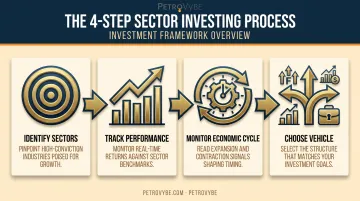
In practice, sector investing follows a simple sequence:
- Identify which sectors align with your thesis or outlook
- Track performance through sector indexes, ETFs, or direct holdings
- Monitor where each sector sits in the broader economic cycle
- Choose a vehicle — fund, individual stocks, or private placement
An investor who believes AI-driven data centers will strain the power grid might overweight Energy and Utilities today, betting that electricity demand growth outpaces what current generation capacity can handle.
The 11 GICS Sectors at a Glance
| Sector | What It Includes |
|---|---|
| Energy | Oil, gas, and fuel producers and equipment suppliers |
| Materials | Chemicals, mining, and raw industrial inputs |
| Industrials | Manufacturing, aerospace, transportation, and construction |
| Consumer Discretionary | Retail, autos, and non-essential goods |
| Consumer Staples | Food, beverages, and household necessities |
| Health Care | Pharmaceuticals, biotech, and medical services |
| Financials | Banks, insurers, and asset managers |
| Information Technology | Software, hardware, and semiconductors |
| Communication Services | Telecom, media, and internet platforms |
| Utilities | Electric, gas, and water providers |
| Real Estate | REITs and property management firms |
Why Investors Use Sector Investment Strategies
Sector investing offers a middle ground between owning a single stock and owning the entire market. You get targeted diversification across dozens of companies in one industry rather than betting your capital on one ticker, while still holding real conviction.
Sectors don't move in lockstep, and that gap in performance is measurable. Fidelity's 20-year data shows sector standard deviations ranging from 11% for Consumer Staples to 26% for Energy, against a 16% figure for the broader U.S. equity market. Sector risk profiles vary just as much as their returns.
Business cycles and secular trends create real opportunity, too. Communication Services posted year-over-year EPS growth of 96.3% in Q4 2023, 73.6% in Q1 2024, and 46.8% in Q2 2024, leading every other S&P 500 sector during the generative AI boom, according to S&P Global Market Intelligence data. Investors positioned early in that sector captured earnings growth other segments of the market simply didn't produce.
That said, tactical overweighting isn't a free lunch:
- Identifying the next outperforming sector requires discipline, not just conviction
- Being early or late by even a few quarters can erase the edge
- Outperformance in one cycle doesn't guarantee it repeats in the next
Top Sector Investment Strategies to Know
These approaches range from simple to sophisticated, and professionals rarely use just one. The right combination depends on your time horizon, risk tolerance, and how hands-on you want to be.
Sector Rotation
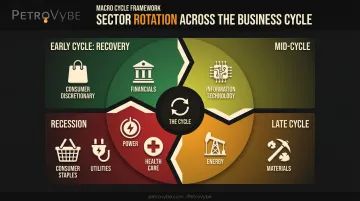
Sector rotation shifts capital between sectors based on where the economy sits in the business cycle:
- Early cycle/recovery — Consumer Discretionary and Financials tend to lead
- Mid-cycle — Information Technology has historically shown the strongest leadership
- Late cycle — Energy and Materials often take over as inflation and capacity constraints build
- Recession — Consumer Staples, Utilities, and Health Care typically hold up best
Here's the catch: a 2024 peer-reviewed study by Molchanov and Stangl tested conventional rotation over 1948–2021 and found it earned 10.4% annually versus 10.3% for the S&P 500, a statistically insignificant edge that flipped negative once a modest 0.1% per-trade cost was applied (International Journal of Finance and Economics). Rotation depends heavily on timing skill, and most investors don't reliably have it.
Thematic Investing
Thematic investing targets long-term secular trends, like AI adoption, the clean energy transition, or aging demographics, that cut across sectors rather than staying confined to one. Within a sector, you can narrow further: cybersecurity or AI infrastructure inside Technology, or renewable generation inside Energy and Utilities.
Top-Down and Bottom-Up Analysis
Top-down analysis starts with macro conditions, then narrows to sector, then company. Bottom-up starts with individual company fundamentals and builds up. Combining both strengthens conviction: macro tailwinds mean little if the companies inside a sector have weak balance sheets, and strong companies can still underperform in a sector facing structural headwinds.
Tactical Allocation
Tactical allocation means short-term, rules-based sector shifts in response to changing conditions, like a Fed announcement or an earnings surprise. It demands fast decisions, clear exit rules set in advance, and awareness that frequent trading racks up costs quickly.
Blending Growth and Defensive Sectors
Rather than rotating fully in and out, many investors hold both cyclical/growth sectors and defensive sectors (Utilities, Staples, Health Care) simultaneously, then rebalance periodically. This smooths returns without requiring the timing precision full rotation demands.
Direct, Private Investment Within a Sector
Public ETFs, mutual funds, and individual stocks aren't the only doors into a sector. Accredited investors can co-invest directly in private, development-stage projects, sidestepping daily public-market volatility and single-stock risk entirely.
Energy is a prime example. Natural gas already supplies nearly half of U.S. electricity generation, and demand is climbing as AI data centers strain the grid. Companies like PetroVybe offer accredited investors direct participation in early-stage natural gas development in South Texas and the Gulf Coast Basin, rather than shares in a company that already peaked years ago.
The structural difference matters:
- Public energy ETFs buy maturity : assets whose growth has already been priced in
- Private development projects offer entry-point exposure to the growth phase itself
- Intangible Drilling Cost (IDC) deductions on projects like PetroVybe ONE aren't restricted to passive income ; partners have received 91–94% deductions against active income, including W-2 wages and capital gains, a benefit public sector ETFs simply can't replicate
Risks of Sector Investing
Concentration risk is the most obvious. A downturn that barely dents a diversified portfolio can devastate a sector-only one. When Brent crude fell from $108 to $57 a barrel in 2014 (EIA data), the S&P 500 Energy sector's total return dropped 21.12% in 2015. Investors concentrated in energy stocks felt that collapse directly; diversified investors barely noticed.
Market timing risk is harder to see coming but just as real. Even professionals struggle to call sector entries and exits correctly — the same Molchanov and Stangl research cited above found gross rotation returns barely matched the market before costs, let alone after.
Policy and macro sensitivity hits sectors unevenly:
- Interest rate hikes can compress or expand bank net interest margins depending on the tightening episode
- Environmental regulations can raise operating costs for Energy producers overnight
- Geopolitical shocks tend to ripple through Financials and Energy faster than through Consumer Staples
Choosing the Right Sector Strategy and Vehicle for You
Match your approach to your time horizon. Active, tactical strategies suit investors who want to watch markets closely and act fast. Thematic or blended growth-defensive approaches suit those holding for years, not weeks.
| Vehicle | Best For | Trade-off |
|---|---|---|
| Public sector ETFs/mutual funds | Liquidity, low cost, easy entry/exit | Correlated to daily market swings |
| Individual sector stocks | Higher conviction, targeted bets | Single-company risk within the sector |
| Private/direct placements | Accredited investors seeking tax efficiency and lower public-market correlation | Illiquid, higher minimums, longer hold periods |
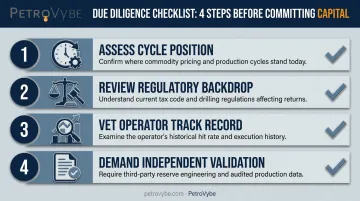
Before committing capital to any sector strategy, run through this checklist:
- Assess where the sector sits in its cycle: early, mid, late, or recession-adjacent phases each call for a different entry strategy
- Review the regulatory backdrop for pending rules or policy shifts that could hit the sector directly
- Vet the operator's track record on private deals. PetroVybe, for example, highlights its Chief Geophysicist's 75.2% career hit rate on profitable well locations, nearly double the industry peer average
- Demand independent validation: a $48 million third-party engineered reserve report, like the one backing PetroVybe's projects, carries more weight than internal projections alone
Frequently Asked Questions
What are the 4 types of sectors?
The broad economic classification splits activity into primary (raw materials), secondary (manufacturing), tertiary (services), and quaternary (knowledge work). This differs from the 11 GICS market sectors used for stock investing.
What are the four investment strategies?
There's no single authoritative source, but growth, value, income, and index/passive investing are commonly cited as core approaches. Sector investing can be layered onto any of them.
Does sector rotation actually work?
Evidence is mixed. Gross historical returns roughly matched the market, but once realistic trading costs were applied, rotation underperformed simpler buy-and-hold approaches in peer-reviewed research.
Is sector investing too risky for beginners?
Concentrated sector bets carry more volatility than broad index funds. Beginners should consider starting small or using diversified sector ETFs before making concentrated bets.
What's the difference between sector investing and thematic investing?
Sector investing follows the 11 fixed GICS categories. Thematic investing targets secular trends, like AI or clean energy, that often span multiple sectors at once.
Can I invest directly in the energy sector outside of the stock market?
Yes. Accredited investors can access private natural gas and oil development opportunities, such as those offered by PetroVybe, gaining entry-point exposure and tax advantages public ETFs don't provide.