

Since 1926, dividends have contributed roughly 31% of the S&P 500's total return, with the rest coming from capital appreciation, according to S&P Dow Jones Indices. That's nearly a third of the market's historical gains riding on how investors handle their payouts.
This article breaks down what reinvesting and taking cash actually mean, compares them side by side, and gives you a framework for deciding which path fits your situation. We'll also look at an alternative asset class offering a similar income-versus-growth tradeoff, with tax leverage public dividend stocks simply can't match.
Key Takeaways
- Reinvesting compounds returns automatically via DRIPs but concentrates risk in a single holding.
- Cash delivers liquidity now; it only builds wealth if you redeploy it elsewhere.
- Taxes stay identical either way; reinvesting only changes cost-basis tracking, not your bill.
- The right call hinges on time horizon, income needs, position size, and account type.
- Alternatives like natural gas development pair cash income with tax deductions dividend stocks can't match.
Reinvest vs. Cash: Quick Comparison
Here's the decision laid out at a glance before we cover the mechanics behind it:
| Factor | Reinvest | Take Cash |
|---|---|---|
| Growth Potential | Compounds through additional shares, increasing future dividend payouts | Capped to whatever you do with the cash next |
| Liquidity & Income | No immediate liquidity; income is locked into more shares | Full liquidity for expenses, debt paydown, or new investments |
| Tax Treatment | Same tax owed in the year received; adds cost-basis complexity | Same tax owed; simpler basis calculation |
| Risk & Concentration | Increases exposure to the same stock or sector over time | Allows rebalancing and diversification |
| Ideal Investor | Long time horizon, growth-focused, "set it and forget it" savers | Retirees or income-focused investors needing cash flow now |
Neither column is objectively better. The right pick depends on where you sit in that table right now, not where you might sit in ten years.
What Reinvesting and Taking Cash Really Mean
What It Means to Reinvest Dividends
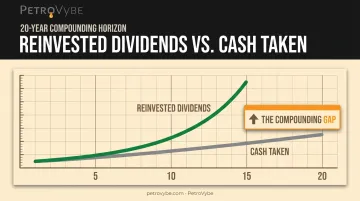
Reinvesting means your dividend proceeds automatically buy more shares (often fractional) of the same stock or fund, typically through a Dividend Reinvestment Plan, or DRIP. Instead of cash hitting your account, you end up holding a slightly larger position.
The appeal is the snowball effect. More shares generate a larger future payout, which buys even more shares next quarter. Over a long holding period, this compounding can meaningfully outpace a static position.
Not all DRIPs work the same way:
- Broker-facilitated DRIPs automatically purchase whole and fractional shares inside your existing brokerage account, with pricing and fees set by the broker, per Charles Schwab's DRIP documentation.
- Company-sponsored direct plans let you buy through the issuer or a plan administrator, and some offer optional cash purchases or modest purchase discounts.
- Tax treatment doesn't change based on plan type: reinvested dividends in a taxable account are still taxable income in the year they're paid, even though no cash ever reaches your pocket.
Reinvestment tends to fit younger investors with decades-long horizons, and it's a near-default choice for assets sitting inside tax-deferred retirement accounts, where there's no annual tax bill to worry about either way.
What It Means to Take Dividends as Cash
Taking cash means the dividend is deposited directly into your account and sits there, available to withdraw or redeploy however you choose. Nothing is automatically repurchased.
The benefit is flexibility. That cash can cover living expenses, pay down debt, or get reallocated into a completely different asset. Retirees supplementing Social Security or a pension often take dividends as cash for exactly this reason. So do investors trying to trim an overconcentrated position instead of adding to it.
One catch: uninvested cash often sits in a low-yield sweep account by default. Taking dividends as cash still requires an active decision about where that money goes next — left untouched, it can underperform for months without you noticing.
Which Is Better: Reinvest or Cash? A Decision Framework
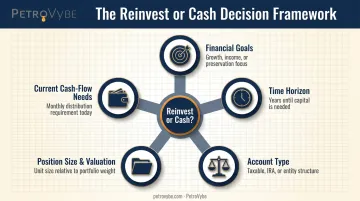
There's no universal answer here. The right call depends on a handful of factors you should weigh together, not in isolation:
- Financial goals: Are you optimizing for growth or for current income?
- Time horizon: How many years until you need this money?
- Account type: Taxable brokerage or tax-deferred IRA/401(k)?
- Position size and valuation: Is this holding already a large chunk of your portfolio, or trading above fair value?
- Current cash-flow needs: Do you need this income to live on today?
The decision often comes down to two scenarios:
| Choose Reinvestment When | Choose Cash When |
|---|---|
| You're 10+ years from needing the funds | You need current income now |
| You want hands-off compounding growth | You already hold a concentrated position in this stock |
| You don't want to manage redeployment decisions | Shares are trading above what you'd consider fair value |
The Tax Myth, Debunked
A lot of investors assume reinvesting dividends somehow defers or reduces their tax bill. It doesn't. In a taxable account, dividends are taxed as income in the year they're paid, whether you reinvest them or take the cash, according to IRS Publication 550.
Reinvesting only adds complexity: each purchase creates a new tax lot with its own cost basis, which you'll need to track when you eventually sell.
That said, many investors don't pick just one path. A common hybrid approach: reinvest dividends on core, long-term holdings while taking cash on positions that have grown too large or where the income is needed now. There's no rule saying every holding has to follow the same treatment.
Beyond the Stock Market: A Tax-Advantaged Alternative for Income and Growth
The reinvest-versus-cash dilemma isn't unique to public stocks. Accredited investors increasingly look at private alternative assets, such as oil and natural gas development, for a similar tradeoff, with meaningfully better tax treatment attached.
PetroVybe operates on a model that mirrors the dividend decision in structure, but not in tax consequence. Partners receive direct cash distributions from producing natural gas wells, functioning much like a dividend payout.
Meanwhile, the company reinvests a portion of cash flow into new wells and workovers, compounding production and asset value over the life of the project. PetroVybe targets a 10-year MOIC of roughly 2.2x to 5.8x and an IRR near 26%, based on its conservative-case financial modeling.
Where the Tax Edge Comes In
This is where the comparison to stock dividends breaks down. Natural gas development investments can generate Intangible Drilling Cost (IDC) deductions, permitted under 26 CFR 1.612-4, allowing operators to expense a large share of eligible drilling costs in the first year. Independent producers can often deduct up to 100% of eligible IDCs.
This deduction can offset active income, including W-2 earnings and capital gains, not just passive income. That's a fundamentally different tax posture than a dividend check, which is simply taxable income regardless of what you do with it. PetroVybe partners achieved 94% tax deductions in 2024 and 91% in 2025 against active income.
A few additional data points worth knowing:
- Chief Geophysicist Michael Stamatedes has recorded a 75.2% well-success rate, well above an industry peer average below 40%.
- An independent engineering firm valued PetroVybe's proved reserves at $48 million (PV-09).
- The company underwent a clean 2025 audit from independent auditor Weaver.

Participation requires accredited investor status and a $100,000 minimum investment. If you've been weighing reinvestment versus cash on your dividend portfolio, this income-and-growth structure offers a comparable choice with a tax advantage built in from year one. Talk with the PetroVybe team about how it could work alongside your existing holdings.
Conclusion
Neither reinvesting nor taking cash is universally the "better" choice. It depends on your goals, time horizon, and tax situation, not a one-size-fits-all rule. Long-term wealth builders tend to benefit from letting compounding run, while income-focused investors need the liquidity that cash distributions provide.
For those who want both, tax-advantaged income and long-term growth, private alternatives like PetroVybe's natural gas development partnerships are worth a closer look. Accredited investors can pair a 94% first-year tax deduction with monthly passive distributions, a combination stock dividends can't match.
Frequently Asked Questions
What does it mean to reinvest cash income?
Reinvesting means using dividend or interest payouts to automatically purchase more shares or units of the same investment, rather than withdrawing the cash. It typically happens through a DRIP or similar automated plan.
Is it better to reinvest dividends or cash them out?
It depends on your goals. Reinvesting suits long-term growth and compounding, while cashing out suits investors who need current income or want portfolio flexibility.
Do you pay tax on reinvested income?
Yes. In taxable accounts, dividends are taxed as income in the year received, regardless of whether they're reinvested or taken as cash. Reinvesting only affects your cost-basis tracking, not your tax bill.
How much money do I need to invest to make $10,000 a month in dividends?
At the S&P 500's roughly 1.1% dividend yield, generating $120,000 a year in dividends would require close to $10.9 million invested, before taxes and fees. Alternative income-generating assets can require very different capital thresholds for similar monthly cash flow.
What is a Dividend Reinvestment Plan (DRIP) and how does it work?
A DRIP automatically converts your dividend payouts into additional shares, often fractional, of the same stock or fund, usually at no extra transaction cost.
Are there alternative investments that offer passive income with greater tax advantages than dividend stocks?
Yes. Private asset classes such as oil and natural gas development can pair cash distributions with substantial upfront tax deductions against active income, an advantage direct dividend stock ownership typically lacks.