Introduction
Ask ten people what "oil and gas solutions" means, and most will describe drilling rigs, pipeline maintenance, or software that tracks well pressure. They're not wrong, just incomplete.
The industry now spans exploration technology, water management, digital automation, and direct capital participation. Most searches miss that last piece: structured investment vehicles letting accredited investors own a piece of gas development, not just buy services around it.
This guide breaks down what oil and gas solutions actually cover, from wellhead to market. It also explains how capital and tax-focused models, like the one PetroVybe runs in South Texas, fit into a category most people never knew existed.
Key Takeaways
- Solutions span operational tools like engineering and water treatment, plus financial structures like direct investment
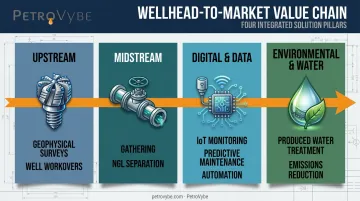
- The value chain spans upstream, midstream, digital, and environmental categories, each with distinct providers
- Accredited investors can access natural gas development directly, often with major first-year tax deductions
- Vet any provider by checking licensing, track record, and independent third-party validation
What Are Oil and Gas Solutions?
Oil and gas solutions are the products, technologies, services, and financing structures that support exploration, production, transport, processing, and increasingly, ownership of energy assets. That last word matters. Ownership structures have joined the conversation alongside pumps and pipelines.
Two broad buckets cover the space. Operational solutions include software, engineering services, field equipment, and technical expertise that keep physical operations running. Capital solutions cover funding structures, tax strategies, and partnership models that finance development and share in its economics.
Rystad Energy forecast that the global market for oil-and-gas contractors would peak at $1 trillion in 2025, a scale that reflects just how much economic activity sits around drilling and production.
Why Demand Is Shifting Right Now
Electricity demand from AI data centers is reshaping the conversation. The IEA projects gas-fired generation serving U.S. data centers will grow by more than 130 TWh by 2030, as natural gas supplies over 40% of that power today. That surge is pulling new capital toward gas development, not just toward turbines and transmission lines.
Solutions providers today range widely:
- Software vendors building predictive maintenance platforms
- Engineering firms handling geophysical surveys and completions
- Private development companies offering investors direct working-interest participation
That third category is where things get interesting, and it's the one most articles skip entirely.
Types of Oil and Gas Solutions Across the Value Chain
Upstream Exploration & Production Solutions
Upstream work covers exploration, extraction, and production, according to EPA's sector definitions. Geophysical and geological solutions locate reserves and reduce dry-hole risk before a single dollar goes into drilling.
Experienced geoscience teams outperform averages substantially. PetroVybe's Chief Geophysicist, Michael Stamatedes, carries a 75.2% well-success rate across a 48-year career, nearly double the industry peer average sitting below 40%. That gap between skilled prospect evaluation and average outcomes is the entire argument for paying attention to who's picking well locations.
Beyond exploration, workover and optimization solutions extend the life of producing wells. Enhanced recovery techniques squeeze more value from assets that have already proven themselves, which is often cheaper and less risky than drilling new holes.
Midstream Transport & Processing Solutions
Once oil and gas leave the wellhead, midstream infrastructure takes over the job of getting them to market. This stage covers gathering, storing, and transporting product between the wellhead and later markets, including pipeline networks, gathering systems, and NGL separation facilities.
Liquids-focused midstream infrastructure matters because natural gas liquids and oil command premium pricing over dry gas alone. Getting NGLs separated and to market efficiently is often the difference between a marginal well and a genuinely profitable one.
Digital & Data Solutions
Moving product efficiently is only half the equation; operators also need visibility into how every asset performs. Three technology categories now handle much of that work:
- IoT sensors for remote asset monitoring
- AI models for predictive maintenance
- Automation tools for production optimization
Adoption, though, is far behind the hype.
DNV's 2024 survey of nearly 1,300 senior energy professionals found that only 15% of oil-and-gas respondents had AI in live operations, with just 3% running highly integrated or advanced applications.
Meanwhile, 47% expected to deploy AI-driven tools within the year. Plans are running well ahead of actual implementation, which tells you where the real opportunity, and the real risk, sits.
Environmental & Water Management Solutions
Beyond digital tools, environmental performance has become just as central to project economics. Produced water management and emissions reduction have shifted from optional to standard practice: EPA's 2023 methane rule was projected to prevent 58 million short tons of methane emissions from 2024 through 2038, nearly 80% of what covered sources would otherwise emit.
NGLs also play a growing role as a cleaner-burning alternative. EIA data shows natural gas produces 52.91 kg of CO2 per million Btu compared to propane's 62.88 kg, both well below distillate fuel oil's 74.14 kg. That's a fuel-specific comparison, not a blanket claim, but it explains why liquids-rich gas plays are drawing environmental interest alongside financial interest.
Investment Solutions: The Overlooked Category of Oil and Gas Solutions
Here's the piece most "oil and gas solutions" content skips entirely: capital structures that let accredited investors participate directly in development economics, not just buy services around it.
Direct working-interest investment differs fundamentally from stocks, ETFs, or royalty trusts. Each structure puts you at a different distance from the underlying asset:
- A stock gives you exposure through a company's balance sheet
- An ETF spreads exposure across a portfolio
- A royalty trust holds a nonoperating interest
- A working interest puts you at the entry point where value is created, sharing in both the costs and the upside of the wells themselves
The Tax Angle Nobody Talks About Enough
Intangible Drilling Cost (IDC) deductions let investors expense qualifying drilling and development costs, and under IRS Publication 925, a working interest held without limited liability isn't automatically treated as a passive activity. That means the deduction can offset active income, including W-2 wages and capital gains, not just passive income the way most real estate deductions work.
PetroVybe's documented figures show this in practice:
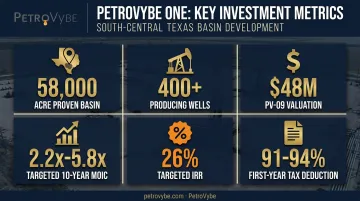
- 94% first-year tax deduction against active income for 2024 partners
- 91% first-year tax deduction against active income for 2025 partners
- A sample $600,000 capital contribution generating roughly $401,772 in first-year deductions
PetroVybe as a Real-World Example
PetroVybe is a private, Texas-based natural gas development company operating across South Texas and the Gulf Coast Basin, centered in Lavaca County. It offers accredited investors direct access to early-stage gas assets rather than just a services contract or a stock ticker.
The numbers behind it:
- 58,000-acre proven basin with roughly 400 producing wells and 57+ planned new wells
- $48 million PV-09 reserve valuation, independently verified by a licensed third-party engineering firm
- Targeted 10-year MOIC of 2.2x to 5.8x with roughly 26% IRR
- Monthly passive distributions projected to peak above $10,000 during peak production
Leadership backs these numbers with a track record across prior ventures:
- CEO Peter Snell led a 5x year-over-year EBITDAX increase in a prior turnaround
- President Blaine Yeary scaled a $5 billion asset from zero to 35,000 BOEPD over eight years
- CFO Clayton Riddle drove a 9x EBITDAX increase and grew EBITDA by 900% at a previous company
The firm also holds a 5.0 rating across 8 verified reviews on Invest Clearly, an independent platform for accredited investor due diligence.
Who This Fits
That combination of track record and asset backing makes this solution fit specific investor profiles:
- High-income W-2 earners or business owners carrying a heavy active tax burden
- Investors with $100,000+ in accessible liquidity, deployable within 7-21 days
- Those seeking diversification beyond stocks, bonds, and real estate
- Long-term wealth builders comfortable with a 2-3 year runway before first distributions
Key Benefits of Modern Oil and Gas Solutions
Modern solutions deliver value across three distinct dimensions:
Operational efficiency. Predictive maintenance and automated inspections cut unplanned downtime and reduce manual monitoring costs. PetroVybe's VP of Asset Intelligence, Luke McIntosh, applies this kind of data-driven oversight to existing wells. The result: 33% EBITDAX-positive operations, a figure that exceeded the company's most recent quarterly plan by the same margin.
Risk mitigation. Experienced technical teams and independent validation reduce guesswork. Chief Geophysicist Michael Stamatedes, whose 75.2% success rate nearly doubles the industry average, combined with third-party PV-09 engineering reviews, gives investors and operators alike a clearer picture of what they're actually funding.
Financial upside. For investors specifically:
- Reduces tax liability through IDC deductions applied against active income
- Generates passive income once production ramps
- Diversifies portfolios into a tangible, cash-flowing asset class
None of these benefits are guaranteed. Commodity prices swing, drilling outcomes vary, and forecasts remain forecasts. But the mechanisms behind them are documented and verifiable, which separates a real solution from a sales pitch.
How to Choose the Right Oil and Gas Solutions Partner
The vetting process differs depending on what you're buying: a service contract or an ownership stake.
For operators evaluating tech or service vendors:
- Confirm domain expertise specific to your asset type and geology
- Check that data integration works with your existing systems, not around them
- Ask for references from projects similar in scale and geography
For investors evaluating development partners:
- Demand transparency in reporting, including regular updates and audited financials
- Confirm independent engineering reviews exist for reserve valuations
- Look for verified investor reviews on third-party platforms, not testimonials on a company's own site
- Assess whether leadership's actions match its stated values, such as accountability and stewardship
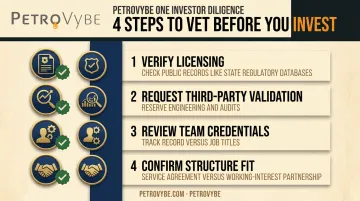
Before committing capital or signing a contract, run this checklist:
- Verify licensing through public records, such as a Texas Railroad Commission P-5 Organization Report for operators in Texas
- Request third-party validation, including reserve engineering and independent audits
- Review team credentials against actual track records, not just job titles
- Confirm structure matches your goals, whether that's a service agreement or a working-interest partnership
PetroVybe's operating entity, PetroVybe OpCo LLC, holds its operator standing through the Texas Railroad Commission, with well records publicly searchable via the Texas Railroad Commission's database. That kind of independently checkable detail is exactly what separates a legitimate solutions partner from a pitch deck.
Frequently Asked Questions
What are oil and gas services?
Oil and gas services are the products and processes that support exploration, transport, and processing of energy assets. They're typically delivered by specialized providers under contract, covering everything from geological surveying to production optimization.
What is an example of a gas solution?
Examples include NGL separation technology, predictive maintenance software for remote wells, and direct investment structures like working-interest partnerships in natural gas development.
What is the difference between upstream, midstream, and downstream solutions?
Upstream covers exploration and production, midstream handles gathering and transport between production and markets, and downstream covers refining, marketing, and distribution to end users.
Can accredited investors invest directly in oil and gas development?
Yes, through working-interest participation in a development project. PetroVybe's model lets accredited investors with $100,000+ in liquidity own a direct stake in gas assets across South Texas and the Gulf Coast Basin.
What tax benefits come with oil and gas investment solutions?
Intangible Drilling Cost deductions can offset active income, including W-2 wages and capital gains. PetroVybe partners saw 94% first-year deductions in 2024 and 91% in 2025.
How do digital technologies improve oil and gas operations?
Predictive maintenance and remote monitoring reduce downtime and catch issues before they become costly failures. Adoption is still early, with DNV reporting only 15% of operators running live AI applications as of 2024.