Introduction
The top 10% of U.S. households now hold 67.5% of all household wealth, while the bottom half holds just 2.5%, according to Federal Reserve distributional data through Q4 2024. The top 1% alone controls 31%.
If you're a high earner and still feel like you're treading water, you're not imagining it. Taxes eat into your paycheck, inflation erodes your savings, and asset prices keep climbing out of reach for anyone starting from scratch.
This article breaks down the real difference between wealth creation and wealth distribution, then walks through the seven stages of building wealth that actually compounds. It also covers modern strategies, including alternative assets, that high-income earners are using to get ahead.
Key Takeaways
- Wealth creation builds new value; wealth distribution allocates what already exists
- Three decades of rising U.S. wealth concentration have weakened old wealth-building strategies
- Sustainable wealth building follows seven stages, from foundation to legacy transfer
- Tax-advantaged alternative assets now drive accelerated wealth building for high earners
What Is Wealth Creation and Distribution?
Wealth creation is the process of generating new value (through income, business ownership, and compounding investment returns) rather than simply earning a paycheck. Wealth distribution, by contrast, describes how existing wealth is already spread across a population.
Understanding both concepts matters because they operate on different rules. One is about production. The other is about ownership.
Wealth Creation Explained
Wealth creation happens through three core mechanisms:
- Earned income: Wages and salary, the starting point for most people
- Business ownership: Building equity in a company you control
- Investment compounding: Reinvesting returns so growth builds on itself
Entrepreneurship carries outsized weight in this equation. Historical U.S. data found that entrepreneurs made up just 7.6% of the population but owned 33% of total wealth, according to UNU-WIDER research. Among the top 1% of wealth holders, 81% were entrepreneurs.
That data comes from 1989, so treat it as a historical pattern rather than a current guarantee. Still, it illustrates a persistent truth: ownership, not just income, drives wealth creation.
Wealth Distribution Explained
Wealth is calculated simply: assets minus liabilities. It measures what you own after debts are subtracted, not what flows into your bank account each month.
That distinction matters because wealth distribution today is deeply skewed. The top 10% hold 67.5% of U.S. household wealth, while the bottom 50% hold just 2.5%, a gap of roughly 12.5 to 1.
Economists often use the Gini coefficient to measure this, a scale from 0 (perfect equality) to 100 (total concentration). UBS assigned the United States a wealth Gini of 75 in its 2023 data, higher than Germany, the UK, France, Italy, and Japan. That makes the U.S. the most wealth-unequal country among reported G7 peers.
Here's the part people miss: wealth inequality runs far deeper than income inequality. Equitable Growth reported that the top 10% received 23% of income in 2016, but held 70% of wealth in 2018. Different years, different datasets, but the direction is unmistakable: owning assets compounds unevenly in a way that earning a paycheck simply doesn't.
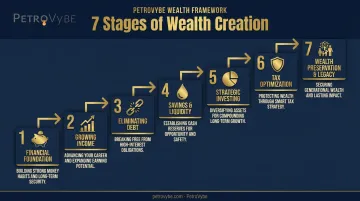
The 7 Stages of Wealth Creation
Wealth creation is a multi-stage progression, and skipping stages tends to backfire. Each one builds the foundation the next stage depends on.
Stage 1: Building a Financial Foundation
This starts with financial literacy and budgeting discipline, not investment picks. Research links financial literacy to an 8.1 to 8.4 percentage-point higher likelihood of holding three months of liquid savings. The mindset shift, treating money as a tool for building rather than just spending, comes before anything else.
Stage 2: Growing Income and Career Capital
Every wealth strategy needs fuel. That means maximizing earned income through career growth, new skills, or side income streams. This is the stage where you generate the initial capital that later stages will put to work.
Stage 3: Eliminating High-Interest Debt
Debt service drains capital that should be going toward investments. Nearly 37% of all U.S. adults carried a credit card balance at least once in 2024. Paying down high-interest debt first is a prerequisite for compounding to work in your favor instead of against you.
Stage 4: Establishing Savings and Liquidity
An emergency fund protects everything you've built so far. In 2024, 63% of U.S. adults could cover a $400 emergency expense with cash on hand. Liquid reserves keep a single unexpected bill from derailing years of progress.
Stage 5: Strategic Investing and Diversification
Once the foundation holds, it's time to move beyond a single asset class. Relying only on stocks, or only on real estate, concentrates risk in one market's cycle. True diversification spreads exposure across:
- Public equities and bonds
- Real estate
- Private and alternative assets
- Cash-flowing business interests
Stage 6: Tax Optimization and Asset Protection
As a portfolio grows, tax drag becomes one of the biggest threats to long-term returns. This is where specialized vehicles start to matter, including upstream energy deductions tied to oil and gas development. These structures can materially shift after-tax outcomes for high earners in ways standard brokerage accounts can't.
Stage 7: Wealth Preservation and Legacy Transfer
The final stage shifts the focus from accumulation to protection. Estate planning, trusts, and structured wealth transfer ensure what you've built survives beyond your own lifetime and reaches the next generation intact.
How Wealth Distribution Looks Today
Generational wealth gaps compound this picture further. Federal Reserve data groups households by birth year:
- Baby Boomers (1946–1964)
- Gen X (1965–1980)
- Millennials (1981 and later, capturing Gen Z as well)
This data consistently shows older generations holding a disproportionate share of total household wealth relative to their population size.
This isn't a uniquely American problem. Globally, the top 1% held 44.5% of global household wealth in 2022, per UBS data, a share that dipped slightly from prior years but remains historically high.
What this means for newer wealth builders: asset appreciation and inheritance are increasingly what drives concentration at the top, not simply working harder. That reality demands a different approach than what worked for prior generations: owning appreciating assets early, not waiting to inherit them.
Building Sustainable Growth: Modern Strategies for Wealth Creation
Diversifying beyond traditional stocks, bonds, and real estate has become less of an option and more of a necessity. Alternative asset classes offer a hedge against inflation and reduce the correlation risk that comes from having everything tied to the same market cycle.
Tax efficiency matters just as much. For high-income W-2 earners and capital gains holders, after-tax returns — not gross returns — determine actual wealth growth. A 10% return taxed at 37% behaves very differently from a 10% return sheltered by legitimate deductions.
Passive income adds a third dimension: assets that generate cash flow without consuming your time let wealth compound independently of your career.
Where PetroVybe Fits Into This Strategy
Direct-access alternative investments meet all three of these criteria at once. PetroVybe, a Texas-based natural gas development company, offers accredited investors direct equity in upstream energy projects through limited partnership units.
The core mechanism is the Intangible Drilling Cost (IDC) deduction. IDCs typically represent 60–80% of total invested capital in a new drilling project, and PetroVybe's structure projects roughly 70% of invested capital as a first-year deduction against active income, including W-2 wages.
Combined with depletion allowances and depreciation on tangible assets, PetroVybe partners have realized 94% total deductions in 2024 and 91% in 2025 against active income.
A few things worth checking before committing capital to any operator:
- Independent engineering reports: PetroVybe's reserves carry a $48 million valuation, verified by a licensed third-party engineering firm
- Verified investor reviews: The company holds a 5.0 rating across 8 verified reviews on Invest Clearly, an independent platform for sponsor track records
- Documented growth: PetroVybe has posted 4X year-over-year revenue growth and 5X EBITDA growth, driven by reinvesting cash flow into new development rather than distributing it all immediately
That last point illustrates the compounding principle directly. Reinvesting cash flow into new wells, rather than pulling it out, is how a development portfolio scales from a handful of projects into hundreds of producing wells.

Why Natural Gas Development Is Emerging as a Wealth-Building Asset
AI data centers are reshaping electricity demand faster than most grid planners anticipated. McKinsey projects U.S. data center electricity use jumping from 147 TWh in 2023 to 606 TWh by 2030, moving from 3.7% to nearly 11.7% of total U.S. power demand. That figure comes from McKinsey's analysis of data center capacity growth.
Natural gas is projected to supply the largest share of that additional load through 2030.
That structural shift creates real upstream development opportunity for investors positioned early, not years from now once the demand curve has already flattened.
Beyond the growth trajectory, the investment structure itself carries a built-in edge: **IDC deductions can offset active income**, including W-2 wages, a benefit that doesn't extend to most real estate or passive-only strategies, which are typically confined to offsetting passive income under IRS rules.
PetroVybe's projects channel that advantage directly. Its operations are concentrated in South Texas and the Gulf Coast Basin, with its flagship PetroVybe ONE project based in Lavaca County. The offering is structured for accredited investors with $100,000 or more in liquidity seeking:
- Diversification beyond stocks, bonds, and traditional real estate
- Meaningful tax offset against active income
- Long-term passive income and legacy wealth building
Frequently Asked Questions
What is wealth creation and distribution?
Wealth creation is generating new economic value through income, business ownership, and compounding investments. Wealth distribution describes how existing wealth is already spread across a population.
What are the 7 stages of wealth creation?
The stages are: building a financial foundation, growing income, eliminating high-interest debt, establishing savings, strategic investing, tax optimization, and wealth preservation and legacy transfer.
What is the difference between wealth creation and wealth distribution?
Creation actively builds new value through work, investment, or business growth. Distribution simply reflects how groups currently hold existing wealth, regardless of how it was earned.
How can I build sustainable wealth in today's economy?
Focus on diversification beyond traditional assets, tax-efficient investing, and passive income streams that compound independent of your day job. Consistency across each of these areas is what compounds results over time.
What are examples of alternative investments for building wealth?
Common examples include private real estate, private equity, and energy development such as natural gas projects. These sit outside traditional public market correlation.
Why is tax planning important for wealth creation?
After-tax returns, not gross returns, determine real wealth growth. High-income earners face steep tax burdens, and deductions like Intangible Drilling Costs (IDCs) in energy investments can offset up to 90% of that liability.