
This surprises more business owners than you'd think. Interest income doesn't get the favorable treatment many people expect. It stacks directly on top of your operating income and pushes your total tax bill higher, dollar for dollar.
This guide breaks down how interest income is classified, how it's taxed under current US corporate tax rules, where it gets reported, and what strategic deductions, including some outside the usual playbook, can help offset the added burden.
Key Takeaways
- Interest income is ordinary income, taxed at the flat 21% federal rate with no exceptions.
- Common sources include bank accounts, shareholder loans, bonds, and late-payment charges.
- State income taxes can stack on top of the federal bill, and rules vary by state.
- With no built-in shelter, many owners offset interest income using deductions like oil and gas development interests.
What Counts as Interest Income for a Corporation?
Any interest a company earns as a lender or from holding interest-bearing assets counts as taxable income. It must be recognized in the year it's received or accrued, depending on your accounting method.
Common sources of corporate interest income:
- Interest from business bank accounts and money market funds
- Loan interest charged to shareholders, employees, or subsidiaries
- Interest earned on bonds or Treasury securities held by the company
- Late-payment or finance charges billed on outstanding receivables
Intercompany and Shareholder Loans
When a corporation lends money to a related party, the IRS doesn't let you charge zero interest and walk away. Under IRC Section 7872, below-market loans between a corporation and a shareholder trigger imputed interest rules. The company must use a rate tied to the Applicable Federal Rate (AFR), published monthly, or the IRS will treat forgone interest as if it were paid and re-loaned back.
The AFR varies by term (short-term, mid-term, or long-term), so the loan's maturity determines which published rate applies. Skip it, and the IRS may treat the shortfall as a taxable dividend or additional compensation, depending on the borrower's relationship to the company.
Trade Interest vs. Incidental Interest
There's a meaningful difference between a bank or lending business (where interest is the core operating income) and an ordinary operating company that happens to earn interest on idle cash. For most businesses reading this, interest is incidental, not their trade. But incidental doesn't mean untaxed. It still lands on the return as gross income, just categorized separately from operating revenue.
So how does an ordinary company end up with interest income? Usually through idle cash in a reserve account, a related-party financing arrangement, or investment holdings like bonds bought with surplus capital.
How Is Interest Income Taxed for Corporations?
Here's the direct answer: yes, you pay corporation tax on interest income, and it's taxed the same as any other business income. Under IRC Section 11, C corporations pay a flat 21% federal rate on all taxable income. There's no reduced bracket, no capital-gains-style treatment, and no exemption carved out for interest specifically.
The 2025 Form 1120 instructions confirm that taxable interest gets reported on page 1, line 5, and flows directly into the taxable income calculation subject to that 21% rate. Interest expense cannot be netted against interest income on the return; they're reported as separate line items.
State-Level Treatment Varies Widely
Federal tax is only part of the equation. Most states levy their own corporate income tax on top of the federal 21%, and the rules aren't uniform.
Texas is a useful example of how different state treatment can look. The state has no corporate income tax, but it does impose a franchise tax based on taxable margin, according to the Texas Comptroller's franchise tax page:
- Retail and wholesale businesses: 0.375% franchise tax rate
- Other businesses: 0.75% franchise tax rate
- No-tax-due threshold: around $2.65 million in total revenue; entities below this file an information return only
Because these thresholds and rates shift periodically, verify current figures for your specific state before filing.
Pass-Through Entities Work Differently
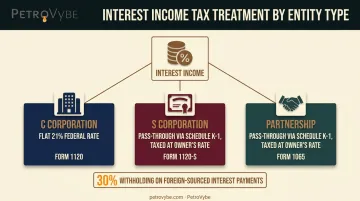
S corporations and partnerships don't pay entity-level tax on interest income. Instead, it flows through to the owners' personal returns via Schedule K-1 and gets taxed at each owner's individual rate. A shareholder in the 32% bracket pays 32% on their share of that interest, not 21%. If you hold units in an oil and gas partnership like PetroVybe, this same K-1 pass-through structure applies to any interest income the partnership earns.
Foreign Lenders and Cross-Border Interest
If your company pays interest to a foreign lender, or receives interest from a foreign source, withholding rules can apply. US-source interest paid to foreign persons is generally subject to 30% withholding unless a treaty or statutory exemption applies. This is a narrow slice of most domestic businesses' concerns, but worth flagging if you have any cross-border lending arrangements.
Interest Income vs. Dividends and Capital Gains: Key Tax Differences
This is where a lot of confusion sets in. Business owners often assume interest gets grouped with dividends or capital gains for tax purposes. It doesn't, and the gap matters.
Dividends received from another domestic corporation may qualify for a Dividends Received Deduction (DRD). Depending on ownership percentage, a corporation can deduct 50% or 65% of qualifying dividends before calculating tax, effectively shrinking the taxable portion. Interest income gets no equivalent deduction. Every dollar is taxable.
Capital gains for C corporations don't get the same break individuals enjoy either. The old preferential capital-gains rate for corporations was repealed years ago. C corporation capital gains are taxed at the same flat 21% rate as ordinary income. The real planning question centers on which deductions and structures are available, not on rate differences.
Here's a quick comparison:
| Income Type | Taxable Amount | Available Deduction | Reporting Form |
|---|---|---|---|
| Interest income | 100% of amount received | None | Form 1120, line 5 |
| Dividends (domestic, <20% ownership) | Reduced by DRD | 50% deduction | Form 1120, Schedule C |
| Dividends (domestic, ≥20% ownership) | Reduced by DRD | 65% deduction | Form 1120, Schedule C |
| Capital gains | 100% of gain | None (corporate) | Form 1120, Schedule D |
The takeaway: interest income stands alone as the least tax-advantaged category of investment income a corporation can earn.
Reporting Interest Income on Your Corporate Tax Return
For C corporations, taxable interest goes on Form 1120, page 1, line 5. That figure needs to match your books, so accurate categorization from bookkeeping through filing matters more than it seems at first glance. Misclassifying interest as some other type of income (or missing accrued interest entirely) creates reconciliation headaches down the line.
Pass-through entities report it differently:
- S corporations: ordinary-course interest on page 1, line 5; portfolio interest separately on Schedule K, line 4, and Schedule K-1, box 4
- Partnerships: portfolio interest on Schedule K, line 5a, and Schedule K-1, box 5
The 1099-INT Reconciliation Problem
A payer generally issues Form 1099-INT for any payment of $10 or more in reportable interest. Here's the catch: payments to corporations are typically exempt from 1099-INT reporting, with limited exceptions. That means the absence of a 1099-INT doesn't mean you have no taxable interest.
For example, a corporation earning $18,000 from a business money market account may never receive a 1099-INT, yet that income remains fully taxable. Your company still needs to track and report interest under its accounting method, whether or not a form shows up. Under the accrual method, interest counts as it's earned, not when it's received, so year-end accruals deserve the same attention as cash receipts.
Estimated Tax Adjustments
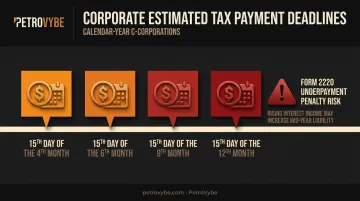
Extra interest income can push a corporation's expected tax liability past the $500 threshold that triggers mandatory estimated tax payments. Calendar-year corporations generally pay by the 15th day of the 4th, 6th, 9th, and 12th months.
Say a corporation projects $40,000 in annual tax liability, then receives an unexpected $150,000 interest payment in the third quarter. That windfall can make earlier quarterly estimates look understated once the full year closes. If you don't adjust your remaining estimates to account for it, you risk an underpayment penalty calculated on Form 2220, even when the original estimates were reasonable at the time they were filed.
Reducing Your Corporate Tax Burden Beyond Interest Income
Since interest income carries no built-in shelter, the real opportunity lies elsewhere on the return. Businesses and high-income individuals with interest-heavy portfolios typically look for deductions that offset the added exposure rather than trying to change how the interest itself is taxed.
Standard offsets worth maximizing first:
- Depreciation and bonus depreciation on qualifying property
- Section 179 expensing (capped at $2.56 million for tax years beginning in 2026, phasing out above $4.09 million in purchases)
- Ordinary business expense deductions that reduce taxable income dollar-for-dollar
These are useful, but capped. For interest-heavy portfolios generating substantial taxable income each year, standard deductions often don't move the needle enough on their own.
Direct-Participation Oil and Gas Programs
One asset class with outsized deduction potential is direct-participation natural gas and oil development. Under Section 263(c), an operator holding a working interest can elect to deduct Intangible Drilling Costs (IDCs), meaning labor, fuel, and supplies used to drill and prepare a well, rather than capitalizing them over time.
What makes this structure distinct from most other passive investments: under Section 469(c)(3), a working interest held without limited liability isn't treated as a passive activity.
That means qualifying IDC deductions can offset active income, including W-2 wages, capital gains, and yes, interest income, not just passive income the way most real estate deductions are restricted.
PetroVybe, a natural gas development company operating in Lavaca County, Texas within the Gulf Coast Basin, structures its flagship program, PetroVybe ONE, around this exact mechanism. Investors participate as limited partners through a private placement offered under SEC Regulation D 506(c), restricted to accredited investors with $100,000 in minimum liquidity.
Because the deduction flows through via K-1, partners have used it to offset active income directly:
- 2024 partners realized a 94% tax deduction against active income
- 2025 partners realized a 91% tax deduction against active income

For someone sitting on a large interest income position with no shelter, a single well-structured allocation into a program like this can meaningfully reduce the tax hit in the same year it's earned.
Tax outcomes vary based on individual circumstances, income mix, and entity structure. Speak with a qualified CPA or tax advisor before acting on any strategy discussed here.
Frequently Asked Questions
Do you pay corporation tax on interest income?
Yes. Interest income earned by a corporation is fully taxable as ordinary income at the applicable corporate rate. There's no exemption or reduced bracket for it.
How does a company have interest income?
Most commonly through interest earned on cash reserves, loans made to shareholders or affiliates, bonds held as investments, or finance charges applied to overdue customer receivables.
Is interest income taxed differently than dividend income for corporations?
Yes. Dividends from other domestic corporations may qualify for a 50% or 65% Dividends Received Deduction. Interest income gets no such deduction and is fully taxable.
Do S corporations pay tax on interest income differently than C corporations?
Yes. S corporation interest income passes through to shareholders' personal returns via Schedule K-1 rather than being taxed at the entity level like a C corporation.
Can a business deduct interest expense against interest income?
Interest expense and interest income are reported separately, not netted. Larger businesses may also face limits on deducting interest expense under Section 163(j), generally capped at 30% of adjusted taxable income plus business interest income.
What tax form reports corporate interest income?
C corporations report it on Form 1120, page 1, line 5. Pass-through entities report it on their respective return (1120-S or 1065) with the owner's share passed through on a Schedule K-1.