
This is why cash reserves matter more than net worth alone, for individuals and businesses alike. A cash reserve is money set aside specifically for emergencies or short-term needs, kept separate from long-term investments.
The scale of this practice today is enormous. As of Q1 2026, U.S. households and nonprofits held $20.6 trillion in deposits and money market funds, according to the Federal Reserve's Financial Accounts release. This article breaks down what cash reserves are, how much you actually need, and where excess capital should go once your reserve is built.
Key Takeaways
- Cash reserves are liquid funds set aside for emergencies, not for growth investing
- Most households need 3-6 months of expenses; retirees and variable-income earners often need more
- Idle cash loses purchasing power to inflation and forfeits better returns elsewhere
- Once your reserve is funded, put extra capital into diversified, tax-efficient assets
What Are Cash Reserves?
A cash reserve is liquid money held by an individual or business to cover emergencies, short-term obligations, or unexpected opportunities. This money is earmarked for access, not growth.
The Consumer Financial Protection Bureau defines an emergency fund as "a cash reserve that's specifically set aside for unplanned expenses or financial emergencies," including medical bills, repairs, or income loss. That definition captures the personal-finance side well, but reserves show up in three practical forms:
- Cash on hand or bank deposits — checking and savings balances you can tap immediately
- Short-term investments — Treasury bills, money market funds, or short-duration CDs
- Other easily liquidated assets — instruments that convert to cash within days without losing value
Not every liquid asset qualifies as a cash reserve, though — all cash reserves are liquid assets, but the reverse isn't true. A liquid asset broadly means anything convertible to cash without much loss in value. A cash reserve is narrower: it's money deliberately parked for a specific defensive or opportunistic purpose.
For businesses, this distinction has an accounting dimension. Unrestricted cash and qualifying cash equivalents typically appear as current assets on the balance sheet, provided they meet the maturity and liquidity tests under standard accounting rules. Cash that's restricted for a future purpose, like a planned equipment purchase or a debt covenant, generally doesn't count in that current-asset bucket.
Cash Reserves for Individuals vs. Businesses
The purpose overlaps, but the triggers differ:
Individuals typically draw on reserves for:
- Job loss or reduced hours
- Medical emergencies not fully covered by insurance
- Home or auto repairs
Businesses typically draw on reserves for:
- Revenue dips during slow seasons
- Maintaining payroll through a rough quarter
- Jumping on a bulk-purchase discount or acquisition opportunity before financing comes through
Same principle. Different scoreboard.
How Much Cash Reserve Do You Need?
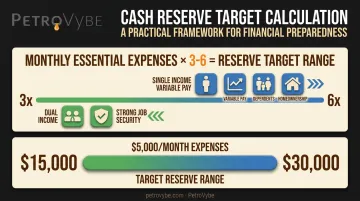
The standard guideline is 3-6 months of essential expenses. The math is simple: take your monthly essential spending (housing, utilities, groceries, insurance, minimum debt payments) and multiply by 3 to 6, depending on your risk profile.
Several factors push that number higher or lower:
- Single income vs. dual income — one earner means one point of failure, favoring the higher end
- Job specialization — a niche role often takes longer to replace than a generalist position
- Variable or commission income — irregular paychecks demand a bigger cushion
- Dependents — more mouths to feed means less room for error
- Homeownership — repairs and maintenance add unpredictable costs
Worked example: A household with $5,000 in monthly essential expenses would target a reserve between $15,000 and $30,000. A single-income household with kids and a mortgage should lean toward the top of that range; a dual-income household with strong job security might comfortably sit at the bottom.
Cash Reserves in Retirement
Retirees need to think about this differently. Rather than expenses alone, the calculation should account for the gap between guaranteed income (Social Security, pensions) and necessary spending.
Schwab recommends holding roughly one year of that gap in cash, while Vanguard research points to 12 months or more of spending needs, with an additional 3-6 months set aside for larger disruptions.
Why retirees are more exposed:
- Healthcare costs tend to be less predictable, and Medicare doesn't cover routine dental, vision, or hearing care
- Selling investments during a market downturn to cover living expenses can permanently damage a portfolio's ability to recover, a risk often called sequence-of-returns risk
- Fixed income sources like Social Security rarely keep pace with inflation, widening the gap retirees must cover from savings over time
Cash Reserves for Businesses
Businesses can start with the same 3-6 month framework, then adjust for industry volatility and seasonality. A construction firm with predictable winter slowdowns needs a bigger cushion than a subscription software company with steady monthly recurring revenue.
Consider how the target shifts by business type:
- Seasonal retailers need reserves that stretch through slow months, not just an average one
- Service businesses with multi-year contracts can often sit near the 3-month minimum
- Companies with heavy fixed costs, like equipment leases or large payrolls, should target 6 months or more
Key Benefits of Maintaining a Cash Reserve
A well-funded reserve does more than sit there looking responsible. It changes how you make decisions.
Financial stability. Reserves absorb shocks such as an unplanned bill or a slow quarter, without forcing you to sell investments at a loss or reach for high-interest credit cards or loans.
Strategic flexibility. Cash on hand lets you move fast. A discounted bulk purchase, a time-sensitive acquisition, or an investment opportunity that closes in days rather than weeks all favor whoever doesn't have to wait on financing approval.
Improved creditworthiness and peace of mind. Lenders and investors read healthy reserves as a sign of discipline. For individuals, there's a quieter benefit too: knowing the rent is covered for six months changes how confidently you make long-term decisions such as career moves, family planning, or big purchases.
The Risks of Holding Too Much Cash — And Smarter Alternatives
Reserves solve one problem and create another if you overdo it. Cash sitting idle earns very little, and inflation steadily erodes its purchasing power.
Consider the numbers. The national average savings account yield sat at just 0.38% as of June 2026, according to FDIC data, while the Consumer Price Index rose 3.5% over the same period, well above the Federal Reserve's long-run 2% inflation target. That gap matters:
- A $50,000 reserve earning 0.38% generates about $190 a year in interest
- Inflation running at 3.5% erodes roughly $1,750 of purchasing power on that same balance
- Net result: the reserve loses over $1,500 in real value annually, even though the account balance never drops
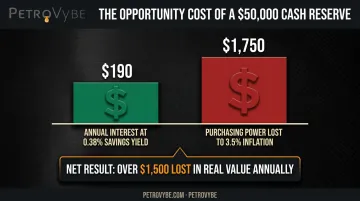
That's the core opportunity cost problem. Excess cash, beyond what a genuine reserve requires, also signals something else to investors and lenders: poor capital allocation. Businesses hoarding far more cash than operations require often face questions about why that capital isn't being put to work.
The fix is simple: cap the reserve once your 3-6 month buffer (or 12+ months in retirement) is secured. Additional capital deserves a better home than a savings account earning less than inflation.
Diversified, tax-advantaged, inflation-resistant assets offer a better home for that surplus. For accredited investors and high-income earners with capital beyond their core reserve, PetroVybe offers one example worth understanding.
PetroVybe is a private natural gas development company operating in South Texas and the Gulf Coast Basin. It gives accredited investors direct access to early-stage development projects rather than shares of a publicly traded energy stock.
The structure includes:
- Upfront tax deductions against active income, including W-2 earnings and capital gains, via the Intangible Drilling Cost deduction, unrestricted to passive income
- A target IRR of approximately 26% over a 10-year hold, designed to outpace inflation rather than merely track it
- A minimum investment of $100,000, positioned explicitly for capital beyond a core emergency reserve, not as a replacement for one
That last point matters. PetroVybe's own partnership criteria call for investors with low cashflow urgency and a long time perspective, meaning this is capital that isn't needed for near-term liquidity. Your reserve stays in the bank. Your surplus goes to work.
Where to Keep and How to Build Your Cash Reserve
Not all cash needs to sit in a checking account earning nothing. A tiered structure balances accessibility with modest returns:
| Vehicle | Access speed | Typical yield range |
|---|---|---|
| High-yield savings account | Same day to 1-2 days | Around 3.00% APY |
| Money market account | 1-2 days | Roughly 0.6% (bank average) to 3%+ (fund-based) |
| Short-term CD or T-bill | Fixed maturity (weeks to months) | Roughly 1.6% to 4%, depending on term |
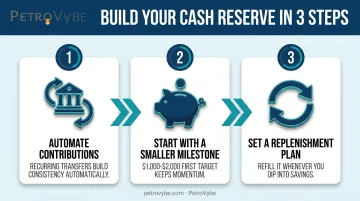
Building the reserve:
- Automate contributions: set a fixed percentage of income or business profit to transfer into a dedicated account each month
- Start with a smaller milestone: many advisors suggest an initial $1,000-$2,000 buffer before working toward the full 3-6 month target
- Set a replenishment plan: decide in advance how you'll rebuild the reserve after it's tapped
Usage rules: limit the reserve to genuine emergencies or high-value, time-sensitive opportunities. If it becomes a backup checking account for everyday spending, it stops functioning as a reserve at all.
Frequently Asked Questions
What is a cash reserve fund?
A cash reserve fund is liquid money set aside by individuals or businesses to cover emergencies or short-term opportunities. It exists so you don't have to rely on high-interest debt when unexpected costs arise.
Is there a benefit to keeping a cash reserve?
Yes. Reserves provide financial stability during emergencies, give you flexibility to act on time-sensitive opportunities, and help you avoid high-interest debt or forced asset sales.
How much cash reserve should I have in retirement?
Retirees generally need 12 months or more of essential spending, calculated as the gap between guaranteed income and necessary expenses. Healthcare costs and market timing risk make this cushion especially important.
What's the difference between a cash reserve and an emergency fund?
People often use these terms interchangeably. The main distinction is that a cash reserve can also cover planned near-term or strategic opportunities, not just emergencies.
Are cash reserves reported on a balance sheet or taxed differently?
Business cash reserves typically appear under current assets on the balance sheet. Personal reserves sit in standard bank or brokerage accounts and receive no special tax treatment.
Can I invest my cash reserve to earn a better return?
Yes, within limits. Money market funds and short-term Treasury bills offer modest yields while keeping your funds highly liquid, so you don't sacrifice access for a small return bump.