

Introduction
Money management and investing both drive financial freedom, yet most people only master one. Neglecting either one stalls your progress fast.
You can budget perfectly and still lose ground to rising prices. The Consumer Price Index climbed 2.9% in 2024 and another 2.7% in 2025, with electricity costs jumping 6.7% in the latter year alone, according to the Bureau of Labor Statistics. Cash sitting idle loses value every year inflation outpaces it.
The core problem: many high earners have excellent cash flow but no real strategy. That gap costs them wealth-building opportunities and hands the IRS more than necessary.
This article covers five tips, moving from foundational budgeting to advanced tax-efficient diversification.
Key Takeaways
- Consistent budgeting and investing compound wealth over decades, not months
- The 50/30/20 rule works, but high earners often need to flip it toward savings
- An emergency fund protects your investments from forced, poorly-timed sales
- Starting early cuts your required monthly investment dramatically
- Direct energy investments can offset active income for accredited investors
What Is Money Management and Investment?
Money management is the ongoing discipline of budgeting, saving, spending, and tracking your finances against specific goals. It's the daily and monthly work: knowing where every dollar goes and adjusting course when life changes.
Investing is different. It means allocating money into assets such as stocks, bonds, real estate, or alternatives that are expected to grow in value over time. Saving parks your cash. Investing puts it to work.
Here's the distinction that trips people up:
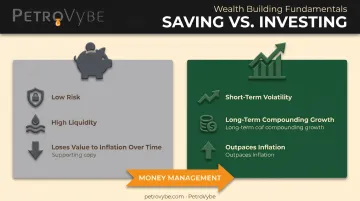
- Saving protects money from loss but rarely beats inflation over the long run
- Investing accepts short-term risk in exchange for long-term growth
- Money management is the discipline that makes consistent investing possible in the first place
Money parked in a checking account earns next to nothing and loses ground to inflation every year. Money invested in retirement or brokerage accounts benefits from compounding growth instead, which is why disciplined investors tend to build far larger balances over time. Discipline plus consistent market exposure compounds. Discipline alone just preserves what you already have.
Tip 1: Assess Your Finances and Set Clear Goals
You can't build a strategy on guesswork. Start with a full financial inventory:
- Income sources — salary, bonuses, side income, investment distributions
- Monthly expenses — fixed and variable, including subscriptions you forgot about
- Existing debts — balances, interest rates, minimum payments
- Current assets — cash, retirement accounts, real estate, brokerage holdings
Once you know where you stand, set SMART goals: specific, measurable, and tied to a timeline. "Save more" isn't a goal. "Save $60,000 for a home down payment in 36 months" is.
Short-Term vs. Long-Term Goals
Separate your objectives by horizon:
| Horizon | Timeframe | Example Goals |
|---|---|---|
| Short-term | 1-3 years | Emergency fund, home down payment, debt payoff |
| Long-term | 10+ years | Retirement, children's education, legacy wealth transfer |
According to Charles Schwab's 2025 Modern Wealth Survey, a majority of Americans still don't have a fully documented financial plan. Most operate on vague intentions rather than written numbers. That gap is exactly what causes high earners to drift financially despite strong income. Writing your goals down, even in a simple spreadsheet, changes how you spend and invest.
Tip 2: Master a Budget You Can Actually Stick To
The 50/30/20 rule, popularized by Elizabeth Warren, splits after-tax income three ways:
- 50% to needs: housing, utilities, insurance, groceries, minimum debt payments
- 30% to wants: dining out, travel, entertainment, hobbies
- 20% to savings and investing: retirement contributions, brokerage deposits, extra debt payoff
Applying the Rule Step by Step
- Calculate your after-tax income: start with your take-home pay, not your gross salary
- Categorize every expense: sort transactions into needs, wants, and savings buckets
- Compare against the 50/30/20 targets: adjust spending where you're over budget
- Automate the 20%: set up automatic transfers so investing happens before you can spend it
Here's the honest truth: the 50/30/20 split is a starting point, not a law. High-income earners often push savings and investing well past 20%, sometimes to 30% or 40%, because their "needs" don't scale linearly with income.
If percentage-based budgeting feels too loose, try zero-based budgeting instead. Every dollar gets assigned a job before the month starts: income minus expenses minus savings should equal zero. It's more work upfront but leaves no room for money to vanish unaccounted for.
Bank of America's research shows a meaningful share of households earning six figures still spend more than 95% of their income on necessities in a given quarter, technically living paycheck to paycheck. High income doesn't automatically mean financial breathing room. Budgeting matters at every income level, not just for people who are struggling.
Tip 3: Protect Yourself First - Build an Emergency Fund and Manage Debt
Before you invest aggressively, build a buffer. The standard guideline is 3-6 months of essential expenses in an accessible account, per both Fidelity and Vanguard. Self-employed earners with variable income often need to lean toward the higher end of that range, or beyond, given less predictable cash flow.
Once your cash cushion is in place, turn to the other side of your balance sheet: debt. Not all debt deserves the same urgency, so split it into two categories:
| Debt Type | Examples | Effect |
|---|---|---|
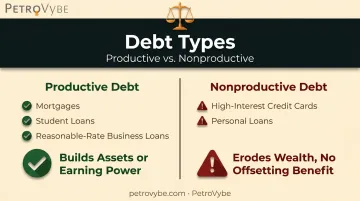
| Productive debt | Mortgages, student loans, business loans with reasonable rates | Builds assets or earning power |
| Nonproductive debt | High-interest credit cards, personal loans | Erodes wealth with no offsetting benefit |
Pay down nonproductive debt aggressively. A credit card charging 22% interest is a guaranteed negative return that no investment reliably beats.
Debt payoff and cash reserves protect the same thing: your invested capital. Without an emergency fund, a market downturn or unexpected expense forces you to sell investments at the worst possible time. That's the single fastest way to turn a paper loss into a permanent one. Cash reserves let your portfolio ride out volatility instead of getting liquidated in a panic.
Tip 4: Make Your Money Grow Through Strategic Investing
Compound growth works like a snowball rolling downhill. It starts small, but every rotation picks up more mass. The same principle applies to your money: returns generate their own returns, and the effect accelerates over time.
This is why time in the market beats timing the market. According to FINRA's investor education resources, consistently predicting short-term price swings is extraordinarily difficult, even for professionals. Staying invested through volatility outperforms trying to jump in and out.
How Much Do You Need for $1,000 a Month in Passive Income?
Using a common 4% withdrawal rate, a widely referenced historical benchmark:
- Annual income needed: $1,000 × 12 = $12,000
- Required portfolio: $12,000 ÷ 0.04 = $300,000
Use a more conservative 3% yield assumption instead, and that number climbs closer to $400,000. The exact figure shifts with your chosen return rate, but the math gives you a real target to plan around.
Starting Early Changes Everything
Assume a 7% average annual return and a $1,000,000 target by age 65:
| Starting Age | Approx. Monthly Contribution Needed |
|---|---|
| 25 | ~$400 |
| 35 | ~$900 |
| 45 | ~$2,000 |
A decade of delay roughly doubles your required monthly contribution, which is the real cost of waiting to start.
Tax-Advantaged Accounts and Employer Match
Don't skip the easiest return available: employer 401(k) matching. Many employers match 4-5% of pay, free money added directly to your contributions. Between 401(k)s and IRAs, the IRS allows meaningful annual contributions with catch-up provisions for those 50 and older.
Before choosing your asset allocation, be honest about two things: your risk tolerance and your time horizon. A 30-year-old investing for retirement can absorb more volatility than someone five years from needing the funds.
Tip 5: Diversify Beyond Traditional Assets for Tax Efficiency
Stocks, bonds, and real estate form a solid foundation. But traditional diversification has a blind spot: it does little to offset the tax bill on your active income, your salary, bonuses, and capital gains.
That's where accredited investors increasingly look at alternative asset classes:
- Private placements
- Real estate syndications
- Direct energy development investments
The IDC Tax Deduction Advantage
Oil and gas investments carry a unique benefit: Intangible Drilling Cost (IDC) deductions. Under IRS rules, costs like labor, fuel, and supplies used in drilling can be deducted immediately.
Unlike many passive investments, working-interest losses in oil and gas can offset nonpassive income, including W-2 earnings and capital gains, when specific liability conditions are met, according to IRS Publication 925.
PetroVybe operates directly in this space, offering accredited-investor-only natural gas development opportunities in South Texas and the Gulf Coast Basin, including projects in Lavaca County.
Recent partner results include:
- Published tax deduction rates in the 91-94% range against active income
- A 10-year target MOIC of roughly 2.2x to 5.8x
- A target IRR near 26%
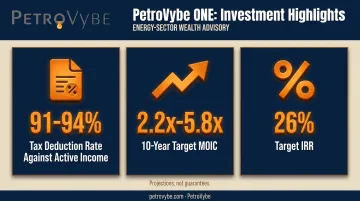
Those figures are forward-looking projections tied to commodity pricing and production performance, not guarantees.
Before committing capital to any alternative investment, confirm your accredited investor status and consult a licensed tax or financial advisor. Alternatives carry real risk, including illiquidity and potential loss of principal.
Frequently Asked Questions
How much do I need to invest to earn $1,000 a month?
Using a 4% withdrawal rate, you'd need roughly $300,000 invested. At a more conservative 3% yield, that figure rises closer to $400,000. The exact amount depends on the return rate you assume.
What is money management and investment?
Money management is the discipline of budgeting, saving, and tracking your finances. Investing is allocating money into assets like stocks or real estate expected to grow. Together, they build and protect wealth over time.
What is the 50/30/20 rule for managing money?
It's a budgeting split: 50% of after-tax income goes to needs, 30% to wants, and 20% to savings, investing, or debt repayment. High earners often push savings past 20%.
What is the best way to start investing with little money?
Start with your employer's 401(k), especially if there's a match, or open a low-minimum index fund. Many brokerages now offer fractional shares and automated micro-investing apps with no minimum balance.
How do accredited investors diversify beyond stocks and bonds?
Common alternatives include private placements, real estate syndications, and direct energy development investments like natural gas projects. Companies such as PetroVybe structure these natural gas partnerships specifically to offer diversification alongside meaningful tax advantages against active income.
Are alternative investments like oil and gas risky?
Yes, all investments carry risk, including illiquidity and potential loss of principal. Reduce that risk by verifying track records, checking third-party engineering reports, and working with experienced, transparent operators.