

High-income professionals are catching on to this. Doctors, executives, and salaried specialists with strong incomes are increasingly redirecting capital toward business ownership, real estate, and private alternative investments, rather than parking everything in a retirement account and hoping compound interest handles the rest.
This guide breaks down what "acquisition of wealth" actually means, the core strategies that move the needle, and how business ownership and tax-advantaged private investments fit into a plan most salaried earners never consider.
Key Takeaways
- Wealth acquisition means owning appreciating or income-producing assets, not just earning a paycheck
- Business owners with 5+ employees have a median net worth of $1.25 million vs. $155,700 for non-owners
- Combining two to three strategies outperforms concentrating in just one
- Tax-advantaged vehicles like energy development can offset most active income in year one
- Due diligence, not luck, separates strong acquisitions from expensive mistakes
What Is Acquisition of Wealth? (Definition & Meaning)
Acquisition of wealth is the deliberate process of obtaining assets, money, property, businesses, or contractual rights that generate income or appreciate over time. It's different from earning wealth, which is the linear act of trading hours for a paycheck.
Acquiring vs. Earning: The Core Distinction
Earning wealth stops the moment you stop working. Acquiring wealth compounds whether you're on the clock or not.
| Aspect | Earning | Acquiring |
|---|---|---|
| Structure | Linear — one hour of work equals one hour of pay | Exponential — an owned asset can appreciate, generate cash flow, and be leveraged, all at once |
| Ceiling | Capped by a salary limit | Uncapped, scales with the asset's value |
| Risk | Predictable, tied to job security | Variable, tied to market and asset performance |
The data backs this up. Families that own a business with more than five employees carry a median non-business net worth of $1,250,700, compared to just $155,700 for families without one, according to the Federal Reserve's 2022 Survey of Consumer Finances.
That's not proof ownership causes wealth, but the association is hard to ignore, especially since private business ownership climbed from 13% of U.S. families in 2019 to 20% in 2022.
The Modern Asset Menu
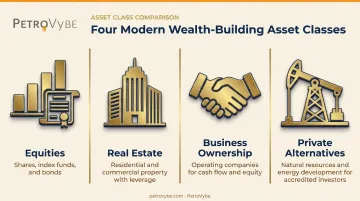
Acquisition of wealth today spans four broad categories:
- Equities – shares of public companies, index funds, and bonds
- Real estate – residential or commercial property acquired with leverage
- Business ownership – operating companies bought or built for cash flow and equity
- Private alternatives – direct investments in natural resources and energy development, typically reserved for accredited investors
Each category carries a different risk profile, liquidity timeline, and tax treatment. The next section breaks down how to weigh them against each other.
Key Strategies for Acquiring Wealth
Not every asset class deserves equal attention. The Pareto principle applies here: a small number of well-chosen strategies typically drive most of your results. Spreading capital thin across a dozen ideas usually produces mediocre returns everywhere.
Here's how the four core strategies stack up:
| Strategy | How It Works | Upside | Trade-off |
|---|---|---|---|
| Traditional investing | Stocks, bonds, index funds | Liquid and simple; the S&P 500 posted an 11.7% annualized return over the trailing 20 years, per J.P. Morgan's Guide to the Markets | Fully correlated to market swings; a 60/40 blend averaged only 9.4% over the same period |
| Real estate | Purchase property with mortgage leverage | Appreciation plus rental cash flow, often financed with 77-90% leverage | Active management, tenant risk, illiquidity |
| Business ownership | Buy or build a cash-flowing company | Direct control over equity growth and cash flow | Operational demands and financing complexity |
| Alternative/tax-advantaged assets | Private development projects, such as natural gas | Diversification plus significant tax efficiency | Illiquid, long hold periods, accredited-investor only |
The strongest wealth-acquisition plans rarely rely on one lane. Common combinations that spread risk without diluting focus:
- Real estate + business ownership for steady rental cash flow alongside equity growth
- Traditional investing + alternative assets, such as PetroVybe's natural gas partnerships, for liquidity paired with tax efficiency
- Business ownership + alternative assets for active operating income plus passive compounding
A cash-flowing business paired with a tax-advantaged passive asset balances active involvement with hands-off growth. Layering two or three approaches spreads risk across asset classes that don't move together.
Business Acquisition: A Proven Path to Wealth
Buying an existing business and starting one from scratch aren't equally risky, even though they often get compared as if they were.
Buy vs. Build: What the Data Shows
Search funds, entities formed specifically to acquire a single operating company, offer one of the clearest data sets available. Stanford's 2024 study of 681 search funds found an aggregate investor IRR of 35.1% and a 4.5x return on invested capital across 296 acquired companies dating back to 1984.
Compare that with new business survival: data from the U.S. Bureau of Labor Statistics shows fewer than half of new employer establishments survive five years. These are different measurements: one tracks investor returns, the other tracks establishment survival. Yet the pattern holds: buying something already proven tends to de-risk the outcome relative to building from zero.
A Simple ROI Example
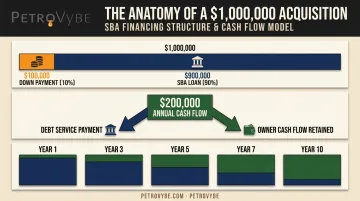
Picture acquiring a business generating $200,000 in annual cash flow for a $1 million purchase price, financed with a 10% down payment ($100,000) and an SBA-style loan for the rest.
Even after debt service, the owner captures cash flow now and equity build-up later, as the loan balance shrinks each year. That combination is what makes acquisition arithmetic so different from a salary.
Why Buying Wins on Margin of Safety
An existing business comes with:
- Proven product-market fit and an established customer base
- Historical financials to underwrite instead of a business plan
- Existing staff, vendor relationships, and operating systems already in place
Capturing that safety margin still requires capital upfront, and that's where many high-income professionals stall out. High earners often fall into the "high salary trap," spending in step with income instead of redirecting it toward acquisition. Breaking that pattern usually starts with treating part of every paycheck as investable capital, not disposable income.
Once that capital is earmarked, due diligence matters just as much as the decision to buy. A quality-of-earnings review, legal counsel, and an experienced advisory team help confirm the numbers are real before you sign. Skipping that step is how buyers inherit hidden liabilities, or worse, discover the financials were never accurate.
Tax-Advantaged Alternative Investments: Acquiring Wealth Through Energy Development
High W-2 earners and investors sitting on capital gains face the same problem every year: a tax bill that grows right alongside their success. That's pushed more of them toward asset classes offering real tax efficiency, not just deferral.
How Intangible Drilling Costs Work
Section 263(c) of the tax code lets oil and gas investors deduct Intangible Drilling Costs, the wages, fuel, and supplies used to drill a well. That deduction applies in the year the costs are incurred, per 26 CFR 1.612-4.
A working interest in a well isn't treated as a passive activity, so the deduction can offset active income, including W-2 wages and capital gains, not just passive income from other investments. That's a meaningfully different tax position than most real estate or equity holdings offer.
PetroVybe: Direct Access to Energy Development
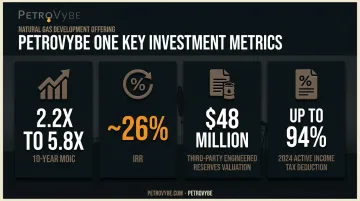
PetroVybe is a Texas-based natural gas development company built around this mechanism. Instead of buying shares in an already-priced public energy stock, accredited investors take a direct equity position in upstream development projects in Lavaca County and the broader Gulf Coast Basin. Its flagship offering, PetroVybe ONE, targets:
- A 10-year MOIC of roughly 2.2x to 5.8x
- An IRR near 26%
- A $48 million third-party engineered reserves valuation
In 2024, partners received tax deductions as high as 94% against active income.
Inflation Protection and Investor Requirements
Tangible, production-based assets often behave differently than paper investments during inflationary periods, since their value is tied to physical output and commodity pricing rather than market sentiment alone.
That inflation resilience isn't available to just anyone, though. SEC rules restrict these opportunities to accredited investors, generally those with $1 million in net worth (excluding a primary residence) or $200,000-plus in individual annual income. Illiquidity and multi-year hold periods come with the territory, not as a footnote.
Common Mistakes That Derail Wealth Acquisition
Even well-capitalized investors sabotage their own progress. Three mistakes show up again and again.
- Chasing the passive income myth. Most acquisition vehicles demand active oversight or rigorous vetting, not "set it and forget it" returns—verify before you wire funds.
- Over-concentrating in one asset class. Betting everything on stocks or real estate ties your net worth to a single market's cycle. Spreading capital across ownership-based and tax-advantaged vehicles, such as energy partnerships, softens that swing.
- Skipping third-party verification. Whether you're buying a business or a development project, unverified numbers are a red flag. Independent engineering reports, quality-of-earnings reviews, and audited financials exist because self-reported figures can't always be trusted.
Building Your Personal Wealth Acquisition Plan
Ready to move from theory to action? Start here.
- Assess your starting position. Calculate your current tax burden, liquidity, and risk tolerance. $100,000 or more in liquid capital opens the door to accredited alternative investments; less than that usually means starting with real estate or a smaller business acquisition.
- Diversify across at least two vehicles. Pairing a cash-flowing business with a tax-advantaged passive asset gives you direct oversight from one and steady compounding from the other, so you're not dependent on one income stream or market cycle.
- Partner with proven operators. Whether it's a business broker, an SBA lender, or a development company like PetroVybe, work with people who bring independent, third-party validated track records instead of going it alone.
The plan doesn't need to be complicated. It needs to match your actual liquidity, risk appetite, and time horizon, then get executed with real due diligence behind it.
Frequently Asked Questions
What does "acquisition of wealth" mean?
It's the deliberate process of obtaining income-generating or appreciating assets, businesses, property, or rights, rather than simply earning a salary. The distinction is ownership versus labor: owned assets compound in value over time, while wages don't.
What is the fastest way to acquire wealth?
There's no guaranteed fastest path, but ownership-based strategies like business acquisition, real estate, and alternative investments have historically outperformed pure salary-based saving. Speed usually comes with higher risk attached.
Is buying an existing business a good wealth-building strategy?
Yes, for the right buyer. Acquired companies come with proven cash flow and existing customers, but success still depends on rigorous due diligence and honest financials before closing.
What are the tax benefits of investing in oil and gas development?
Intangible Drilling Costs can be deducted against active income, including W-2 wages, in the year they're incurred. PetroVybe partners, for example, received deductions as high as 94% against active income in 2024.
How much capital do I need to start acquiring wealth through alternative investments?
Accredited alternative investments like private energy development typically require $100,000 or more in liquidity. Other paths, such as business acquisition with SBA financing, can start with a smaller down payment.
What is MOIC and why does it matter?
Multiple on Invested Capital measures total value returned divided by capital invested, so a 2x MOIC means your investment doubled. It doesn't account for time, which is why it's usually evaluated alongside IRR.