

Intangible Drilling Costs (IDCs) are different. Codified in the U.S. tax code since 1913, IDCs let qualifying investors deduct a substantial share of an oil and gas investment in the same year the money goes to work, and in specific cases, that deduction can offset active income, not just passive gains.
This guide breaks down what IDCs are, how the deduction actually works, the limitations you need to know before investing, and how working interest positions like those PetroVybe structures for accredited investors put this provision to use.
Key Takeaways
- IDCs typically equal 60% to 80% of well costs and are deductible the year incurred.
- Working interest structures let IDC deductions offset active income, including W-2 wages and capital gains.
- Investors can expense IDCs immediately or spread them over a 60-month period.
- AMT preference rules, passive activity limits, and recapture provisions can affect your tax outcome.
What Are Intangible Drilling Costs?
Intangible Drilling Costs are the non-salvageable expenses required to drill and prepare a well for production. Once the well is drilled, these costs have no resale or scrap value; they simply disappear into the ground.
Treasury Regulation 1.612-4 spells out what qualifies. Common IDC categories include:
- Wages and labor for the drilling crew and field personnel
- Drilling and fracturing services, including fluids, chemicals, and fuel
- Ground clearing and road construction to access the well site
- Geological and geophysical work tied to a specific well
- Equipment installation labor (not the equipment itself)
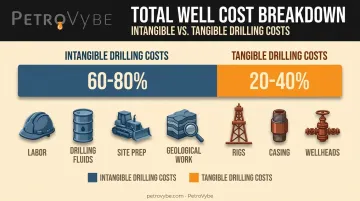
In a typical development project, IDCs make up 60% to 80% of total well costs, making them the single largest deductible expense category in the entire drilling budget. This isn't a fixed IRS statistic. It's an industry-standard range that reflects how capital splits between qualifying services and depreciable equipment on a given project.
Nor is this a new loophole. Congress built the IDC deduction into the tax code in 1913 to encourage capital-intensive, high-risk drilling at a time when the country needed to expand its domestic energy supply, according to a Congressional Research Service report.
It's survived more than a century of tax reform because it does exactly what it was designed to do: pull private capital into domestic energy production.
Tangible vs. Intangible Drilling Costs
Not every dollar spent drilling a well qualifies as an IDC. Tangible Drilling Costs (TDCs) cover the physical, salvageable equipment: rigs, wellhead components, casing, and production or storage facilities. These are still fully deductible, just on a slower schedule.
| Cost Type | What It Covers | Deduction Timing |
|---|---|---|
| Intangible (IDC) | Labor, fuel, site prep, drilling fluids | Deducted immediately (or over 60 months) |
| Tangible (TDC) | Rigs, casing, wellheads, storage equipment | Capitalized, depreciated over 7 years |
The distinction matters because it's what makes IDCs uniquely powerful. Most business deductions require you to spread costs out over years. IDCs let you take the bulk of a well's cost as a deduction almost immediately.
Are Intangible Drilling Costs Tax Deductible? How the Deduction Works
Yes. Under IRC Section 263(c), a qualifying working interest owner can elect to deduct qualifying IDCs in the year they're incurred, whether or not the well ever produces a single barrel. That last point surprises a lot of first-time investors: productivity isn't the trigger. Incurring the cost is.
A few conditions determine who actually qualifies:
- Working interest requirement: Only investors holding a working interest, and bearing a share of operating costs, qualify. Royalty interest holders don't.
- Domestic well restriction: Only wells drilled onshore or offshore within the United States are eligible.
- Timing for cash-method taxpayers: If you're prepaying costs before drilling starts, the IRS generally wants to see drilling underway shortly after year-end, not an open-ended commitment.
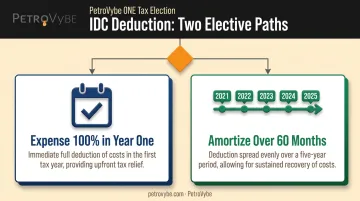
Once you qualify, you have two elective paths:
- Expense 100% in year one. Deduct the full qualifying IDC amount against your income in the tax year the cost was paid or incurred.
- Amortize over 60 months. Spread the deduction evenly across five years starting the month costs were incurred, which some investors prefer for AMT planning (more on that below).
For partners in a structure like PetroVybe's, this election drives most of the first-year tax benefit: recent partners deducted 91-94% of their investment against active income, including W-2 earnings and capital gains.
There's one exception worth knowing: major integrated oil companies don't get the full first-year benefit. They're limited to deducting 70% of IDCs immediately, with the remaining 30% amortized over five years. Individual investors and independent producers aren't subject to this haircut.
No special election form is required to claim the deduction. It's simply reported on your applicable return, Form 1040 for individuals, based on the figures your operator or partnership provides. A brief footnote disclosure describing the election is a smart best practice, even though it's not mandatory.
Key Tax Considerations & Limitations
The IDC deduction is powerful, but it's not unconditional. Four areas trip up investors who don't plan ahead.
Alternative Minimum Tax (AMT). Excess IDC is the amount by which your deduction exceeds what you'd have gotten from capitalizing and depreciating those costs over 120 months. It can become an AMT preference item once it exceeds 65% of your net income from oil and gas properties. Here's a simplified version:
- IDC incurred: $1,000,000
- Amount deducted currently: $700,000
- Hypothetical 120-month depreciation equivalent: $50,000
- Excess IDC: $650,000
- Preference item: the portion of that $650,000 above 65% of net income from the property
Independent producers generally get relief from this rule, though the benefit is capped at 40% of alternative minimum taxable income. This is exactly why some investors choose the 60-month amortization election instead of full first-year expensing.
Passive activity loss rules. A working interest held without limited liability is statutorily excluded from passive activity treatment, regardless of whether you materially participate. That's the mechanism that allows the deduction to reach active income at all. If your interest is held through a structure that caps your liability, this exception generally doesn't apply, and losses may be stuck offsetting only passive income.
Dry hole costs. If the well comes up dry, the IDCs don't disappear with it. They remain fully deductible in the year the well is completed, productive or not.
Recapture risk. Sell your working interest after claiming IDC deductions, and a portion of that benefit can be recaptured as ordinary income under Section 1254. The tax code doesn't set a hard expiration date on this exposure, but the risk is highest in the earlier years of a project, which is one more argument for a longer hold.
One more note: IDCs incurred on wells outside the U.S. don't qualify for current expensing. Foreign IDCs must generally be capitalized and amortized, typically over 10 years.
Why IDCs Matter for Active-Income Investors
Here's the problem with most tax-advantaged investments: real estate depreciation, passive fund losses, and similar strategies only offset passive income. If your income is mostly W-2 wages or capital gains, those tools sit on the shelf unused.
A working interest position is structured differently. Because it's excluded from passive activity treatment, qualifying investors can apply IDC deductions against active income, including salary and capital gains, not just passive rental or fund income.
PetroVybe's own results illustrate the scale of this benefit:
- 2024 partners received a 94% total tax deduction against ordinary income.
- 2025 partners achieved a 91% total tax deduction against ordinary income.
- The first-year IDC component alone typically delivers roughly 70% of invested capital as a deduction against active income.

A $100,000 position, for example, can generate $60,000 to $80,000 in IDC deductions in year one before layering in depletion allowances and other benefits that push the total higher.
These deduction percentages are possible because of how PetroVybe structures each investment. Rather than pooling capital into a passive fund, PetroVybe offers direct working interest positions in South Texas and the Gulf Coast Basin, specifically Lavaca County, keeping IDC deductions tied to active income instead of capping them at passive-income eligibility.
This structure fits a specific investor profile:
- Requires accredited investor status under SEC rules
- $100,000 minimum investment per position
- 10-year hold period targeting both the upfront deduction and long-term passive income with MOIC/IRR returns
How to Claim the IDC Deduction
Claiming the deduction is more paperwork than mystery, but the details matter for PetroVybe partners.
- Report it on Form 1040. Individual investors report their share of IDCs based on the cost breakdown provided by the well operator or sponsor, typically delivered via a Schedule K-1.
- Keep your documentation. Retain the K-1 and any supporting cost allocation statements from your operator. If the IRS ever asks how your deduction was calculated, this is your answer.
- Loop in a tax professional early. The choice between expensing 100% immediately or amortizing over 60 months depends on your bracket, expected income, and AMT exposure.
- Model your options. A CPA experienced with oil and gas structures can compare both scenarios against your specific tax picture rather than guessing.
Frequently Asked Questions
What are intangible drilling costs?
IDCs are the non-salvageable expenses needed to drill and prepare a well, things like labor, fuel, and site preparation. They typically account for 60% to 80% of total well costs.
Are intangible drilling costs deductible?
Yes. Working interest owners can generally deduct IDCs in full in the year incurred, regardless of whether the well ends up producing.
What are tangible drilling costs and how are they depreciated?
Tangible costs cover physical equipment like rigs, casings, and wellheads. Unlike IDCs, they're capitalized and depreciated over seven years rather than deducted immediately.
Can I deduct IDCs against my W-2 income or capital gains?
Investors holding a qualifying working interest, rather than a limited, liability-capped fund position, can typically apply IDC deductions against active income, including W-2 wages and capital gains.
What happens if I sell my working interest after claiming the IDC deduction?
A portion of your previously deducted IDCs may be recaptured as ordinary income upon sale. This risk is highest in the first several years after drilling.
Is there a limit on how much I can deduct in intangible drilling costs in one year?
Individual investors can deduct up to 100% of qualifying IDCs in year one. Major integrated oil companies are capped at 70% immediately, with the rest amortized over five years.