
It shapes far more than a single portfolio. Asset demand drives interest rate cycles, determines how capital flows through Treasury markets, and dictates whether institutional money floods into stocks or retreats to cash. When large pools of capital shift how they want to hold wealth, prices move, sometimes sharply, because most asset markets absorb demand shocks less smoothly than textbook models assume.
This guide breaks down what asset demand means, the four factors behind it, real-world examples, and how everyday investors can apply the same principles institutions use.
Key Takeaways
- Asset demand explains why investors choose stocks, bonds, or real estate over cash
- Wealth, expected return, risk, and liquidity drive every allocation decision
- Demand shocks move prices further than standard models predict in inelastic markets
- Tangible assets, including energy development, apply institutional demand principles directly
What Is Asset Demand?
Asset demand is the desire to hold wealth in appreciating or income-generating assets, such as stocks, bonds, real estate, commodities, and natural resources, rather than spending it or parking it as idle cash. It's the flip side of consumption: instead of buying something today, you're betting an asset will grow your purchasing power tomorrow.
The concept comes from portfolio-choice theory, a framework popularized by economist Frederic Mishkin that models how individuals and institutions divide wealth across competing assets to maximize risk-adjusted returns. Fund managers, retirees, and households weighing a 401(k) allocation are all running some version of this calculation, whether they realize it or not.
Asset demand also matters at the market level. Prices only stabilize when aggregate investor demand for an asset matches its available supply. If demand outpaces supply, prices climb until equilibrium returns. If supply overwhelms demand, prices fall.
One key distinction: monetary economics uses "asset demand" specifically to describe holding money or bonds as a store of value, distinct from the broader portfolio-choice application across all asset classes. Both concepts matter, but they answer different questions.
A Simple $50,000 Example
Picture an investor with $50,000 to deploy. Here's how the options stack up:
- Savings account: Near-zero risk, high liquidity, but returns barely outpace inflation
- Stocks: Higher expected return, higher volatility, easy to sell
- Bonds: Moderate return, lower risk than stocks, still liquid
- Tangible asset (real estate, natural resource development): Potentially strong cash flow and tax benefits, but lower liquidity and longer time horizons
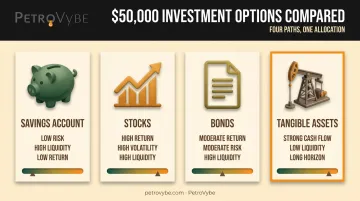
The "right" choice depends entirely on that investor's wealth, return expectations, risk tolerance, and need for liquidity, which brings us to the four determinants that govern every asset demand decision.
The Four Determinants of Asset Demand
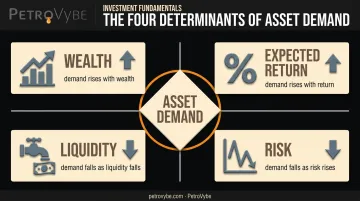
Whether it's a household choosing between a savings account and stocks, or a pension fund reallocating billions, the same four variables drive the decision: wealth, expected return, risk, and liquidity.
Wealth
As total wealth grows, demand for assets rises, but unevenly. Cash-like "necessity" holdings grow demand slowly. Stocks and alternative investments, often treated as "luxury" assets, see demand accelerate faster as wealth increases.
The data backs this up. Real median U.S. family net worth rose 37%, from $141,100 in 2019 to $192,900 in 2022, according to the Federal Reserve's 2022 Survey of Consumer Finances. Stock ownership followed a steep income gradient: just 34% of families in the bottom half of income held stocks, compared to 95% in the top decile.
High-net-worth investors show the same pattern with alternatives. Average allocations to alternative investments among HNW clients rose from 7.7% in 2020 to 9.1% in 2022, with advisers projecting 9.6% by 2024.
Expected Return
Expected return is the probability-weighted average return an investor anticipates. When an asset's expected return rises relative to alternatives, demand for it increases. Simple enough.
The catch is that most investors compare the wrong number. Nominal return ignores taxes and inflation. Real, after-tax return is what actually determines purchasing power, and it's often meaningfully lower than the headline figure most people quote at dinner parties.
Risk
Most investors are risk-averse. Between two assets offering the same expected return, demand shifts toward the less volatile one. Standard deviation is the common way risk gets measured, capturing how far returns swing above and below their average.
Consider a volatile tech stock and a stable bond, each averaging 8% annual returns. The stock might swing between -20% and +36% in a given year. The bond might range from 5% to 11%. Same average, wildly different risk profile, and demand tilts toward the bond for anyone who can't stomach the swings.
Liquidity
Liquidity is how quickly an asset converts to cash without losing value. U.S. Treasury bills sit at the liquid end of the spectrum. Real estate and private placements sit at the illiquid end.
Lower liquidity typically demands a return premium to attract capital. Research on private equity secondaries found interests selling at an average 13.8% discount to net asset value across 700 transactions between 2006 and 2014. That illiquidity premium is directly relevant to long-hold alternative structures, including private oil and gas partnerships, where investors accept a 10-year (or longer) lockup in exchange for higher targeted returns.
Asset Demand vs. Transactions Demand for Money
Not all money held is asset demand. Classical macroeconomics splits money holding into two categories.
Transactions demand is money held for routine daily spending—groceries, rent, bills. It's driven by income, not interest rates, and doesn't respond much to what savings accounts are paying.
Asset demand (sometimes called speculative demand) is money or financial assets held as a store of value. This component moves inversely with interest rates.
Together, these two components form the total money demand curve used in money market and interest rate equilibrium models. Here's the mechanism that matters for investors:
- When interest rates rise, holding idle cash becomes more expensive in opportunity-cost terms
- Asset demand for cash falls as investors shift into interest-bearing or productive assets
- When rates fall, the opposite happens, and idle cash becomes relatively more attractive
This is why rate hikes tend to pull capital out of cash and into yield-generating assets, and why rate cuts often send investors searching for safety again. For investors evaluating tangible, income-producing alternatives like direct oil and gas partnerships, this cash-to-asset rotation offers a useful framework for timing capital deployment.
Real-World Examples of Asset Demand in Action
Theory is one thing. Watching asset demand move real markets is another.
Stocks Don't Behave Like Textbooks Predict
When a stock gets added to or removed from a major index like the S&P 500, funds tracking that index are forced to buy or sell, regardless of the company's fundamentals. Early studies found abnormal returns of 5-7% around these events. That's a demand shock, not a change in the company's prospects.
More strikingly, research from Gabaix and Koijen estimates aggregate stock-demand elasticity at roughly 0.2, implying a flow multiplier near 5. In plain terms: a $1 inflow into the stock market can raise aggregate market value by roughly $5. Stock demand is far less price-elastic than standard models assume, which means flows and rebalancing move prices more than most investors expect.
Bonds and the Safe-Asset Bid
Strong foreign and institutional demand for "safe" assets like U.S. Treasuries has been a documented driver of low real interest rates. An IMF study estimated that foreign Treasury purchases cumulatively reduced long-term real U.S. yields by about 80 basis points. That's asset demand theory playing out at a global scale: when everyone wants the same safe store of value, its price rises and its yield falls.
Real Estate as a Store of Value
Property has long attracted demand as an inflation hedge, with commercial real estate showing a documented correlation with inflation over multi-decade samples. The tradeoff is liquidity. Selling a building takes months, not minutes, which is precisely why real estate commands different demand dynamics than a publicly traded stock.
Natural Gas Development and the AI Power Surge
Here's where asset demand theory meets a genuinely new market force. Lawrence Berkeley National Laboratory projects U.S. data center electricity use could reach 325-580 TWh by 2028, up from roughly 176 TWh in 2023, driven almost entirely by AI computing growth.
That electricity has to come from somewhere. Natural gas already supplies nearly half of U.S. electricity generation, and it's uniquely positioned to meet fast-growing, dispatchable demand in a way wind, solar, and nuclear currently can't match at the same speed.
PetroVybe is positioned squarely around this demand shift. The company develops natural gas and natural gas liquids assets in South Texas's Lavaca County and the broader Gulf Coast Basin, offering accredited investors direct equity participation through PetroVybe ONE, a limited partnership structure with a $100,000 minimum investment.
It's a tangible, cash-flow-generating alternative to traditional stocks and bonds, paired with substantial tax advantages: partners who joined in 2024 received a 94% tax deduction against active income, including W-2 earnings and capital gains.

Why Asset Demand Matters for Market Dynamics and Asset Prices
Demand elasticity measures how sensitive an asset's price is to shifts in investor demand. Low elasticity means small demand shocks can move prices dramatically, and the research bears this out across both stocks and government debt.
The BIS found that a 1 percentage-point rise in long-term yields increases non-central-bank demand for government debt by 11.4%.
Fed research on quantitative easing programs found that large-scale asset purchases lowered the 10-year Treasury yield by roughly 25 basis points, purely through the portfolio-balance channel of removing supply from the market.
What does this mean practically?
- Triggers sharp price moves: Demand shocks like quantitative easing, large fund rebalancing, or macro policy shifts can move prices quickly, even without new fundamental information
- Cuts both ways: This inelasticity creates risk for anyone forced to sell into an illiquid moment, and opportunity for anyone positioned ahead of a demand shift
- Widens pricing gaps in illiquid markets: Private energy development and other less liquid markets often show the biggest gaps between price and underlying value, since fewer participants are actively pricing them
Understanding this dynamic helps investors spot mispricing before it corrects, and protect capital before a demand shock hits.
Applying Asset Demand Principles to Build a Resilient Portfolio
Institutions don't just buy stocks and bonds and call it a day. They diversify into tangible, cash-flow-producing assets specifically to lower correlation risk and strengthen portfolios against inflation and interest rate shocks. That principle is available to accredited individual investors too, not just endowments and pension funds.
PetroVybe applies exactly this logic. The company gives accredited investors early-stage exposure to natural gas assets positioned to benefit from AI-driven electricity demand, backed by:
- A 10-year target MOIC range of approximately 2.2x-5.8x
- A target IRR of approximately 26%
- Up to 100% total tax deduction, with roughly 70% available in the first year against active income
- Monthly passive distributions projected to peak above $10,000 per month during peak production
- A $48 million proved reserves valuation (PV-09), determined by a licensed third-party engineering firm

Before allocating capital to any new asset class, whether it's natural gas development, private real estate, or a new fund structure, evaluate it the way institutions do:
- Assess wealth fit — Does this allocation match your overall net worth and risk capacity?
- Weigh expected return: compare it on a real, after-tax basis, not the headline number
- Measure risk honestly — Understand volatility and downside scenarios before committing capital
- Confirm liquidity needs: know your hold period and whether you can tolerate a multi-year lockup
Asset demand theory is the framework behind every serious capital allocation decision. It works just as well for a $100,000 check into a Texas gas development project as it does for a trillion-dollar sovereign wealth fund.
Frequently Asked Questions
What is asset demand?
Asset demand is the desire to hold wealth in appreciating or income-generating assets, like stocks, bonds, or real estate, rather than as idle cash. It's the core concept behind portfolio-choice theory in macro-finance.
What are the determinants of asset demand?
Four factors drive asset demand: wealth, expected return, risk, and liquidity. As wealth or expected return rises, demand increases; as risk rises or liquidity falls, demand decreases.
What is an example of asset demand?
An investor shifting funds from a low-yield savings account into stocks, bonds, or a direct natural gas development project illustrates asset demand in action. Each option involves different tradeoffs in return, risk, and liquidity.
What is the difference between asset demand and transactions demand for money?
Transactions demand is money held for routine daily spending, unaffected by interest rates. Asset demand is money or financial assets held as a store of value, which falls as interest rates rise.
How does asset demand affect asset prices?
Shifts in aggregate demand can move asset prices well beyond fundamentals, especially in markets with low price elasticity, like stocks and government bonds. Demand shocks such as fund flows or central bank purchases often drive this divergence.
How can investors apply asset demand theory to alternative investments?
Investors should weigh expected return, risk, and liquidity before allocating capital to alternatives such as natural gas development opportunities. Applying the same institutional framework used for stocks and bonds helps identify where diversification genuinely reduces portfolio risk.