
Many high-income professionals lean almost entirely on that second asset. They earn well, spend comfortably, and assume the paycheck will keep flowing indefinitely. That assumption is risky. A six-figure salary with no investment strategy behind it is a fragile kind of wealth.
This article breaks down human capital and financial capital, shows how the two interact across a career, and outlines practical ways to shift value from "earned" to "owned" — including tax-advantaged strategies built specifically for high W-2 earners.
Key Takeaways
- Human capital is the present value of your future earnings
- Financial capital is what you've already converted into owned assets
- Your human-to-financial capital ratio should flip over time — earnings-heavy in your 20s-40s, asset-heavy later
- Taxes and inflation erode the conversion process every year
- Tax-advantaged, passive investments can accelerate that shift for high earners without demanding more of your time
What Is Human Capital?
Human capital is the economic value of everything you bring to the table: your education, skills, health, and the working years you have left. Economist Gary Becker built the foundational theory behind this idea, framing education and training as investments that compound into future income.
The CFA Institute applies this directly to financial planning, defining human capital as the present value of a person's expected labor income over their remaining career.
For most people under 40, this is by far their largest asset. It's worth more than their home, more than their 401(k), more than any stock portfolio they've assembled.
The Bond You Can't See on Your Balance Sheet
Human capital behaves a lot like a bond inside your total portfolio. It throws off steady "income" in the form of a paycheck, but it depletes with every year that passes and can't be sold, transferred, or refinanced.
- Bond-like human capital: stable, low-volatility careers (tenured professors, government employees)
- Stock-like human capital: commission-based or market-tied income (traders, sales roles, business owners)
- Hybrid human capital: salaried roles with bonus or equity upside (corporate managers, tech employees)
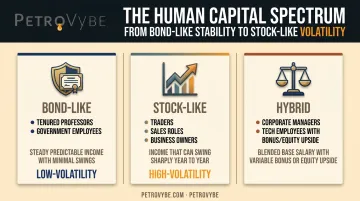
The more stock-like your income looks, the more your financial portfolio should lean toward stability, not the other way around.
When Human Capital Breaks Down
Unlike financial capital, human capital can vanish overnight. A 20-year-old worker today has roughly a 1-in-4 chance of becoming disabled before reaching full retirement age, according to the Social Security Administration. Add in industry disruption, layoffs, and health setbacks, and it becomes clear why leaning entirely on a paycheck is a single point of failure.
What Is Financial Capital?
Financial capital is everything tangible you've already accumulated. It includes:
- Cash and cash equivalents
- Stocks and bonds
- Real estate equity
- Business interests
- Alternative investments
Think of it as stored human capital: the physical result of converting active income into owned assets through saving and investing.
The advantage financial capital has over human capital is simple: it can be diversified. You can spread it across asset classes, industries, and geographies. Your paycheck, by contrast, is tied to one employer, one industry, one skill set.
Sophisticated investors have been leaning harder into this diversification advantage. Cerulli Associates found that high-net-worth investor allocations to alternative investments climbed from 7.7% in 2020 to 9.1% in 2022, with advisors expecting continued growth. Preqin's research backs this up: among investors already using alternatives, 62% planned to increase those allocations further.
That shift matters because traditional stock-and-bond portfolios don't capture every source of return available. Direct positions in real assets, including private equity, real estate, and energy development, offer exposure that public markets simply don't provide.
The Lifecycle Relationship: Balancing Human and Financial Capital
Financial planning has a classic framework for this: young professionals carry high human capital and low financial capital. Because decades of future earnings can absorb short-term losses, they can afford to take on more investment risk early.
That balance flips with age.
| Career Stage | Human Capital | Financial Capital | Risk Capacity |
|---|---|---|---|
| 20s-30s | High | Low | High |
| 40s-50s | Moderate, declining | Growing | Moderate |
| 60s+ | Low | Should be high | Lower |
Total wealth is the sum of both. Ignoring human capital when setting your asset allocation is a common miscalculation. A 35-year-old surgeon with decades of stable income ahead can reasonably hold more equities than a 60-year-old nearing retirement, even with identical portfolio balances.
Here's the part most people miss: income taxes tax the conversion process itself. Every dollar of active income gets taxed before it ever has a chance to compound.
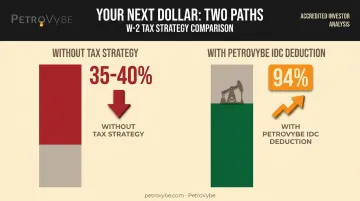
A high-earning W-2 professional in a top bracket might see 35-40% of every marginal dollar disappear before it becomes an investable asset. That's not a one-time hit; it's a permanent drag on the compounding math over an entire career.
This is exactly why high earners with strong human capital but heavy tax burdens need a deliberate plan, not just a savings habit, to accelerate the shift toward financial capital.
PetroVybe's IDC deduction structure was built for this exact scenario — offsetting up to 94% of active income while redirecting the freed-up capital into a productive, tangible asset.
Strategies to Convert Human Capital into Long-Term Financial Capital
Three levers control how fast you convert earnings into lasting assets:
- Increase your savings rate: the most straightforward lever, but limited by lifestyle and taxes
- Improve investment returns: diversify beyond public markets into alternative and direct assets
- Minimize taxes and fees: every dollar saved from Uncle Sam is a dollar that starts compounding immediately
Diversifying Into Direct, Tax-Advantaged Assets
Real estate deductions are typically capped by passive-loss rules: they can only offset passive income unless you qualify as a full-time real estate professional. Oil and gas development operates under a different section of the tax code entirely.
Intangible Drilling Cost (IDC) deductions, when structured through a direct working interest, are treated as nonpassive, meaning they can offset active income, including W-2 wages and capital gains.
This is the model behind PetroVybe's approach. Partners who joined PetroVybe ONE in 2024 received a 94% tax deduction against active income, while 2025 partners saw that figure land at 91%. In practice, a $100,000 investment can generate a $60,000-$80,000 first-year IDC deduction, applied directly against ordinary income, with the remaining structure contributing to the total percentage.
- Structure: 10-year hold, with monthly passive distributions projected to exceed $10,000 per unit during peak production
- Targets: ~2.2x-5.8x MOIC and ~26% IRR over the 10-year window
- Accreditation: required under SEC Regulation D 506(c), with net worth over $1 million excluding primary residence, or income over $200,000 individually ($300,000 jointly)
Passive Structures Protect Your Human Capital Too
The point of converting human capital is building assets that don't require more of your time, not just accumulating more of them. PetroVybe ONE is structured as a fully passive limited partnership.
Investors aren't drilling wells or managing operations. The company's team handles asset acquisition, workovers, and new drilling, focused on protecting legacy production while scaling output through reinvestment. That means your financial capital compounds without pulling hours out of your week: the exact opposite of the human-capital treadmill.
Due Diligence Still Matters
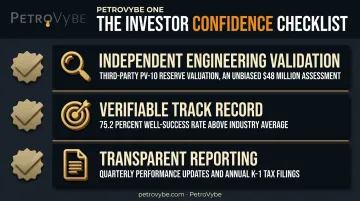
Passive structure aside, not every alternative investment deserves your capital. Before deploying money into any direct asset, look for:
- Independent engineering validation: PetroVybe's proved reserves are valued at $48 million (PV-10), determined by a licensed third-party engineering firm
- A verifiable track record: PetroVybe's chief geophysicist has a documented 75.2% success rate on profitable well locations across a 48-year career, against an industry average below 40%
- Transparent reporting: quarterly updates, K-1 documentation, and public regulatory records
Common Mistakes That Undermine Long-Term Wealth
Even high earners fall into predictable traps that slow down the human-to-financial capital conversion.
- Relying solely on the paycheck. Vanguard's 2025 How America Saves report found high earners above $150,000 defer just 8.6% of pay, well below the recommended 12-15% for a secure retirement. Without parallel financial capital, earning disruptions can collapse total wealth.
- Leaving human capital unprotected. Skipping disability insurance and ongoing skill development leaves the entire plan exposed to a single point of failure.
- Ignoring tax efficiency. Paying full ordinary rates instead of using legal deductions slows how fast human capital converts into compounding financial capital. Every dollar lost to unnecessary tax never gets the chance to grow.
Frequently Asked Questions
Is $100,000 considered wealthy?
It depends on context. As income, $100,000 tops the national median household income of $83,730. As net worth, it falls short of the $192,900 median family figure. True wealth depends on the ratio of capital to expenses, not one number.
What is the difference between human capital and financial capital?
Human capital is your future earning potential — the present value of the paychecks still ahead of you. Financial capital is what you've already converted into owned, tangible assets. Together, they make up your total wealth.
At what age should I start focusing more on financial capital than human capital?
The shift typically begins in your 30s-40s as career earnings peak and fewer working years remain. Aggressive saving and tax-advantaged investing can accelerate that shift much earlier.
How can high-income earners protect and grow their human capital?
Disability and income-protection insurance guard against career-ending events. Ongoing skill development and diversifying income streams reduce reliance on a single employer or industry.
What are alternative investments and how do they help build financial capital?
Alternative investments include private equity, real assets, and direct energy development, meaning anything outside traditional stocks and bonds. They add diversification and often offer higher risk-adjusted return potential than public markets alone.
Can tax-advantaged investments really help convert active income into long-term wealth?
Yes. Vehicles like oil and gas IDC deductions let high earners cut their tax bill immediately, sometimes by 90%+ against active income, while building passive cash flow. That combination shifts wealth from human capital to financial capital faster than fully-taxed savings.