Inflation keeps eroding purchasing power. Markets swing on headlines. Regulations shift faster than most compliance teams can track. Many investors are left wondering which risks are worth taking and which ones quietly threaten decades of accumulated wealth.
This article breaks down the types of risk every asset manager faces, the framework professionals use to manage them, and the modern tools reshaping risk mitigation. We'll also look at how experienced operators apply these same principles to a less conventional asset class: natural resource development.
Key Takeaways
- Risk management blends data-driven models with experienced human judgment.
- Six to seven core risk categories need active, ongoing monitoring.
- A disciplined identify-assess-mitigate-monitor framework beats reactive guesswork.
- Third-party-validated, tangible assets can lower portfolio correlation risk.
What Is Risk Management in Asset Management?
Risk management is the process of identifying, measuring, and controlling the uncertainty around investment outcomes. The goal isn't a risk-free portfolio. There's no such thing. The goal is protecting and growing capital despite the uncertainty that comes with every position an asset manager takes.
Why call it an "art"? Because it doesn't run on a fixed formula. A model can calculate standard deviation in seconds, but it can't tell you whether a geopolitical flashpoint will spiral into a market-moving event next quarter. That takes judgment, pattern recognition, and experience — the human layer that sits on top of the math.
Why Risk Management Matters More Than Ever
Macro conditions have made risk management harder to get right. Inflation, interest rate volatility, geopolitical instability, and AI-driven shifts in capital allocation are compounding on top of one another rather than arriving one at a time.
The data backs this up. In the 2024 Natixis Institutional Outlook Survey of 500 institutional investors across 27 countries, 62% cited interest rates and 61% cited inflation as their biggest portfolio concerns. Nearly half pointed to geopolitical instability as the leading macroeconomic threat.
These pressures explain the anxiety, but the CFA Institute frames risk management as more than a defensive shield. It's described as an offensive tool: a way to pursue better outcomes, not just protect against bad ones. Managers who treat risk management as pure defense tend to under-allocate to opportunities that carry short-term volatility but long-term upside.
Risk Management vs. Risk Avoidance
Here's a common misconception worth clearing up: minimizing risk is not the objective.
An investor who avoids all risk also avoids all return. The real job is optimizing the risk-return tradeoff for a specific investor's goals and time horizon, while factoring in their tax situation. A 30-year-old accumulating wealth and a retiree drawing income need very different risk postures, even if they're evaluating the same asset.
Risk avoidance is passive; risk management is active, a deliberate choice about which risks are worth taking.
The 7 Core Types of Risk Every Asset Manager Must Monitor
Every asset, whether it's a stock, a bond, or a working interest in a gas well, carries some combination of these risk categories. They rarely show up alone.
| Risk Type | What It Means |
|---|---|
| Market risk | Exposure to price swings in equities, rates, currencies, and commodities |
| Credit risk | A counterparty or partner fails to meet a financial obligation |
| Liquidity risk | Inability to exit a position without a steep price discount |
| Operational risk | Losses from internal process failures, personnel gaps, or external shocks |
| Regulatory/legal risk | Compliance failures or shifting laws that alter an asset's value |
| Model risk | Flawed valuation or predictive models produce bad decisions |
| Tail risk | Rare, extreme events that fall outside normal statistical assumptions |
A few of these deserve closer attention for alternative and commodity-linked assets:
- Market risk in commodity-linked investments moves differently than equities. Natural gas pricing, for example, responds to weather, storage levels, and export demand rather than corporate earnings.
- Liquidity risk is especially relevant in private and alternative investments. Lock-up periods mean investors can't exit on a bad day the way they could sell a stock.
- Operational risk for physical assets includes weather events, equipment failures, and cyberattacks — not just internal process breakdowns.
- Tail risk, per GARP's guide on tail risk in wealth management, covers events so rare that historical-data models often fail to capture them adequately.
The Risk Management Framework: A Step-by-Step Process
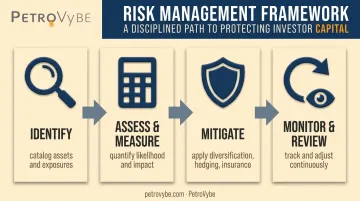
Professional asset managers don't manage risk on instinct alone. They follow a repeatable process, and it usually looks like this:
- Identify: Catalog every asset, exposure, and potential threat. Institutional managers often use a risk register that links specific vulnerabilities to specific holdings, so nothing falls through the cracks.
- Assess & Measure: Quantify likelihood and impact. This might mean calculating standard deviation and beta for a stock portfolio, or commissioning a third-party engineering audit for a physical asset like an oil and gas project.
- Mitigate: Apply strategies that reduce exposure: diversification, hedging, insurance, or contractual protections written into partnership agreements.
- Monitor & Review: Track risks continuously and adjust as conditions change. Static risk assessments go stale fast in volatile markets.
Risk Budgeting: Matching Risk to Investor Goals
Underneath all four steps sits a concept institutional managers call risk budgeting: allocating total risk appetite across sub-portfolios based on each investor's tolerance and time horizon.
A manager with a 10-year hold period can budget for more short-term volatility than one managing a five-year exit window. Risk tolerance isn't generic. It has to align with the specific goals of the capital being deployed.
Modern Risk Mitigation Strategies for a Volatile Market
Diversification Beyond Stocks and Bonds
Traditional 60/40 portfolios still carry more correlated risk than most investors realize. When equities drop, bonds don't always provide the cushion they used to.
Allocating a portion of a portfolio to tangible, alternative assets can meaningfully reduce that correlation. According to a Brookfield analysis of institutional benchmarks, private U.S. real estate showed a 0.04 correlation with the S&P 500 over the 20-year period through December 2024, practically no relationship at all.
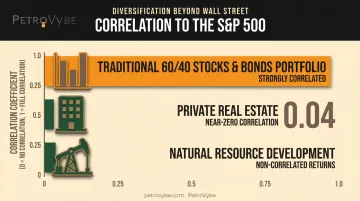
Natural resource development sits in a similar category: its returns are driven by geology, commodity demand, and production economics, not stock market sentiment.
Data Analytics, AI, and Stress Testing
Predictive modeling has become a standard part of the risk manager's toolkit. CFA Institute research found that 29% of systematic investors already use AI to develop and test investment strategies, and more than 75% expect to in the near future. Stress testing, running portfolios through hypothetical shock scenarios, helps managers spot vulnerabilities before they materialize into real losses.
Third-Party Validation as a Trust-Building Tool
Independent audits, engineering reports, and verified investor reviews close the information gap between managers and the people trusting them with capital. A proved reserves valuation confirmed by a licensed third-party engineering firm, for example, carries more weight than any internal projection because the firm has no financial stake in the outcome. That kind of independent verification is what builds the trust that keeps capital invested for the long haul.
How PetroVybe Applies Institutional-Grade Risk Management to Natural Gas Development
Natural resource investing carries risks that don't show up in a typical stock portfolio: geological uncertainty, commodity price swings, and operational execution in the field. Managing them well requires more than a spreadsheet.
Geological risk is the first hurdle, and it's the biggest one. PetroVybe's Chief Geophysicist, Michael Stamatedes, brings a 48-year career and a 75.2% well-success rate, well above the industry peer average that hovers below 40%.
His track record includes more than 3 TCF of natural gas discoveries and 270 BCF produced. In an industry where roughly six out of ten wells can miss, that kind of hit rate is a direct mitigant against the single largest risk in upstream development.
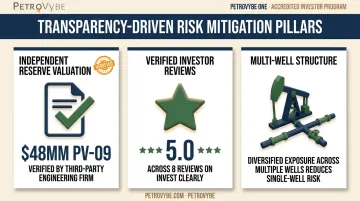
Transparency reduces information risk further:
- Independent reserve valuation. PetroVybe's proved reserves are valued at $48MM (PV-09), determined by a licensed third-party engineering firm rather than internal projections.
- Verified investor reviews. PetroVybe holds a 5.0 rating across 8 verified reviews on Invest Clearly, an independent platform where accredited investors document real experiences.
- Multi-well structure. Projects are built across multiple wells rather than a single wellbore, so one underperforming well doesn't sink the entire investment thesis.
There's also a tax dimension to risk-adjusted returns. Through Intangible Drilling Cost deductions, PetroVybe partners received a 91-94% tax deduction against active income in 2024 and 2025. That deduction lowers the effective cost basis of the investment, which cushions downside exposure before a single well even starts producing. That effect makes the deduction a structural risk mitigant rather than simply a tax perk.
Frequently Asked Questions
What are the risks in asset management?
The main categories are market, credit, liquidity, operational, and regulatory risk. These risks rarely occur in isolation — a liquidity crunch, for instance, often follows a market shock, so managers need to watch for interaction effects, not just single-category exposure.
What are the 7 types of risk?
Market, credit, liquidity, operational, legal/regulatory, model, and tail risk. Each covers a distinct source of uncertainty, from price swings and counterparty defaults to rare, high-impact events that fall outside normal statistical models.
What are the 5 P's of asset management?
A common due-diligence framework evaluates managers on People, Philosophy, Process, Performance, and Price. It's a practical adaptation of frameworks used by firms like Morningstar and CFA Institute for manager selection.
How is risk management different from risk avoidance in asset management?
Risk management means deliberately choosing and balancing risk to optimize returns for a specific goal. Risk avoidance tries to eliminate risk entirely, which usually means eliminating meaningful returns along with it.
Can alternative investments like natural gas development reduce portfolio risk?
Yes, when properly vetted. Tangible assets with low correlation to public markets can diversify a portfolio, but only when backed by third-party reserve validation, experienced operators, and transparent reporting.
How do asset managers measure risk?
Common tools include standard deviation, beta, and Value-at-Risk for quantifying market exposure, plus stress testing and scenario analysis to model how a portfolio would behave under adverse conditions.