

Introduction
A doctor earning $400,000 a year and a retired teacher with a paid-off house and a $2 million portfolio can both look "rich" at a dinner party. Only one of them is actually wealthy.
That mix-up between income and wealth trips up smart people constantly. Many high earners struggle with lifestyle creep, mistaking a big paycheck for financial security. Only about one in three American millionaires consider themselves genuinely wealthy, according to Northwestern Mutual's 2025 Planning & Progress Study.
That gap is exactly what wealth theory tries to explain. This article breaks down what wealth theory actually means, its core pillars, and the frameworks people use to apply it. You'll also see how to put these ideas to work in your own financial life.
Key Takeaways
- Wealth is a stock (net worth now); income is a flow (earnings over time) that shouldn't be confused
- Six pillars drive wealth theory: income generation, savings, asset growth, tax efficiency, diversification, and legacy planning
- Frameworks like the 5 Levels of Wealth, the Wealth Effect, and the Goldilocks Theory show wealth theory in action
- Lasting wealth requires moving past a salary into asset ownership, tax-advantaged strategies, and compounding returns
What Is Wealth Theory? (Definition)
Wealth theory is the body of economic and financial thinking that explains how wealth gets created, measured, distributed, and protected. Investopedia defines wealth as the value of accumulated assets, both physical and intangible, minus debts. In practice, that means:
Net Worth = Assets − Liabilities
This formula is the backbone of financial planning because it's simple, measurable, and comparable across time.
Wealth Is a Stock, Income Is a Flow
Adam Smith drew this distinction back in 1776 in The Wealth of Nations, separating "stock" reserved for future use from revenue generated along the way. Modern economics kept that split:
Wealth is a snapshot, measured at one point in time, like a photo. Income is an ongoing stream, measured over a period, like a video.
A surgeon making $500,000 a year has strong income. If she spends most of it, her wealth might barely move. This is why wealth theory treats net worth, not salary, as the real scoreboard.
Wealth is also relative. People judge their financial well-being against peers, not against an absolute number. That's part of why so many high-net-worth individuals still don't feel wealthy — the Northwestern Mutual study cited above found only 36% of millionaires felt truly wealthy, while 49% said their financial plans needed work.
Beyond Money: What Counts as Wealth
Historically, wealth wasn't measured in dollars at all; it was land, livestock, wheat, or gold. The common thread across every era: scarcity. Something only holds wealth value if it's limited in supply relative to demand.
Modern frameworks push this further. The UN's "inclusive wealth" concept measures nations using produced capital, human capital, and natural capital together, not just GDP. The takeaway for individuals is similar: real wealth includes skills, relationships, and health, not just a brokerage statement.
The Key Pillars of Wealth Theory
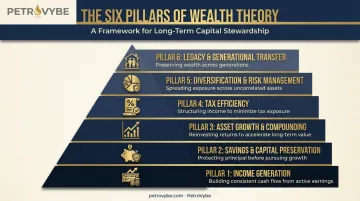
So what are the pillars of wealth? Most wealth-building frameworks, whether built by economists or financial planners, rest on the same six foundational ideas.
Pillar 1: Income Generation
Active income comes from labor (a salary, a paycheck). Passive income comes from assets working on your behalf, think rental payments, dividends, or royalties. Wealth theory prioritizes passive income because it keeps flowing whether or not you show up to work.
Pillar 2: Savings and Capital Preservation
You can't build wealth without a surplus to invest. Yet many people struggle here. Vanguard's 2025 retirement research found only about 7% of defined-contribution plan participants saved at least 15% of their own pay. That figure jumps to 32% once employer contributions are included. Savings is the base of the pyramid; nothing above it works without it.
Pillar 3: Asset Growth and Compounding
Reinvested returns compound. A modest sum, left alone and reinvested, grows far larger than most people expect because gains generate their own gains. This is why time in the market beats timing the market — an extra five years of compounding often outperforms a perfectly timed entry.
Pillar 4: Tax Efficiency
Taxes are one of the largest lifetime expenses for high earners, yet this pillar gets ignored constantly. Minimizing tax drag through legal deductions and tax-advantaged vehicles is a deliberate, often overlooked, wealth-building strategy that compounds for decades.
Pillar 5: Diversification and Risk Management
Spreading capital across asset classes protects wealth from any single downturn. A portfolio might include:
- Public equities
- Real estate
- Fixed income
- Alternative assets like energy, commodities, or private partnerships
Pillar 6: Legacy and Generational Transfer
Wealth theory doesn't stop at your lifetime. Estate planning and generational transfer determine whether what you build outlasts you, or gets eaten by taxes, probate, and poor planning.
Real-World Examples: Wealth Theory Frameworks in Action
Economists and financial thinkers have translated wealth theory into practical models people actually use. Here are four worth knowing.
The 5 Levels of Wealth Framework
The Money Guy Show's framework maps wealth-building to five progressive stages:
- Financial Stability — bills and basic needs are covered
- Financial Strategy — consistently directing roughly 20-25% of income toward future goals
- Financial Security — small discretionary expenses don't cause anxiety
- Financial Freedom — net worth reaches a benchmark tied to age and income
- Financial Abundance — money no longer restricts choices, freeing focus for purpose and legacy
The Wealth Effect
Behavioral economists have long observed that rising asset values (a home price jump, a stock rally) make people spend as though they're richer, even without any change in income. Federal Reserve research estimated that a permanent $1 increase in household wealth was tied to roughly 3-5 cents of additional long-run spending.
A useful historical example: when the U.S. imposed a temporary 10% tax surcharge in 1968, consumers largely kept spending anyway. The personal saving rate dropped from 7.5% to 5.6% as people covered the tax hike by saving less rather than cutting spending. That's the wealth effect (and its inverse) playing out in real economic data.
The Goldilocks Theory of Wealth
Entrepreneur Ben Casnocha argues there's a "just right" amount of wealth: enough to secure independence and choice, but not so much that it creates hassle, isolation, or motivational problems. Past a certain threshold, Casnocha contends, extra income brings diminishing returns: more assets mean more management headaches and less incentive to keep building. The theory challenges the assumption that unlimited accumulation is always the goal.
Net Worth Distribution Examples
Wealth theory has real stakes at the national level, too. As of Q1 2026, the top 1% of U.S. households held 31.6% of aggregate net worth, according to Federal Reserve data. Compare that to the median U.S. family net worth of roughly $192,900 (2022 Survey of Consumer Finances data). That gap explains why these frameworks matter beyond theory: they determine who can weather a job loss, retire on schedule, or leave a legacy.

The Three Laws of Wealth
If you strip wealth theory down to its essentials, three laws hold regardless of income level:
- Spend less than you earn. Without a surplus, none of the other pillars matter.
- Invest the surplus in appreciating, income-producing assets. Cash sitting idle loses purchasing power to inflation.
- Protect and compound that capital over time through tax efficiency and diversification.
These laws apply just as much to someone earning $60,000 as someone earning $600,000. A high-earning executive who spends every dollar of a large salary and never invests the surplus will accumulate less real wealth than a modest earner who consistently follows all three laws. Income alone doesn't build wealth. Behavior does.
Wealth vs. Income vs. Net Worth: Why the Distinction Matters
Thomas Stanley's research in The Millionaire Next Door drew a sharp line between two types of affluence:
| Type | Description | Typical Trait |
|---|---|---|
| Income Statement Affluent | High income, high spending | Looks wealthy, isn't |
| Balance Sheet Affluent | Substantial accumulated net worth | Is wealthy, may not look it |
Consider a surgeon earning a $500,000 salary who leases a luxury car. That surgeon may be income statement affluent, but the numbers tell a different story:
- High income funds a high-spending lifestyle, not asset growth
- Lease and loan payments erode balance sheet gains
- Net worth (assets minus liabilities), not salary, determines actual wealth
This same confusion shows up at the national level. GDP gets cited constantly as a measure of a country's wealth. In reality, it's a measure of income, the value of goods and services produced during a period, not the stock of assets a nation holds. The distinction holds whether you're analyzing a single household or an entire economy.
How to Apply Wealth Theory to Build Real, Lasting Wealth
Applying wealth theory in practice means shifting focus from earning more to owning appreciating, income-generating assets that compound over time. That shift is where tax efficiency and asset growth start working together instead of separately.
One modern example: tax-advantaged, tangible asset investments like direct participation in oil and natural gas development. Here's how that pairing works structurally. Upfront tax efficiency comes first: Intangible Drilling Costs (IDCs) are typically 60-80% deductible in the year invested, and this deduction can offset active income, including W-2 earnings and capital gains, not just passive income. Long-term asset growth follows, as capital deployed into drilling builds a producing asset base that generates monthly passive distributions over a multi-year hold period.
PetroVybe's structure illustrates this directly: partners received a 94% tax deduction against active income in 2024 and 91% in 2025. That same invested capital builds toward projected passive distributions that can exceed $10,000 per month during peak production, across a projected 10-year hold with a targeted MOIC range of roughly 2.2x-5.8x.

Numbers like these are compelling, but they don't replace due diligence. Before committing capital to any asset class, run it through the three laws:
- Does this let me keep spending below my income?
- Does it put my surplus into an appreciating, income-producing asset?
- Does it include a real mechanism to protect and compound that capital, whether through tax efficiency, diversification, or reinvestment?
If an opportunity satisfies all three, it aligns with wealth theory. If it only satisfies one, it's a good story, not necessarily a good plan.
Frequently Asked Questions
What are the pillars of wealth?
The core pillars are income generation, savings, asset growth through compounding, tax efficiency, diversification, and legacy planning. Most durable wealth-building strategies touch on all six in some form.
What are the three laws of wealth?
Spend less than you earn, invest the surplus in appreciating and income-producing assets, then protect and compound that capital through tax efficiency and diversification. They apply at any income level.
What is the difference between being rich and being wealthy?
"Rich" typically describes high income or visible spending power. "Wealthy" describes accumulated net worth and the financial freedom that comes with it, regardless of how flashy someone's lifestyle looks.
How is personal wealth measured?
The standard measure is net worth: total assets minus total liabilities. It's a stock measurement, meaning it reflects your financial position at a specific point in time, not what you earned last year.
What is the "wealth effect" in economics?
It's the behavioral pattern where rising asset values, like home prices or stock portfolios, make people feel richer. This confidence boost leads to increased spending, even without any actual change in their income.
Can tax-advantaged passive investments help build long-term wealth?
Yes. Vehicles that pair upfront tax deductions with tangible asset ownership, such as direct natural gas development investments, can address the tax-efficiency and asset-growth pillars simultaneously for accredited investors.