

Cash flow problems don't discriminate by industry or size. CB Insights' analysis of 385 VC-backed companies that shut down since 2023 found that 70% ran out of capital before they ran out of ideas. Profitability didn't save them. Liquidity did — or in these cases, didn't.
The same principle applies to investors holding stocks, real estate, or private partnerships. An asset can be worth a fortune on paper and still leave you unable to cover this month's obligations if you can't sell it fast enough, or without a steep discount.
This guide breaks down liquidity management for operating businesses and investment portfolios, including how it applies to illiquid alternative assets like direct energy development, where a longer hold is the trade-off for stronger return potential.
Key Takeaways
- Liquidity management keeps cash on hand to meet obligations without forced sales
- Current, quick, and cash ratios reveal short-term liability coverage
- Solvency, profitability, and liquidity are separate — none guarantees the others
- Public markets offer daily liquidity; private equity and energy trade time for returns
- Accredited investors pair liquid reserves with illiquid assets once cash needs are met
What Is Liquidity Management?
Liquidity management is the set of strategies a business or investor uses to keep enough liquid assets available to meet short-term obligations, without leaving so much cash idle that it drags down returns.
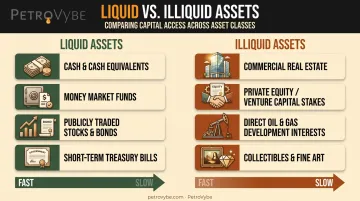
Liquid assets convert to cash quickly, at or near market value:
- Cash and cash equivalents
- Money market funds
- Publicly traded stocks and bonds
- Short-term Treasury bills
Illiquid assets take longer to sell, often at a discount if you need to exit fast:
- Commercial real estate
- Private equity and venture capital stakes
- Direct oil and gas development interests
- Collectibles and fine art
The discipline applies at two levels. Businesses and banks manage liquidity to cover payroll, supplier payments, and debt service. Individual investors manage it to make sure a portfolio's overall mix won't leave them scrambling if a large expense or opportunity shows up unexpectedly.
Liquidity vs. Solvency vs. Cash Flow
These three terms get used interchangeably, but they measure different things.
A company can be solvent (total assets exceed total liabilities) and still be illiquid, unable to cover this month's payroll because its assets sit in inventory, receivables, or equipment. Solvency is a long-term balance sheet question. Liquidity is a "can you pay the bill due Friday" question.
Positive cash flow over a quarter doesn't guarantee liquidity at any single point, either. A business that collects most of its revenue in the last week of the month but owes rent, payroll, and loan payments on the 1st can show healthy cash flow on paper. It can still miss a payment mid-month. Timing, not totals, is what liquidity management is built to solve.
Why Liquidity Risk Matters
Liquidity risk splits into two categories:
- Market liquidity risk: the inability to sell an asset quickly at a fair price
- Funding liquidity risk: the inability to meet cash obligations as they come due
The Federal Reserve's own review of Silicon Valley Bank's 2023 collapse called it "a textbook case of mismanagement," noting that leadership failed to manage basic interest-rate and liquidity risk. SVB wasn't insolvent right up until the run. But when depositors tried to pull more than $40 billion in a single day, the bank couldn't convert its bond holdings to cash fast enough without realizing steep losses. That's funding liquidity risk playing out in real time, and it's why regulators now treat liquidity oversight as seriously as capital adequacy.
Liquidity Management in Business
Every business liquidity strategy starts by comparing what a company owes soon against what it can convert to cash soon. That's the job of the current, quick, and cash ratios, covered in detail further down.
Ratios are a snapshot, though. Real liquidity management runs on rolling cash flow forecasts:
- 13-week (short-term) forecasts — track weekly cash positions for immediate visibility into shortfalls, often used to monitor loan covenants
- 3-to-12 month (medium-term) forecasts — built from budgets and historical patterns rather than confirmed transactions
- Longer-range (long-term) models — extend 12-18 months to support decisions like hiring or capital spending
Tightening the Cash Conversion Cycle
Working capital optimization is where most controllable liquidity gains happen. It comes down to three levers:
- Receivables — invoice promptly and tighten payment terms to collect cash faster
- Payables — negotiate longer terms with suppliers without straining the relationship
- Inventory — hold less dead stock and turn inventory faster to free up cash
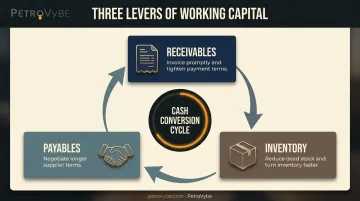
This cycle is the gap between paying for inputs and collecting from customers. Shortening it reduces how much a business needs to borrow or hold in reserve to bridge that timing mismatch.
Backup Liquidity for the Unexpected
Even well-forecasted businesses hit surprises: a late-paying customer, an equipment failure, a slow season that runs long. Backup liquidity tools cover the gap:
- Revolving credit lines
- Cash reserve policies (often 3-6 months of operating expenses)
- Overdraft protection agreements with a primary bank
The startup data cited earlier makes the case plainly: cash shortages end more companies than bad ideas ever do. Backup liquidity tools exist to prevent exactly that outcome.
Liquidity Management in Investing
Market liquidity is how easily you can buy or sell an asset at its current price. The tighter the bid-ask spread, the more liquid the market. A narrow spread means buyers and sellers agree closely on value; a wide spread signals thin trading and a higher cost to exit.
Highly liquid markets include public stocks, major currency pairs, and exchange-traded commodities, where deep trading volume typically keeps spreads tight and execution costs low.
Illiquid asset classes trade far less often and can take months to sell:
- Commercial and residential real estate
- Private equity and venture capital stakes
- Direct oil and gas development interests
- Fine art and other collectibles
Even in liquid markets, liquidity can vanish under stress. A stock's exchange listing doesn't guarantee depth when volatility spikes — spreads can widen and the size available at the best price can shrink fast, leaving even "liquid" holdings harder to exit at a fair price than investors assume.
Why Institutional Size Creates Its Own Risk
Large investors face a paradox: the same size that gives them negotiating power can work against them in thin markets. A fund selling a large block of a lightly traded asset can move the price against itself just by placing the order. Institutions often split large trades across several days or venues to avoid this.
Balancing Liquid and Illiquid Holdings
Portfolio-level liquidity management means avoiding over-concentration in assets that can't be converted to cash quickly relative to near-term needs. An investor who ties up 80% of net worth in real estate and private deals, with only a thin liquid cushion left, is exposed the moment an emergency or opportunity calls for fast cash.
This is where the illiquidity premium comes in: the additional return an investor may demand, or receive, for locking up capital in assets that can't be sold on short notice. It's real and well-documented in private markets, but it's an expectation, not a guarantee.
Investors forced to exit a private fund early often face secondary-market discounts of 10% or more below net asset value, the practical cost of needing liquidity before an asset is ready to give it up. Long-term oil and gas partnerships, such as PetroVybe's 10-year hold structures, are built around this same tradeoff: investors accept reduced liquidity in exchange for tax-advantaged returns and distributions designed to offset the wait.
Balancing Liquidity With Illiquid Alternative Investments
Once an investor has covered near-term cash needs, illiquidity becomes a strategic lever rather than a risk to avoid. Accredited investors regularly allocate part of their portfolio to illiquid alternatives because the years-long capital lockup comes with diversification, inflation protection, and return potential public markets don't always offer.
Direct participation in natural gas development is one example. PetroVybe's projects in Lavaca County and the broader Gulf Coast Basin of South Texas give accredited investors direct equity in upstream energy assets, rather than shares of a publicly traded energy company. The structure pairs three things that matter to liquidity-aware investors:
- A long return horizon: PetroVybe targets a 10-year hold with a projected MOIC of 2.2x-5.8x and an IRR near 26%
- An upfront tax offset: IDC deductions let partners offset active income, including W2 earnings and capital gains, with PetroVybe partners seeing 91-94% deductions in 2024 and 2025
- Accredited-investor access: Participation requires accredited investor status and a $100,000 minimum commitment, reflecting the regulatory framework and multi-year horizon involved

That tax treatment sets this asset class apart from most illiquid alternatives. Real estate depreciation typically offsets only passive income. The IDC deduction, by contrast, can offset active income directly. That difference draws interest from high-earning W2 professionals and investors sitting on recent capital gains, not just passive-income seekers.
This doesn't replace liquid reserves. It sits on top of them. Capital committed to a project like this is generally locked up for years, with distributions typically starting only after production begins, not on day one.
An investor without adequate cash reserves elsewhere shouldn't be eyeing a 10-year illiquid hold, no matter how attractive the return profile looks. Build the liquid foundation first, then layer in illiquid, higher-conviction positions with capital you won't need to touch.
Best Practices and Key Liquidity Ratios
Three ratios cover most of what you need to gauge liquidity risk at a glance.
| Ratio | Formula | General Benchmark |
|---|---|---|
| Current ratio | Current assets ÷ current liabilities | 1.5–3.0 |
| Quick ratio | (Cash + securities + receivables) ÷ current liabilities | 1.0 or higher |
| Cash ratio | Cash & equivalents ÷ current liabilities | 0.5–1.0 |
These benchmarks shift by industry. ReadyRatios' 2024 data from 3,458 U.S. public filers puts the median current ratio at 1.78 across all industries. Capital-intensive sectors like building construction and chemicals run closer to 3.2, a reminder that "good" depends heavily on the business model.
Best practices worth adopting regardless of industry:
- Monitor cash position weekly, not just at month-end close
- Stress-test against a delayed customer payment or a sudden rate spike
- Maintain relationships with more than one bank or lender
- Set a minimum cash reserve target and treat it as non-negotiable
- Reassess ratios quarterly against your specific industry benchmark, not a generic rule of thumb
Frequently Asked Questions
What is liquidity asset management?
Liquidity asset management is the practice of managing cash and easily convertible assets, like money market funds or short-term securities, so obligations are covered while idle funds still earn a return.
What does $30,000 in liquid assets mean?
It means $30,000 held in cash or assets, such as stocks or money market funds, that can be converted to cash quickly without a significant loss of value.
What does illiquid mean?
An illiquid asset or company can't be converted to cash or sold quickly without accepting a discount. Real estate and private business stakes are common examples.
What is the difference between liquidity and solvency?
Liquidity measures whether you can cover obligations due soon. Solvency measures whether total assets exceed total liabilities over the long run. You can have one without the other.
What is considered a good liquidity ratio?
A current ratio above 1.5 and a quick ratio above 1.0 are common benchmarks, though capital-intensive industries often run higher and inventory-heavy ones can run lower.
How do investors manage liquidity risk in a portfolio?
By keeping enough liquid reserves to cover near-term needs before committing capital to illiquid holdings, and by avoiding over-concentration in assets that can't be sold quickly.