
Generational wealth isn't a lottery ticket or a single inheritance check. It's a repeatable process: accumulating assets, protecting them from taxes and market swings, then transferring both the capital and the know-how to manage it.
This matters more now than it did a decade ago. The wealthiest U.S. households hold a disproportionate share of national wealth, and an estimated $124 trillion is projected to change hands by 2048 in the largest generational wealth transfer in history. Families without a plan risk watching that money evaporate within a generation or two.
This guide breaks the process into five sequential steps, from paying off debt to protecting what you've built with an estate plan. Skip a step, and wealth tends to stall or disappear. Follow them in order, and you give your family a real shot at lasting financial security.
Key Takeaways
- Generational wealth-building follows five steps: foundation, income growth, compounding, tax efficiency, and estate protection.
- An estimated $124 trillion will transfer between U.S. generations through 2048, according to Cerulli Associates.
- High earners use natural gas development to offset income and diversify beyond stocks and real estate.
- Wealth transfer plans fail more often from missing financial education than from missing assets.
What Is Generational Wealth?
Generational wealth is the combination of assets, income streams, and financial know-how that a family builds intentionally and passes down, rather than assets that simply arrive as an inheritance. It includes real estate, investment portfolios, business equity, and cash-flowing alternative assets, plus the knowledge needed to manage all of it.
The goal is multi-generational financial security: upward mobility that compounds with each generation instead of resetting to zero after a single windfall.
That compounding effect is exactly why being rich and having generational wealth aren't the same thing. A high income can disappear the moment a paycheck stops. Generational wealth is built with structure:
- Assets that produce income independent of anyone working a job
- Legal protections like trusts and wills that direct where those assets go
- Financial education passed down so heirs know how to manage what they receive
That structure, not the size of the first check, determines whether wealth survives past one generation.
Why Building Generational Wealth Matters Right Now
America's wealth is more concentrated than most people realize. Based on the Federal Reserve's 2026 Distributional Financial Accounts, the top 1% of U.S. households hold about 31.6% of total household wealth, while the top 10% control about 68%. The bottom half of the country holds just 2.5%.
That gap is about to shift. Cerulli Associates projects $124 trillion in wealth transfers through 2048, with roughly $105 trillion moving directly to heirs and the rest going to charity. It's the largest intergenerational wealth shift in U.S. history, and most families haven't built a plan for their piece of it.
Where Most Households Actually Stand
Despite headlines about millionaires, most Americans are nowhere near $1 million in net worth. Census data show median U.S. household wealth was $191,100 in 2023, and only about 1 in 10 households crossed $1.8 million. Building real generational wealth still puts a family ahead of the vast majority of others.
Inflation and Taxes Are Working Against You
Three forces work against wealth-building progress for high earners:
- Inflation: Consumer prices rose 3.5% over the past year, so a portfolio growing slower than that is losing real purchasing power.
- Ordinary income tax: The top federal rate sits at 37% for income above close to $640,600 for single filers in 2026.
- Capital gains and NIIT: Long-term gains are taxed up to 20%, plus a 3.8% Net Investment Income Tax for high earners on both W2 overflow and investment gains.
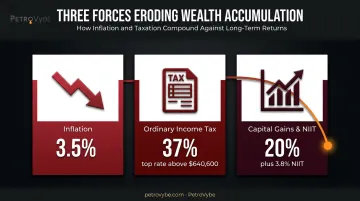
For someone earning a substantial salary or sitting on a large capital gains event, savings and standard brokerage growth alone rarely outrun this combination. That's exactly why tax-efficient, alternative-asset strategies, covered in Step 4 below, have become a serious part of high-earner wealth plans rather than a niche tactic.
The 5 Steps to Building Generational Wealth
Wealth building follows a logical sequence. Stabilize your finances first, accumulate capital, grow it through compounding investments, protect it from taxes through diversification, then transfer it through an estate plan. Skip a step, like investing aggressively while still carrying high-interest debt, and the whole structure tends to buckle. Here's how each stage works.
Step 1: Build a Debt-Free Financial Foundation
Before any investment strategy makes sense, eliminate high-interest debt and build a cash cushion. Credit card balances at 20%+ interest will outpace almost any investment return, so paying those down first isn't optional. It's math.
A solid foundation includes:
- Zero high-interest debt, meaning credit cards and personal loans paid off completely
- 3-6 months of expenses held in an accessible emergency fund
- A working budget that tracks income against spending
This step is also where financial literacy starts compounding across generations. Parents who teach kids how to budget, build credit responsibly, and avoid consumer debt lay groundwork that often matters more than the first dollar invested.
Step 2: Maximize Income and Tax-Advantaged Savings
With debt gone and a safety net in place, the next move is growing income and directing it into accounts that shield growth from taxes. Contribute to a 401(k) up to any employer match, an HSA for its triple tax advantage, and a 529 plan if you're saving for kids or grandkids.
Income growth itself matters enormously here. BLS data show a stark gap by education level:
| Educational Attainment | 2024 Median Weekly Earnings |
|---|---|
| Professional degree | $2,363 |
| Bachelor's degree | $1,543 |
| High-school diploma | $930 |
| Less than high school | $738 |
Workers with a professional degree earn roughly 3.2 times more per week than those without a high school diploma. Investing in credentials or a career change isn't separate from wealth building. It is wealth building, since higher earned income directly expands how much you can save and invest each year.
Step 3: Invest for Long-Term Compounding Growth
Once income flows into tax-advantaged accounts, growth vehicles do the heavy lifting: stocks, real estate equity, and business ownership all compound over decades.
Starting early beats starting big. In a CNBC hypothetical using an assumed 8% average annual return, someone investing $250 a month starting at age 25 ends up with $878,570 by 65. Wait until 35 to start the same contribution, and the total drops to $375,073, less than half, despite losing only ten years of contributions.
That gap shows why time in the market outweighs timing the market. A modest, consistent investment made early typically outperforms a larger investment made later, because compounding needs years to do its work.
Step 4: Diversify Into Tax-Efficient, Alternative Assets
As income and net worth climb, so does the tax bill on conventional accounts and capital gains. A high W2 earner, or someone sitting on a large gain from selling a business or stock, often finds that a 37% top rate plus the 3.8% NIIT erodes returns from savings and standard brokerage growth alone.
This is where direct investment in tangible, cash-flowing alternative assets enters the picture. Natural gas and oil development projects offer something conventional retirement accounts don't: **Intangible Drilling Cost (IDC) deductions that apply directly against active income**, including W2 wages and capital gains, not just passive income.
At PetroVybe, accredited investors participate directly in natural gas development projects across South Texas and the Gulf Coast Basin. Partners who joined in 2024 received a 94% tax deduction against active income; 2025 partners received 91%. A $100,000 investment can generate $91,000 to $94,000 in deductions the same tax year, while the underlying wells continue producing.
The structure is built for long-term compounding:
- Minimum investment of $100,000 in liquidity, with mandatory accredited investor status
- A 2 to 3 year hold period before distributions begin
- Monthly passive distributions projected to peak above $10,000/month during production
- A 10-year target MOIC of roughly 2.2x to 5.8x and target IRR near 26%
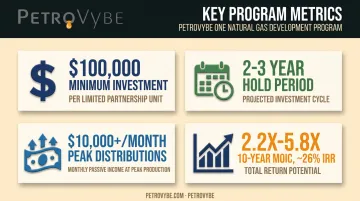
Unlike real estate, where deductions are typically trapped by passive loss rules unless you qualify as a real estate professional, IDC deductions carry no such restriction. That makes energy development one of the few tangible asset classes able to offset a high salary or a one-time capital gain in the same year it happens. You can explore how this works through PetroVybe's investment program.
Step 5: Protect and Transfer Wealth Through Estate Planning
Accumulating wealth means nothing if it's lost to probate delays, unnecessary taxes, or heirs who don't know what to do with it. Estate planning closes that gap.
Three tools do most of the work:
- A will directs how probate assets are distributed, but it doesn't avoid probate on its own.
- A properly funded trust can move assets outside of probate entirely, provided they're actually transferred into the trust during your lifetime.
- Beneficiary designations on retirement accounts, life insurance, and payable-on-death accounts pass directly to named heirs, bypassing probate.
None of these automatically reduce federal estate tax exposure, since the gross estate can include both probate and non-probate property. For 2026, the federal estate tax exclusion sits at $15 million per individual, so most families won't owe federal estate tax, though state rules and business assets can complicate things.
The often-repeated claim that most family wealth disappears by the third generation gets cited constantly in estate planning circles. The exact percentages are hard to verify, but the underlying pattern is well documented: families that pass down assets without passing down financial literacy tend to see that wealth erode fast. Teaching heirs how to manage, invest, and protect what they inherit matters as much as the estate plan itself.
Key Factors That Influence Your Generational Wealth Strategy
Not every family should follow the five steps at the same pace or in the same proportions. A few variables shape the right mix:
- Income level and tax bracket determine whether retirement accounts alone provide enough shelter, or whether direct alternative-asset investments offer more meaningful relief
- Time horizon determines how aggressively you can invest, based on the number of decades available for compounding before wealth needs to transfer
- Risk tolerance and diversification determine how you balance traditional stocks and real estate against less-correlated alternatives like energy development, smoothing returns across market cycles
- Family financial literacy and communication determine whether the next generation is prepared to manage what's transferred, or whether they spend it quickly
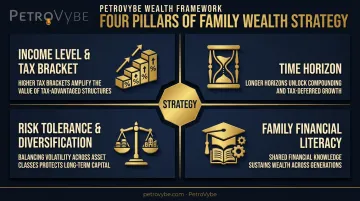
Natural gas development tends to carry lower correlation to stock market swings than equities, since it's tied to physical production and demand rather than market sentiment. For a family already heavy in stocks and real estate, that diversification can matter as much as the returns themselves.
Common Mistakes That Derail Generational Wealth
Building wealth is one challenge. Keeping it intact for decades is another, and most families lose ground in the same few ways.
- Confusing income with wealth: spending like a high earner instead of building appreciating assets leaves nothing behind once the paycheck stops
- Ignoring taxes until it's too late: waiting for a high-income year or major capital gains event to plan taxes usually means an avoidable six- or seven-figure bill
- Skipping heir education: passing down assets without teaching heirs to manage them is a top reason family wealth doesn't survive past two generations
Each of these mistakes shares a common root: treating wealth building as a single event instead of an ongoing process. Families that maintain wealth across generations tend to revisit their strategy regularly, adjusting for new tax law, new life stages, and new heirs entering the picture.
Frequently Asked Questions
What is wealth generation?
Wealth generation is the process of building and growing assets through income, investing, and ownership over time. It's the accumulation side of the equation, distinct from simply earning a high salary.
What are the different types of wealth?
Financial wealth is only one piece. Many advisors also point to time, social, mental, and physical wealth as parts of a fuller, more holistic definition of a wealthy life.
What is the 3-generation rule for wealth?
It's the idea, sometimes called "shirtsleeves to shirtsleeves in three generations," that wealth built by one generation is often lost by the third. Exact statistics are debated, but the pattern, driven by poor communication and unprepared heirs, is well documented.
How many Americans have $1,000,000 in savings?
Fewer than you'd think. U.S. Census Bureau data show 2023 median U.S. household wealth was just $191,100, and only about 1 in 10 households topped $1.8 million in net worth.
What is the best asset for building generational wealth?
There isn't a single best asset. Durable wealth typically combines real estate, equities, business ownership, and tax-efficient alternative assets like natural gas development.
How much money do I need to start building generational wealth?
You can start with modest contributions to retirement accounts. Accredited-investor alternative vehicles like direct energy development, however, typically require $100,000 or more in liquidity plus verified accredited investor status.