

Most people think tax planning means grabbing a few deductions or maxing out a 401(k). That's a small piece of it. The real value shows up in how much wealth you actually keep and compound over decades, not just what you save on April 15th.
This article breaks down why tax planning matters in practice, its core financial advantages, what happens when you skip it, and the advanced strategies available once basic moves stop moving the needle.
Key Takeaways
- Tax planning works best as a year-round strategy woven into every financial decision
- Proactive planning boosts after-tax income, cash flow, and long-term compounding
- High earners can offset active income using tools like oil and gas IDC deductions
- Skipping tax planning often causes overpayments and missed credits
- Strategies need annual review as life events and tax law shift
What Is Tax Planning (Brief Context)
Tax planning is the practice of analyzing your finances ahead of time to legally minimize what you owe, by timing income, expenses, and investment moves before they happen rather than reacting after the fact.
It shows up across several areas of a financial plan:
- Retirement contributions (401k, IRA, HSA timing and amounts)
- Investment account placement (which assets sit in taxable vs. tax-advantaged accounts)
- Business structuring (entity type, expense timing)
- Major life events (marriage, home sale, inheritance)
- Estate planning (gifting, trusts, generational transfers)
Treat it as an ongoing input into your broader financial plan. Not a standalone task you handle once a year with a shoebox of receipts.
Key Advantages of Tax Planning
The advantages below focus on outcomes people actually track: tax liability, cash flow, and long-term wealth. Each one compounds when you treat tax planning as a continuous practice instead of a once-a-year scramble.
Minimizes Tax Liability and Maximizes After-Tax Income
This advantage comes from identifying deductions, credits, and tax-advantaged accounts before income is realized, not after the year closes.
Once income hits your return, most opportunities to reduce it are gone. Planning ahead means:
- Front-loading retirement contributions before contribution windows close
- Timing capital gains realization around lower-income years
- Structuring bonuses or business income to land in favorable tax brackets
High-income earners also turn to tax-advantaged direct investments, such as PetroVybe's oil and gas development partnerships, where intangible drilling cost deductions can offset a significant share of active income, including W-2 earnings and capital gains, in the same tax year.
This matters most during high-income years, bonus or liquidity events, business sales, and years with significant capital gains, where a few smart moves can free up meaningful capital for reinvestment.

Improves Cash Flow and Investment Capacity
Forecasting your tax obligations — through quarterly estimates and withholding adjustments — prevents cash surprises and supports better budgeting throughout the year.
Predictable cash flow means you're not sitting on excess reserves "just in case." Instead, that saved capital can go directly into wealth-building assets. It delivers the most value for:
- Self-employed individuals with irregular income
- Business owners managing variable revenue
- Investors juggling multiple income streams
Reduces Risk of Penalties and Strengthens Compliance
Proactive planning ensures deadlines are met, estimated payments are accurate, and every claimed deduction has documentation behind it.
The cost of skipping this step is real. In FY2025, the IRS assessed 24.25 million failure-to-pay penalties and 15.73 million estimated-tax underpayment penalties on individual, estate, and trust returns, totaling more than $24 billion combined, according to the IRS Data Book for 2025.
Failure-to-file penalties run 5% of unpaid tax per month, up to 25% total, and failure-to-pay adds another 0.5% monthly, with interest accruing on top of both.
The stakes rise in complex situations: multiple income sources, business ownership, or major life transitions, where one missed estimated payment can trigger a chain of penalties.
Advanced Tax Planning Strategies for High-Income Earners and Investors
Once you've maxed out standard deductions and retirement contributions, those basic moves stop making a dent in your effective tax rate. High W-2 earners, business owners, and investors sitting on capital gains need tools with more horsepower.
Common next-level moves:
- Backdoor Roth conversions for those who exceed direct Roth contribution income limits
- HSA stacking to layer additional tax-advantaged savings beyond standard limits
- Tax-loss harvesting to offset realized capital gains with losses (subject to wash-sale rules)
Intangible Drilling Cost Deductions: A Different Category
Most passive investment deductions, real estate depreciation included, only offset passive income unless you qualify as a real estate professional. Intangible Drilling Cost (IDC) deductions work differently.
Codified under 26 CFR 1.612-4, IDC deductions let accredited investors in qualifying oil and gas development projects deduct drilling-related costs, such as wages, fuel, surveying, and drilling services, against active income, including W-2 earnings and capital gains.
Here's the scale this can reach in practice. PetroVybe, a Texas-based natural gas development company, reported that partners in its PetroVybe ONE structure achieved 94% total tax deductions against active income in 2024 and 91% in 2025, with roughly 70% typically deductible in the first year alone through the IDC component.
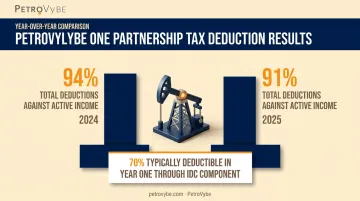
On a $100,000 investment, that translates to $60,000 to $80,000 in first-year deductions, delivered through a K-1 rather than a Schedule E.
A few things worth knowing before pursuing this route:
- It requires accredited investor status under SEC rules (income over $200,000 individually, or $300,000 jointly, or net worth over $1M excluding primary residence)
- Direct participation vehicles like this often carry multi-year hold periods and illiquidity, so they aren't a fit for near-term cash needs
- Suitability depends heavily on your actual tax burden: if you're not carrying significant active income tax liability, the deduction has less to offset
This isn't a strategy to pursue solo. Confirm eligibility and fit with a CPA or tax advisor before committing capital.
What Happens When Tax Planning Is Missing or Ignored
Skip tax planning, and the consequences show up in predictable ways:
- Inconsistent, unexpectedly high tax bills at filing time
- Missed deductions and credits you didn't know to claim
- Reactive scrambling in March and April instead of steady, informed decisions
- Underpayment penalties from estimated tax shortfalls
The cost compounds. Small annual overpayments or missed opportunities don't just disappear, they stack up over a decade or more into real lost wealth.
The IRS estimated that more than $1 billion in tax year 2021 refunds went unclaimed by roughly 1.1 million people who never filed. The median refund of $781 per person doesn't even include credits like the Earned Income Tax Credit.
That's one tax year, for people who didn't file at all. Extend that pattern of missed opportunity across years of skipped planning, and the erosion adds up fast.
This erosion hits high-income earners hardest. Without exploring advanced options, they have surprisingly few tools left to meaningfully offset active income and capital gains once the basics are maxed out.
How to Get the Most Value from Tax Planning
Tax planning pays off when it's consistent, not seasonal. Review your strategy at least once a year, and revisit it whenever life shifts: marriage, a business sale, a bonus, a new investment.
Practical habits that make a difference:
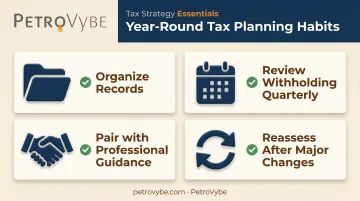
- Organize records year-round: track receipts and documentation as they happen instead of hunting for them in March
- Review withholding and estimates quarterly to catch shortfalls before they become penalties
- Pair personal effort with professional guidance: a CPA, financial planner, or tax attorney can evaluate foundational moves alongside advanced strategies, including tax-advantaged vehicles like oil and gas development partnerships that offer direct deductions against active income
- Reassess after major changes: new tax law, a liquidity event, or a shift in income all warrant a fresh look
Tax planning delivers the most value when it's treated as an ongoing practice, not a once-a-year event. Applying both basic and advanced strategies, from timely record-keeping to specialized investment structures, compounds your savings and keeps your financial plan on track.
Frequently Asked Questions
What is the difference between tax planning and tax management?
Tax planning is forward-looking: structuring your finances now to reduce future liability. Tax management focuses on current compliance, filing accurately, paying on time, and keeping proper records.
Do I need a tax professional to handle tax planning strategies?
Basic moves like maxing out retirement contributions can often be done on your own. Complex strategies, entity restructuring, or alternative investments benefit from a CPA or tax attorney who can confirm compliance and maximize your savings.
What is the difference between tax planning and tax preparation?
Tax preparation is the annual process of completing and filing your return. Tax planning happens year-round and aims to lower the liability that eventually shows up on that return.
What are the main types of tax planning?
Short-range planning covers moves made within the current tax year, like adjusting withholding. Long-range planning spans multiple years, such as retirement account strategy or capital gain timing.
How can high-income earners reduce their tax burden beyond retirement accounts?
Beyond maxing out 401(k), IRA, and HSA limits, high earners can use tax-loss harvesting, charitable giving vehicles, and alternative investments offering active-income deductions, such as IDCs from oil and gas development.
Are alternative investments like oil and gas development a legitimate tax planning strategy?
Yes. IDC deductions are an IRS-recognized incentive for oil and gas development investments, letting accredited investors offset active income. Confirm suitability for your situation with a tax professional first.