Global over-the-counter derivatives carried $846 trillion in notional value at mid-2025, up 16% from a year earlier, according to the Bank for International Settlements. That figure represents contracts, not the cash value of the actual stocks, bonds, currencies, and commodities those contracts reference.
Investors often blur three related but distinct terms: underlying asset, derivative, and security. This article clears up that confusion, walks through real examples, and shows how you can gain exposure to an underlying asset directly rather than through a paper contract based on its price.
Key Takeaways
- An underlying asset is the financial instrument or commodity backing a derivative's value.
- Underlying assets trade in spot/cash markets; derivatives trade on exchanges or over-the-counter.
- Common types span stocks, bonds, currencies, indexes, and commodities like oil, gas, and precious metals.
- You can access an underlying asset indirectly through derivatives, or directly through outright ownership.
What Is an Underlying Asset?
An underlying asset is the real security or commodity that a derivative contract's price and value are based on. The CME Group defines an underlying as the stock, commodity, futures contract, or cash index that serves as the subject of an option contract.
That definition matters because it draws a line between two categories:
- Real assets: a stock, a barrel of oil, a currency, a bond. These are tangible, tradeable items that exist independent of any contract.
- Contingent instruments: the option, future, or swap built on top of that asset. These have no independent value; they derive it entirely from the underlying.
- Cash indexes: benchmarks like the S&P 500 that don't exist as a single tradeable object but are calculated from real underlying components.
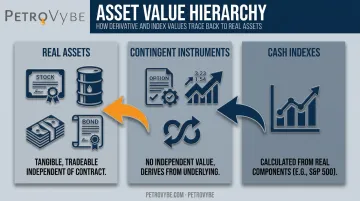
A currency itself is a real asset. An option on a currency swap is a contingent instrument layered on top of it. This distinction determines pricing, payoff, and risk exposure for anything built on the underlying:
- If the underlying's price rises, a call option tied to it generally gains value.
- If the underlying's price falls, that same call option generally loses value.
- Put options move the opposite direction, gaining value as the underlying's price falls.
Underlying assets trade in spot or cash markets — think the New York Stock Exchange for equities or the physical commodity markets for oil. Derivatives, by contrast, trade on specialized futures and options exchanges or privately between counterparties (OTC).
That structural separation explains why the $846 trillion OTC notional figure cited earlier can't be directly compared to "the value of all underlying assets." The two numbers measure fundamentally different things: no single reliable figure combines equities, bonds, currencies, and commodities into one comparable total.
How Underlying Assets Work in Derivative Contracts
Two contract types dominate retail and institutional derivatives trading, and each treats the underlying asset differently.
Options Contracts and the Underlying Asset
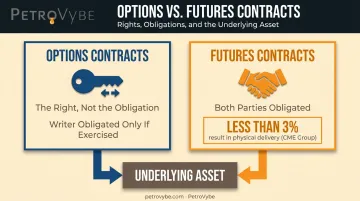
A call option gives the holder the right, not the obligation, to buy the underlying asset at a fixed strike price before expiration. A put option gives the holder the right to sell it. The option writer, on the other hand, takes on the corresponding obligation if the holder exercises.
| Element | Call Option | Put Option |
|---|---|---|
| Holder's right | Buy underlying at strike | Sell underlying at strike |
| Holder's obligation | None | None |
| Writer's obligation if exercised | Deliver the underlying | Purchase the underlying |
Here's a simple example. Say a stock trades at $50 and you buy a call option with a $55 strike price expiring in one month.
- If the stock climbs to $60, your option is now worth exercising: you can buy at $55 while the stock trades at $60.
- If the stock stays at $48, the option expires worthless because there's no reason to buy at $55 what you could buy cheaper on the open market.
The underlying asset's price movement is the entire game. Buying the option purchases a contractual right, not ownership of the stock itself.
Futures Contracts and the Underlying Asset
Futures work differently. Both parties are obligated to transact the underlying asset (crude oil, wheat, natural gas) at a set price on a set date. There's no optionality on either side.
In practice, most traders never take delivery. CME Group reports that less than 3% of futures contracts result in physical delivery, with the rest closed out through offsetting trades, rolled to a later contract month, or settled in cash. That doesn't mean the other 97% are all cash-settled contracts by design; many are simply closed before expiration.
The core principle stays constant across both instruments: the derivative's value rises or falls entirely based on the underlying asset's price performance. Nothing else drives it.
Common Types of Underlying Assets
Underlying assets fall into a handful of broad categories, each with its own derivatives ecosystem.
- Stocks/equities: The most widely traded underlying asset, with deep options chains on thousands of individual names.
- Bonds and fixed income instruments: Interest rate swings and price fluctuations create steady demand for bond futures and interest rate derivatives.
- Currencies: Foreign exchange volatility fuels enormous derivative volume, from simple forward contracts to complex currency swaps.
- Market indexes: A basket of securities like the S&P 500 can serve as the underlying for index options and futures.
- Commodities: Oil and natural gas rank among the most actively traded underlyings in futures markets worldwide.
Energy commodities illustrate the point well. In 2024, WTI Crude Oil futures averaged 983,000 contracts traded per day, up 4% year over year, while Henry Hub Natural Gas futures averaged 629,000 contracts daily, up 29%, according to CME Group's 2024 volume report.
Combined, that's over 1.6 million contracts changing hands daily on two underlyings alone — without a single barrel or cubic foot actually moving on most of those trades.
Direct Ownership vs. Derivative Exposure: A Different Way to Invest in the Underlying Asset
Most retail investors who want oil or gas exposure buy a futures contract, an energy ETF, or options tied to those markets. They never touch the physical asset. That's paper exposure — a bet on price movement, nothing more.
There's another path: owning a fractional interest in the underlying asset itself. Not a contract referencing the reserves. The reserves.
This is the model behind PetroVybe's natural gas development projects in South Texas and the Gulf Coast Basin, specifically in Lavaca County, Texas.
Instead of trading a futures contract on natural gas prices, accredited investors take a direct working interest in wells through a limited partnership structure. They participate in the actual production and reserves, not a price bet layered on top of them.
That distinction carries real, practical consequences:
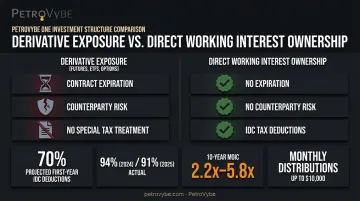
- No contract expiration. A futures contract has a settlement date. A working interest in producing wells doesn't disappear at the end of a contract month.
- No counterparty risk in the derivative sense. You're not relying on an options writer or futures clearinghouse; you hold a direct equity stake in the production asset.
- Tax advantages unavailable to derivative traders. Working interest owners can access Intangible Drilling Cost (IDC) deductions against active income, including W-2 earnings and capital gains, a benefit no futures, ETF, or options position offers.
PetroVybe's own numbers illustrate the mechanics. First-year IDC deductions are projected at roughly 70% against active income, and actual partner cohorts have exceeded that baseline, hitting 94% in 2024 and 91% in 2025.
On the return side, the company targets a 10-year MOIC of approximately 2.2x to 5.8x, alongside projected monthly passive distributions that can peak above $10,000 per month during production.
This kind of structure requires accredited investor status and a $100,000 minimum liquidity threshold, and it's built for investors who want production exposure without ever holding a contract that can simply expire worthless. It's a fundamentally different starting point than buying a call option on an energy ETF.
Frequently Asked Questions
Is gold an underlying asset?
Yes. Gold is a commodity that frequently serves as the underlying asset for futures, options, and other derivatives, largely due to its liquidity and long history of price volatility. Gold options are typically options on gold futures contracts, adding a layer between the option and the physical metal.
What does underlying mean in accounting?
In financial reporting under standards like IFRS 9, "underlying" refers to the specified variable (an interest rate, price, or index) that a derivative's value is contractually tied to. It doesn't always have to be a physically deliverable asset.
What is the difference between a derivative and an underlying asset?
The underlying asset is the real security or commodity itself, such as a stock or barrel of oil. A derivative is a separate contract whose price is derived from that asset's performance, meaning it has no independent value of its own.
Is an underlying asset the same as a security?
Not always. Many underlying assets are securities, like stocks and bonds, but others aren't, including commodities, currencies, and interest rates. The terms overlap in many cases but aren't interchangeable.
Can you own an underlying asset directly instead of trading a derivative on it?
Yes. You can buy the stock outright, or take a working interest in a producing natural gas well, rather than trading a contract based on its price. Direct ownership avoids contract expiration and the counterparty risk built into derivative positions.
What is the most common underlying asset in options trading?
Individual company stocks are the most widely used underlying asset in options trading. Their high liquidity and extensive options chains make them the natural starting point for most retail and institutional options strategies.