

But the door swings both ways. Many accredited investors start with small, high-volume crowdfunding deals, then hit a ceiling: limited allocations, thin due diligence, and returns that don't move the needle on a serious portfolio. Others skip straight to larger private placements with stronger tax treatment and bigger checks.
This guide breaks down how accredited investor crowdfunding actually works under Reg CF and Reg D, where the real risks sit, and why some investors eventually look toward direct private placements instead.
Key Takeaways
- Accredited investors face no investment caps under Reg CF, unlike non-accredited participants
- Reg D 506(c) offerings allow unlimited raises for verified accredited investors only
- Only 18.5% of U.S. households qualify as accredited, per SEC 2025 data
- Crowdfunded securities carry a mandatory one-year resale restriction
- Direct private placements, like oil and gas partnerships, offer larger allocations and active-income tax deductions beyond Reg CF
What Is Crowdfunding for Accredited Investors?
Crowdfunding splits into two very different categories. Donation and rewards-based crowdfunding (think Kickstarter) involves no securities at all. You're just backing a project. Equity crowdfunding is different. It involves the offer and sale of actual securities, which means federal securities law applies.
Accredited investors typically access this space through one of two exemptions: Regulation Crowdfunding (Reg CF), open to accredited and non-accredited investors alike, and Regulation D (Reg D) private placements, generally limited to accredited investors only.
Here's the part many investors miss: accredited investors are not subject to the investment caps that apply to non-accredited participants under Reg CF. That single distinction gives them meaningfully broader access to deal flow and allocation size.
Who Qualifies as an Accredited Investor?
The SEC's criteria haven't changed much in recent years. You qualify if you meet any one of these:
- Net worth exceeding $1 million, excluding your primary residence
- Income exceeding $200,000 individually (or $300,000 jointly with a spouse) in each of the last two years, with reasonable expectation of the same this year
- Professional licensing: holding a Series 7, 65, or 82 license in good standing
According to SEC research published in 2025 using Federal Reserve data, only 18.5% of U.S. households (roughly 24.3 million) qualified as accredited investors under the financial criteria in 2022. That's fewer than one in five households, which explains why accreditation still functions as a real gatekeeper for private market access.
Reg CF vs. Reg D 506(c): Key Differences for Accredited Investors
The two paths look similar on the surface but behave very differently once you're inside a deal.
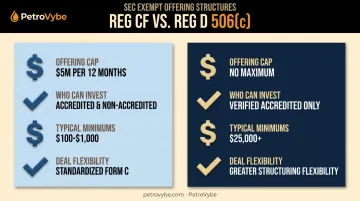
| Feature | Reg CF | Reg D 506(c) |
|---|---|---|
| Offering cap | $5M per 12 months | No maximum |
| Who can invest | Accredited and non-accredited | Verified accredited only |
| Typical minimums | Often low ($100–$1,000) | Often $25,000+ |
| Deal flexibility | Standardized disclosure via Form C | Greater structuring flexibility |
Reg D deals tend to carry higher minimums, but they also unlock larger allocations and institutional-style structuring that public crowdfunding portals simply don't offer. That trade-off (lower entry cost versus deeper access) is the first fork in the road for most accredited investors.
Oil and gas development partnerships like PetroVybe's, for instance, operate squarely in this Reg D 506(c) space, with minimums starting at $100,000 for verified accredited investors.
How Regulation Crowdfunding (Reg CF) Works for Accredited Investors
Every Reg CF transaction has to run through an SEC-registered broker-dealer or funding portal, with no exceptions. Before a company can raise capital, it files a Form C on EDGAR, disclosing its business model, officers, financial condition, and use of proceeds.
Once that filing is public, a common question follows: do you pay back crowdfunding? No. Equity crowdfunding isn't a loan, and investors receive actual securities, such as equity, debt, or convertible notes, in exchange for their capital.
If a company doesn't hit its target offering amount by the deadline, funds sitting in escrow get returned to investors. Nobody owes anybody repayment; it's simply a canceled transaction.
Investment Limits and Resale Restrictions
Non-accredited investors face specific caps based on income and net worth:
| Income/Net Worth Level | Investment Cap |
|---|---|
| Either figure below $124,000 | Greater of $2,500 or 5% of the greater metric |
| Both figures at least $124,000 | 10% of the greater metric, capped at $124,000 |
Accredited investors face no Reg CF investor-level limit, which is the practical advantage of accreditation inside this exemption.
One restriction applies to everyone, though: securities purchased through Reg CF generally cannot be resold for one year, with narrow exceptions for transfers to the issuer, an accredited investor, or family members. This locks up capital regardless of accreditation status.
Companies also carry ongoing obligations. They must file an annual Form C-AR report on EDGAR within 120 days of fiscal year-end, giving investors continued visibility into financials. Miss that filing, and transparency for investors erodes fast.
Benefits of Crowdfunding for Accredited Investors
The appeal for accredited investors comes down to a few concrete advantages.
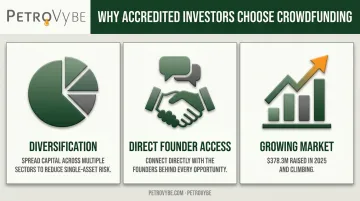
Diversification across low-minimum deals. Instead of committing $250,000 to one opportunity, an accredited investor can spread that same capital across a dozen crowdfunding deals in different sectors, such as software, consumer products, and biotech, reducing single-deal exposure.
Direct access to founders. Crowdfunding platforms often include founder updates, pitch calls, and comment threads. That's a more hands-on experience than buying shares of a public company through a brokerage app.
Growing market activity. Investment crowdfunding hasn't slowed down. KingsCrowd's industry data shows Reg CF capital raised climbed to $378.3 million in 2025, an 11% increase year-over-year, even as the number of new offerings dropped. That suggests capital is concentrating into fewer, larger raises, a trend worth watching if you're picking deals.
Risks and Limitations to Consider Before Investing
None of this comes without real downside. Three risks stand out:
- Startup failure rates run high. Only 34.7% of establishments born in 2013 were still operating a decade later, per Business Employment Dynamics data from the Bureau of Labor Statistics. Total loss of capital is a real possibility, not a footnote.
- Illiquidity compounds the risk. Beyond the mandatory one-year resale restriction, secondary markets are rare, and capital can stay locked up for years waiting on an acquisition or IPO that may never come.
- Due diligence falls on you. Crowdfunded companies rarely have audited financials, long operating histories, or institutional-grade validation. Compare that to a private placement backed by third-party engineering reports or independent audits, and the gap becomes obvious fast.
Beyond Traditional Crowdfunding: Direct Oil & Gas Development Partnerships
Plenty of accredited investors eventually outgrow small-dollar crowdfunding. After a few years of spreading capital across dozens of $5,000 positions, the math starts to feel thin , especially when compared to what's available in asset-backed industries like energy.
PetroVybe operates as a direct example of this alternative path. It's a Reg D 506(c) private placement offering accredited investors direct equity participation in natural gas development across South Texas and the Gulf Coast Basin, in Lavaca County specifically. The positioning is straightforward: rising electricity demand from AI data centers and infrastructure buildouts is driving renewed interest in natural gas as a baseload fuel source.
Tax Advantages Standard Crowdfunding Doesn't Offer
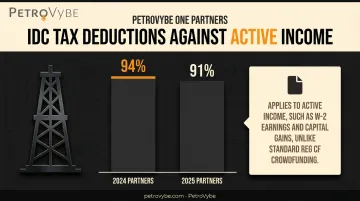
This is where the structural difference becomes significant. Through Intangible Drilling Cost (IDC) deductions, PetroVybe partners have offset a substantial share of their active income, including W-2 earnings and capital gains:
- 2024 partners: 94% tax deduction against active income
- 2025 partners: 91% tax deduction against active income
That's not a passive-income-only deduction. Unlike most real estate tax benefits, this deduction can apply directly against active income, which standard Reg CF equity crowdfunding simply doesn't offer.
Validation You Don't Typically See at the Crowdfunding Stage
Sponsor credibility matters more in direct placements, and PetroVybe leans into it:
- Michael Stamatedes, Chief Geophysicist, brings a 48-year track record with a 75.2% well-success rate — nearly double the industry average below 40%
- Reserves independently valued at $48 million (PV-09) by a licensed third-party engineering firm
- A clean 2025 audit completed by independent auditor Weaver
No Ongoing Time Commitment
Managing a dozen small crowdfunding positions means tracking a dozen different reporting schedules, portal logins, and Form C-AR filings. A direct partnership like PetroVybe requires none of that. Once capital is committed, the structure is fully passive: no active management, just quarterly updates and K-1 tax documents.
How to Evaluate Alternative Investment Opportunities as an Accredited Investor
Whether you're looking at a Reg CF deal or a Reg D private placement, the evaluation process should follow the same discipline.
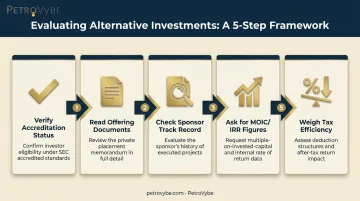
- Verify your accreditation status and confirm it through a qualified third party, such as a CPA, tax attorney, or licensed financial advisor
- Read the full offering documents. For Reg CF, that's Form C. For Reg D, that's the Private Placement Memorandum (PPM), Limited Partnership Agreement, and Subscription Agreement
- Check the sponsor's track record. Look for third-party audits, engineering validation, or independent performance reviews, not just marketing claims
- Ask for target MOIC and IRR figures, and understand what assumptions drive them
- Weigh tax efficiency alongside raw returns. A deduction against active income can meaningfully change your after-tax outcome compared to standard equity crowdfunding, where no such benefit typically exists
A rigorous audit looks like this: PetroVybe's $48 million PV-09 reserve valuation came from an independent, licensed engineering firm, not company management.
Due diligence doesn't stop once you write the check. Ongoing transparency (audited financials, engineering updates, clear reporting cadence) is what separates a well-run private placement from a speculative bet.
Frequently Asked Questions
How much money do you need to be considered an accredited investor?
You need a net worth over $1 million (excluding your primary residence), or income of $200,000 individually ($300,000 jointly) for two consecutive years. Holding a Series 7, 65, or 82 license also qualifies you.
Do you pay back crowdfunding?
No. Equity crowdfunding isn't a loan — investors receive securities in exchange for capital. If a funding target isn't met, escrowed funds are returned to investors rather than triggering any repayment obligation.
What is the UK equivalent of an accredited investor?
The UK uses "Certified High Net Worth Investor" and "Certified" or "Self-Certified Sophisticated Investor" classifications under FCA rules. These aren't exact matches for U.S. accreditation but serve a similar gatekeeping function.
How does direct investment compare to equity crowdfunding for accredited investors?
Direct investment through limited partnership units typically offers larger allocations and closer alignment with the sponsor's incentives than a crowdfunding portal, which pools smaller checks across many unrelated projects.
Is crowdfunding a good investment for accredited investors?
It can support diversification, but it carries high risk and illiquidity. Accredited investors often have access to larger, more vetted alternatives, such as direct private placements with stronger validation and tax advantages.
What's the difference between Reg CF and Reg D for accredited investors?
Reg CF caps raises at $5 million per year and allows both accredited and non-accredited participation. Reg D 506(c) has no raise limit, but restricts participation to verified accredited investors with typically larger, more flexible deal terms.