Aging U.S. infrastructure and climbing capital costs have pushed this topic well beyond municipal engineering departments. Anyone evaluating long-term physical assets — including energy and natural resource investments — needs to understand how these systems are planned, maintained, and eventually replaced.
This guide breaks down what infrastructure assets actually are, how they're managed across their lifecycle, and why the same principles that keep a city's water system running also determine whether an oil and gas development protects or erodes investor capital.
Key Takeaways
- IAM blends engineering, finance, and operations to maximize asset value and service life.
- Proactive condition monitoring costs up to 10x less than emergency repairs.
- Six core pillars, from inventory tracking to capital planning, anchor every mature IAM program.
- In oil and gas, third-party validation and asset performance roles prove IAM in the field.
What Is Infrastructure Asset Management?
Infrastructure asset management is the integrated process of planning, designing, constructing, operating, maintaining, and eventually renewing or replacing physical infrastructure to maximize value and service life.
The Federal Highway Administration defines it more formally as a strategic, systematic process for operating, maintaining, and improving physical assets at the lowest practicable cost while sustaining a desired state of repair.
That definition matters because IAM isn't a single department's job. It requires:
- Engineering input — condition data, failure modes, design specs
- Financial modeling — lifecycle costs, depreciation, capital budgeting
- Operational execution — maintenance scheduling, crew deployment, compliance
Infrastructure assets are also legally and financially distinct from movable capital assets. UC Davis, for example, capitalizes infrastructure at a $35,000 threshold with a 25-year assigned useful life, compared to a $5,000 threshold for movable equipment with just one year of useful life.
That gap illustrates the core distinction: infrastructure assets are large, stationary, and built to last decades, not years.
Common Types & Examples of Infrastructure Assets
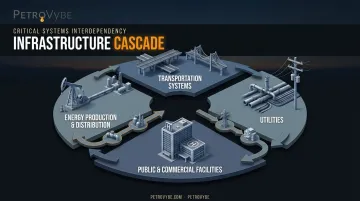
Four broad categories cover most of what people mean when they say "infrastructure":
- Transportation systems — roads, bridges, tunnels, rail
- Utilities — water, sewer, power, and gas pipelines
- Public and commercial facilities — hospitals, schools, government buildings
- Energy production and distribution — wells, gathering pipelines, processing plants, power grids
These assets rarely stand alone. A gas pipeline connects to a processing plant, which feeds a power grid, which serves a hospital. Mismanage one link, and the failure often cascades into the next.
Why Infrastructure Asset Management Matters
The financial and safety stakes here are not theoretical. The American Society of Civil Engineers' 2025 Infrastructure Report Card gave U.S. infrastructure an overall grade of C, with roads at D+, energy at D+, and drinking water at C-. Those grades translate directly into service disruptions, emergency repairs, and safety hazards when maintenance gets deferred.
The financial case for staying ahead of deterioration is stark. Rhode Island estimated that spending $6 million to $7 million on preventive pavement maintenance could have avoided a $30 million rehabilitation project on Interstate 295. Michigan's DOT reported similar payoffs: pavement-specific cases where every $1 of preventive maintenance avoided roughly $10 in later rehabilitation costs.
The underlying goal, whether you're a municipality or an energy operator, is the same:
- Avoid reactive, emergency-level spending
- Protect the asset's productive value over its full life
- Maintain uninterrupted service or production
A municipality avoiding a water main break and an energy company avoiding downtime on a producing well are solving the identical problem — protecting continuity and capital through disciplined, proactive management.
Key Components of an Effective IAM Strategy
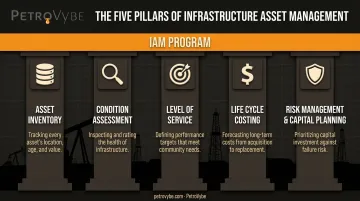
Mature IAM programs, including those aligned with the ISO 55000 family of standards, rest on five interdependent pillars. Skip one, and the whole system weakens.
These five pillars work together to keep infrastructure assets funded, monitored, and maintained:
- Asset Inventory: Maintains a centralized record of every asset's location, age, condition, and specifications. Outdated spreadsheets and paper records remain a leading cause of IAM failure.
- Condition Assessment: Uses regular inspections and scoring to predict repair needs before failure, tied to remaining useful life estimates under the EPA's asset management framework.
- Level of Service (LOS): Defines performance standards for reliability, capacity, and responsiveness, directly shaping budgeting decisions since higher targets require higher sustained investment.
- Life Cycle Costing: Tracks every dollar spent from planning through disposal, not just construction costs. FHWA's pavement preservation data shows underfunded maintenance creates disproportionately larger costs later.
- Risk Management & Capital Planning: Identifies failure risks and builds long-term financial plans so funds exist when major renewal or replacement decisions arrive, as FHWA requires in its Transportation Asset Management Plans.
The Infrastructure Asset Management Lifecycle
Every infrastructure asset moves through a predictable sequence, though most standardized models compress it into four to seven stages depending on the sector.
Plan & Design
Needs assessments, feasibility studies, and engineering design determine whether an asset should be built at all, as when a city evaluates a new treatment plant against funding limits.
Construct or Acquire
The asset is built or purchased within budget and regulatory compliance, the phase most people picture when they think "infrastructure." Bridges and pipelines both pass through permitting before entering service.
Operate & Maintain
Routine and preventive maintenance sustains performance throughout the asset's productive years — this is where most of the lifecycle cost actually accumulates. Deferring repairs for years can multiply eventual replacement costs.
Renew, Replace, or Decommission
Once an asset nears the end of its economically useful life, a cost-benefit decision determines whether to renew, replace, or retire it. A 40-year-old pump station, for instance, may warrant rehabilitation instead of replacement.
Infrastructure Asset Management in the Energy & Oil and Gas Sector
In the energy sector, infrastructure assets look different but the discipline is identical: producing wells, gathering pipelines, gas processing equipment, and storage facilities all require the same inventory, condition monitoring, and lifecycle planning as a municipal water system. Mismanage any one of these, and the company loses production revenue and erodes investor returns, far more costly than a pothole repair.
Predictive maintenance and geological diligence function as the sector's version of condition assessment. Instead of inspecting a bridge deck, operators are evaluating reservoir behavior, decline curves, and equipment wear before problems surface. Industry regulators reinforce this: PHMSA requires gas transmission operators to select threat-appropriate assessment methods, such as inline inspection, pressure testing, or direct assessment, rather than following a one-size-fits-all schedule.
Third-Party Validation as Industry Practice
Beyond meeting regulatory minimums, third-party engineering validation is industry best practice for protecting long-term asset value. It's a clear illustration of what disciplined IAM looks like in upstream energy. PetroVybe, a natural gas development company operating in South Texas and the Gulf Coast Basin, applies this through:
- A dedicated VP of Asset Intelligence & Performance role, overseeing operational metrics and asset performance across its development portfolio
- An independently verified $48MM PV-09 proved reserves valuation, completed by a licensed third-party engineering firm
- A Chief Geophysicist with a 75.2% career hit rate on profitable well location selection over a 48-year career, nearly double the industry peer average of under 40%

That location-selection discipline matters because it functions as a pre-drill risk control. Poor geological diligence produces wells that decline faster and recover less capital, regardless of how sound the financial model looks on paper.
For accredited investors evaluating oil and gas partnerships, asking how a company manages its physical infrastructure (well integrity, pipeline condition, equipment lifecycle) deserves the same scrutiny as reviewing financial projections. A strong MOIC target means little if the underlying assets weren't properly vetted before capital was deployed.
Tools & Technologies Powering Modern IAM
Asset management software has largely replaced fragmented spreadsheets and paper files. Modern platforms centralize records, automate maintenance scheduling, and generate condition reports on demand.
Building on this foundation, several technologies are reshaping how IAM gets executed day to day:
- Geographic Information Systems (GIS) add spatial context, letting managers visualize asset location and condition relative to surrounding infrastructure, such as a water main running beneath a busy interchange
- IoT sensors provide continuous, real-time condition data instead of periodic manual checks that might happen only once or twice a year
- Drones capture inspection imagery in places too costly or dangerous for physical crews
- AI-driven predictive analytics combines sensor data with historical performance to flag developing problems, such as a bridge joint nearing failure, months before they escalate into costlier repairs
None of these tools work in isolation. The real advantage comes from integrating them into a single decision-making system — one where condition data, financial modeling, and risk assessment inform the same capital planning process.
Frequently Asked Questions
What are infrastructure assets?
Infrastructure assets are long-lived, stationary physical systems, including roads, utilities, and energy infrastructure, that serve the public or an organization over decades rather than years. They typically require formal capitalization thresholds and dedicated maintenance planning.
What are four examples of infrastructure?
Transportation systems (roads, bridges, tunnels), utilities (water, sewer, power, gas), public facilities (schools, hospitals), and energy production infrastructure (wells, pipelines, processing plants) cover the four broadest categories.
What is the difference between infrastructure asset management and general asset management?
IAM focuses specifically on physical, stationary infrastructure, while general asset management can also cover financial instruments, movable equipment, or intangible assets. IAM's methods, such as condition scoring and lifecycle costing, are tailored to long-lived, immovable systems.
How often should infrastructure assets be assessed?
Frequency varies by asset type and risk. Bridges follow a federal baseline of inspections every 24 months, while water systems typically review risk assessments on a multi-year cycle. Complexity and failure consequences drive the interval.
What software or tools are used for infrastructure asset management?
Common tools include dedicated asset management software, GIS platforms for spatial mapping, IoT sensors for real-time monitoring, and drones for visual inspection. AI-driven predictive analytics is increasingly layered on top of these systems.
Why does infrastructure asset management matter for energy and oil and gas investments?
Well-managed energy infrastructure directly protects production output and investor returns. A company's discipline around well integrity, pipeline condition, and equipment lifecycle is a factor accredited investors should weigh closely when evaluating operational risk.