
Accredited individual investors now have real access to the same private markets that institutions have quietly compounded wealth in for decades. Meanwhile, high-income W-2 earners are getting squeezed from both directions: rising tax bills and inflation eating into purchasing power, with few tools beyond a 401(k) and a taxable brokerage account.
This guide breaks down what private equity actually is, who qualifies, the different flavors available today, how to get in the door, and the risks worth weighing before you wire a dollar.
Key Takeaways
- Private equity has historically outperformed small-cap public stocks over multi-year periods.
- Accredited investors can access PE via funds, co-investments, secondaries, or direct ownership.
- Qualifying as an accredited investor unlocks Regulation D offerings unavailable to the public.
- Direct ownership in assets like natural gas wells offers tax advantages many pooled PE funds miss.
- Illiquidity and hands-on due diligence are the price of admission for higher returns and less competition.
What Is Private Equity, and Why Is It Opening Up to Individual Investors?
Private equity means capital deployed into companies and assets that don't trade on a public exchange. Think ownership stakes in businesses, real estate, or energy projects that never show up on your brokerage app.
For decades, this was institutional territory. That's shifting for one simple reason: private businesses now vastly outnumber public ones.
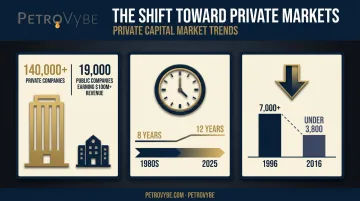
Globally, more than 140,000 private companies generate over $100 million in annual revenue, compared to roughly 19,000 public companies at that same threshold, according to Hamilton Lane's analysis of the private markets landscape. Most of the world's business value simply isn't accessible through a ticker symbol.
Companies Are Staying Private Longer
The median age of a company at IPO has climbed from 8 years in the 1980s to 12 years in 2025. Businesses now spend an extra decade building value before public investors ever get a shot.
At the same time, the pool of public companies has been shrinking. The number of US listed companies fell from more than 7,000 in 1996 to fewer than 3,800 by 2016, a roughly 50% drop, according to Vanguard's research on the shrinking universe of public firms.
Fewer IPOs, longer private runways, and consolidation have pushed a growing share of value creation into private hands.
The Doors Are Opening
Three forces are driving this shift:
- Fintech platforms now handle subscription, reporting, and compliance work that once required a dedicated back office.
- Lower fund minimums — some interval funds now start around $10,000–$25,000, down from the $1 million-plus checks institutions historically wrote.
- New pooled structures, like evergreen and interval funds, let qualified individuals commit smaller amounts alongside institutional capital.
This democratization isn't limited to company equity, either. It extends into real assets, including energy development, giving individuals a way to diversify well beyond Wall Street's usual menu.
Accredited Investor Requirements: Do You Qualify?
Private equity access hinges on one gatekeeper: accredited investor status. The SEC's thresholds haven't changed much in years, but they still filter out most of the country.
You generally qualify if you meet one of these:
- Income test: Individual income exceeding $200,000 (or $300,000 jointly with a spouse) in each of the last two years, with a reasonable expectation of the same this year.
- Net worth test: Net worth over $1 million, excluding your primary residence.
- Professional test: Holding a Series 7, 65, or 82 license in good standing.
These thresholds exist because of Regulation D, which lets companies raise capital privately without the cost and disclosure burden of a public registration, in exchange for restricting who can invest. Two rules govern that trade-off:
| Rule | Investor Access | Verification Requirement |
|---|---|---|
| 506(b) | Up to 35 non-accredited but sophisticated investors allowed | Self-certification accepted |
| 506(c) | Unlimited accredited investors, general solicitation permitted | Third-party verification required |
Here's the exclusivity in numbers: only about 24.3 million US households, or 18.5%, met at least one accredited investor financial test as of 2022. That figure comes from the SEC's own review of the accredited investor definition, and it leaves roughly 4 out of 5 American households outside the door entirely.
Types of Private Equity and Private Market Investments Available to Accredited Investors
Once you qualify, the menu is wider than most people assume. Private market strategies span everything from company buyouts to direct ownership in physical assets.
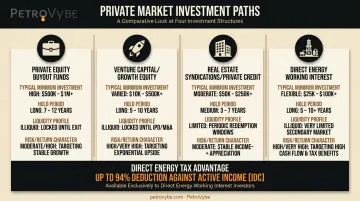
Private Equity Funds and Buyouts
Traditional buyout funds pool capital from many investors and deploy it across a portfolio of private companies. Expect:
- Fund minimums often starting around $25,000 for retail-accessible vehicles, though many traditional funds still require $250,000 or more.
- Fund terms typically lasting 10–12 years.
- Returns delivered as pooled distributions, not individual deal selection.
Venture Capital and Growth Equity
Venture investing funds early-stage companies with high upside and equally high failure rates. Returns follow a power-law pattern: a small number of winners drive most of the fund's performance, while many positions go to zero. Illiquidity here often stretches beyond a decade.
Real Estate Syndications and Private Credit
These strategies offer tangible-asset backing (real estate) or contractual income (private credit), generally with shorter hold periods than a full buyout fund. Real estate syndications pool investor capital into a specific property or portfolio, while private credit generates returns from negotiated loan interest rather than equity appreciation.
Direct Working-Interest Participation in Energy Development
This is a fundamentally different model. Instead of a blind-pool fund, investors own a direct working interest in a specific project, meaning you know exactly which wells your capital is funding, not just a slice of an anonymous portfolio.
PetroVybe is a working example of this structure. Through its PetroVybe ONE program, accredited investors gain direct participation in early-stage natural gas development across South Texas's Lavaca County and the broader Gulf Coast Basin. This region is positioned to help supply the electricity grid amid surging AI-driven power demand.
Natural gas already supplies close to half of US grid electricity, and it's dispatchable in a way solar and wind aren't. Unlike most pooled PE or VC vehicles, this structure pairs asset ownership with upfront tax deductions against active income (more on that below).
How to Access Private Equity Deals as an Individual Investor
There isn't just one path into private markets. Accredited investors generally choose from four routes.
- Fund investing: the traditional entry point. A professional manager pools capital across a diversified portfolio of private companies. You get diversification but no say in individual deal selection.
- Co-investing: investing directly alongside a fund's general partner in one specific deal. This often comes with lower fees and far more transparency into the underlying company than a blind-pool commitment.
- Secondary market transactions: buying or selling previously issued private fund interests. Secondary volume reached roughly $160 billion in 2024, with buyout stakes trading around 97% of NAV and venture and growth stakes closer to 78%. That gap can mean discounted entry points for buyers or earlier liquidity for sellers.
- Direct participation programs: investing straight into a specific asset or project, like a working interest in a natural gas well, rather than into a fund.
That fourth path is where PetroVybe operates. Rather than pooling capital into an undisclosed blind vehicle, investors own a named position in a specific development project. PetroVybe backs this with:
- A $48 million PV-09 reserve valuation from a licensed third-party engineering firm
- A clean 2025 independent audit from Weaver
- Access to a data room with offering documents, redacted K-1 samples, and proforma projections
- A targeted 10-year MOIC range of roughly 2.2x to 5.8x and an IRR near 26%, alongside significant first-year tax deductions most fund structures can't offer
Full transparency into where capital goes, down to the individual well, is what separates direct participation from a traditional fund commitment, where investors often can't see which specific assets their money supports.
Weighing the Risks and Rewards Before You Invest
Private markets don't come free of tradeoffs. Before committing capital, understand what you're signing up for.
Illiquidity is the baseline cost. Most private investments lock up capital for multiple years with limited or no secondary market for early exit. Buyout funds often run 10–12 years, and even interval funds only offer capped quarterly repurchase windows, not exchange-style liquidity.
Beyond illiquidity, due diligence falls largely on you. Regulation D offerings skip the disclosure requirements of public registration, so investors need to do more homework than they would buying a public stock. Independent third-party validation (engineering reports, reserve audits, or financial reviews) is one of the clearest signals separating a credible sponsor from a risky one.
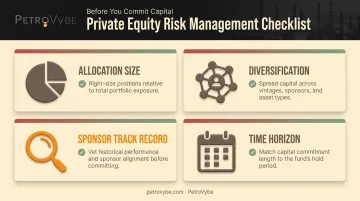
Keep these factors in mind:
- Allocation size: Keep illiquid alternatives to a modest slice of your liquid net worth, not a core holding.
- Diversification: Spread commitments across strategies and sponsors rather than concentrating in a single deal.
- Sponsor track record: Review audited financials, engineering validation, and verified investor reviews before wiring funds.
- Time horizon: Match the hold period to money you genuinely won't need for years.
Frequently Asked Questions
What is the most promising investment right now?
There's no universal answer; it depends on your tax situation, risk tolerance, and time horizon. Private market alternatives like energy development are drawing attention for their tax efficiency and inflation-hedging potential.
What is the minimum investment required to access private equity?
Traditional PE and VC funds often require $250,000 or more. Some direct participation and syndication opportunities, including PetroVybe's $100,000 minimum, start considerably lower.
How do accredited investors typically access private equity deals?
Four main pathways exist: fund investing, co-investing alongside a GP, buying secondaries, and direct participation programs tied to a specific asset or project.
Is private equity riskier than investing in public stocks?
Private equity carries illiquidity and due diligence risk that public stocks don't. In exchange, qualified investors often get lower correlation to public market swings and higher return potential.
Can private equity or private market investments provide tax benefits?
Yes, though the structures vary widely. Direct energy development can offer intangible drilling cost deductions against active income, unlike most traditional PE or real estate structures. PetroVybe partners, for example, received 91–94% deductions in 2024 and 2025.
How long do I need to keep my money invested in a private equity deal?
Hold periods generally range from 3 to 10-plus years depending on the strategy. Only commit capital you're confident you won't need in the near term.