

New research using administrative datasets covering hundreds of millions of worker-years has quietly overturned decades of assumptions about when and how that risk actually strikes. The findings aren't comfortable. Peak earning years, not early-career years, carry the highest hidden risk. Recessions don't just spread pain evenly—they concentrate it in ways older models never captured.
If you're a high-income professional or business owner who assumes your earnings are stable, this research is worth your attention. It's also the reason diversifying beyond a single income source matters more than most financial advice admits.
Key Takeaways
- Income risk tracks your own earnings uncertainty over time, not how you stack up against others
- Recession variance stays flat, but skewness turns sharply negative, making big drops far likelier than big gains
- Earnings shocks peak in severity between ages 45-55, exactly when career recovery time is shortest
- Non-correlated passive income is one of the few genuine hedges against cyclical, job-linked earnings risk
What Is Income Risk?
Income risk is the uncertainty individuals face from year-to-year swings in their own earnings, driven by job loss, a health event, a business downturn, or even an unexpected promotion. Income inequality, by contrast, measures the static distribution of income across a population at a single point in time.
These are two distinct problems:
- Income inequality asks: how does my income compare to everyone else's right now?
- Income risk asks: how much might my own income change next year, and how badly?
A worker at the 70th percentile of earnings can face enormous income risk even while inequality statistics stay flat. Income risk isn't reserved for lower earners either. It hits professionals and business owners at every level, often without warning.
Why This Took So Long to Study
Researchers historically lacked the data to measure this properly. Survey-based panels were too small and too noisy to isolate rare, extreme earnings shocks.
That changed when researchers gained access to the Social Security Administration's Master Earnings File, which tracks roughly 160 million workers annually—about 96% of the U.S. workforce. With decades of near-universal earnings records, economists could finally see what individual income paths actually look like, not just what average models assumed.
Income Risk Over the Business Cycle: New Insights
For decades, the conventional wisdom held that income shocks become far more dispersed, or more variable, during recessions. New research using SSA data challenges that assumption directly: persistent-shock variance rose only about 2% during recessions, nearly flat across the entire business cycle.
Skewness, Not Variance, Is the Real Story
The real damage shows up somewhere else. Skewness, the asymmetry of income shocks, turns strongly negative during downturns. Near the median, Kelley's skewness shifted from roughly -0.14 in expansions to -0.30 in recessions. In practical terms: recessions don't widen the range of outcomes, they tilt the whole distribution toward large losses while shrinking the odds of a large gain.
That asymmetry didn't spare anyone, including earners who assumed a high income was its own insurance policy.
| Recession | Verified earnings result |
|---|---|
| Great Recession (2007-09) | 10th-percentile earners lost 18 percentage points more than 90th-percentile earners; the top 1% lost roughly 30% of 2007 income by 2009 |
| 2000-01 downturn | Top 1% and top 0.1% losses were more severe than during the Great Recession |
| 1989-94 | Top-earner losses were about as severe as the Great Recession |
| 2006-2011 window | The top 0.1% lost roughly 50% of income |
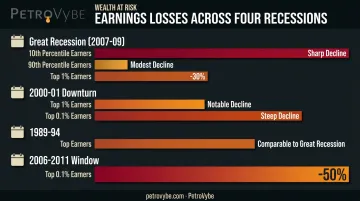
That last figure is worth sitting with. High income does not equal self-insurance, according to NBER's summary of income risk research.
Two Assumptions the Data Doesn't Support
- Dual-earner households aren't meaningfully better protected. Household income pooling reduces the chance that both earners lose their jobs simultaneously, but it does little to remove the procyclical downside tail in earnings.
- Government insurance matters, but coverage varies enormously by country. Progressive taxation and transfers substantially cushion downside skewness in Germany and Sweden. In the U.S., that cushioning is far weaker, leaving individuals more exposed to the same shocks.
Income Risk Over the Life Cycle
Income shocks don't follow a tidy bell curve. Small changes are common, as expected. But extreme, "disaster" shocks occur far more often than standard statistical models assumed. Researchers studying millions of individual worker records found earnings-change distributions with heavy negative skewness and excess kurtosis that standard Gaussian models simply miss.
Risk Peaks Mid-Career, Not Early Career
This is the finding that should reshape how established professionals think about planning:
- Negative skewness intensifies with age and prior earnings, generally peaking around ages 45-55
- Kurtosis (the concentration of extreme outcomes) rises alongside prior earnings through roughly the 80th-90th percentile
- One-year kurtosis can approach 30 for workers ages 40-54, compared to 3 under a normal distribution
- Five-year kurtosis is about 18 for men ages 45-55 earning $100,000, versus roughly 5 for younger, lower earners
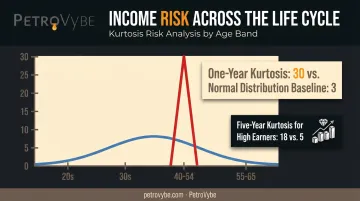
In plain terms, the mid-career professional earning six figures faces a meaningfully higher chance of a severe, hard-to-reverse income shock than either a 28-year-old or a 68-year-old at the same firm. That finding comes from NBER research on lifecycle earnings dynamics.
The Welfare Cost Is Larger Than Anyone Assumed
Even accounting for savings, borrowing, and government redistribution, researchers estimate the true welfare cost of these income fluctuations at 25%-40% of household consumption per year. That's two to three times larger than older, normal-distribution models predicted, according to the Minneapolis Fed's synthesis of this big-data research.
That cost lands hardest during exactly the years people earn and spend the most. Mid-career, high-earning professionals face rising odds of a severe shock (layoff, health event, career plateau) alongside shrinking odds of a large positive surprise. That's not a great combination if your entire financial plan assumes your paycheck or business income keeps climbing steadily.
The 4 Types of Financial Risk You Should Know
Most financial planning frameworks focus on four categories:
- Market risk – losses from price swings in stocks, bonds, or commodities
- Credit risk – losses when a borrower or counterparty fails to meet an obligation
- Liquidity risk – the inability to sell an asset quickly without a price discount
- Inflation risk – the erosion of purchasing power over time
There's a fifth category most frameworks leave out entirely: human capital risk—the uncertainty attached to your own future labor income. For salaried professionals and business owners, this is often the single largest asset on the balance sheet, yet it rarely gets modeled the way a stock portfolio does.
This omission matters because traditional stock-and-bond portfolios don't hedge earnings risk well. Equity markets and job markets tend to decline together in recessions: exactly the scenario the business-cycle research above describes. A portfolio that falls at the same time your paycheck or business income falls simply concentrates risk instead of diversifying it.
How to Protect Your Income and Wealth from Volatility
The planning implication of this research is direct: job- and business-linked income is inherently cyclical, and it tends to fall hardest exactly when the broader economy struggles. Protecting against that means building income that doesn't move in lockstep with your primary paycheck.
What to Look For in a Second Income Stream
Not every "alternative" asset actually diversifies away labor-income risk. Commercial real estate, for example, has shown roughly 40% correlation with housing cycles historically, and energy demand itself isn't immune to downturns—U.S. energy consumption fell 5% in 2008-09 and 7% in 2020.
The right hedge needs genuinely low covariance with your paycheck, your industry, and the broader labor market cycle.
PetroVybe's structure was built around that exact requirement. The company develops natural gas and natural gas liquids assets in South Texas and the Gulf Coast Basin, structured specifically for accredited investors who want a passive income stream separate from employment or business income.
Two structural features are worth understanding:
- Upfront tax deductions against active income. IDC deductions aren't restricted to passive income like many real estate write-offs — 2024 partners received a 94% deduction against W2 earnings and capital gains; 2025 partners saw 91%.
- Long-term, cash-flowing production. Built around a 10-year hold, monthly distributions are projected to peak above $10,000/month, designed to compound rather than pay out and disappear.

This structure addresses two risks from the research above simultaneously: business-cycle income shocks, via a cash-flowing income source not tied to your employer or industry, and inflation risk, via a tangible asset producing real output rather than a paper claim.
Is This the Right Fit?
PetroVybe ONE is available to accredited investors with $100,000 in liquidity, verified through a CPA, tax attorney, or licensed financial advisor. If income volatility research like this has you rethinking how concentrated your financial life really is, it's worth a conversation with PetroVybe's team about opportunities in South Texas and the Gulf Coast Basin.
Frequently Asked Questions
What is at-risk income?
At-risk income is the portion of your earnings exposed to unpredictable fluctuation from job loss, recession, health events, or business downturns. It's distinct from guaranteed or fixed income, such as a pension or bond coupon.
What are the 4 types of financial risk?
The traditional four are market, credit, liquidity, and inflation risk. Many planners now argue human capital risk (the uncertainty in your own future labor income) deserves recognition as a fifth category, especially for working professionals.
Can you live off interest of $1 million?
It depends heavily on current interest rates and your lifestyle needs. Many high-net-worth individuals combine interest income with other passive, cash-flowing investments to build a more resilient, diversified income stream.
How does income risk differ from income inequality?
Inequality measures how income is distributed across a population at one point in time. Income risk measures the uncertainty a single person faces from their own earnings changing year to year.
Does income risk get worse during recessions?
Overall variance stays surprisingly flat, but the risk of a large downward shock rises sharply due to procyclical skewness. Large income gains also become considerably less likely during downturns.
How can I protect my income from economic downturns?
Diversify into non-correlated, cash-flowing assets rather than relying solely on a paycheck or single business. Tax-advantaged passive income strategies, such as direct natural gas development, can reduce dependence on one income source.