
An asset revaluation reserve (ARR) is an equity account that captures unrealized gains when a company restates its fixed assets to fair value, a practice rooted in accounting standards like IAS 16. The gain shows up on the balance sheet, not the income statement.
This guide breaks down what an ARR actually is, how the mechanics work step by step, what happens when the underlying asset gets sold, and why this concept matters specifically for anyone evaluating natural resource investments.
Key Takeaways
- An asset revaluation reserve is an equity account, not cash, recording unrealized fixed asset gains.
- Revaluation gains run through OCI, keeping them separate from operating profit and loss.
- On disposal, balances may shift to retained earnings but never flow through the income statement.
- For oil and gas investors, revaluation mechanics reveal whether a reported net asset value is credible.
What Is an Asset Revaluation Reserve?
An asset revaluation reserve is the equity account that captures the increase in a fixed asset's carrying value above its original cost when that asset is restated to fair value. The concept traces directly to IAS 16, paragraph 31, which allows an item of property, plant, and equipment to be carried at fair value less subsequent depreciation and impairment, provided that fair value can be measured reliably.
This option exists under IFRS only. U.S. GAAP (ASC 360) requires PP&E to remain at historical cost, so American companies typically won't encounter this reserve unless they report under international standards.
Companies must pick one approach per asset class:
- Cost model — assets stay at historical cost minus depreciation
- Revaluation model — assets are periodically restated to fair value
Once chosen, the model must be applied consistently across the entire class. Mixing models within the same class, or applying revaluation to just one property while leaving similar ones at cost, is a common reporting error under IAS 16.
The reserve exists for one main reason: it keeps unrealized valuation swings out of operating profit. A company shouldn't look more (or less) profitable simply because a piece of real estate or a production facility got re-appraised.
A Simple Numeric Example
Suppose a company owns a processing facility purchased for $2,000,000. After several years of depreciation, its carrying amount sits at $1,600,000. An independent appraisal now values the facility at $2,400,000.
The revaluation increase is $800,000 ($2,400,000 minus $1,600,000). That full amount gets credited to the revaluation reserve within equity — it never touches the income statement.
Revaluation losses work differently. They're typically charged straight to profit or loss, except to the extent they reverse a gain previously recorded in that same asset's reserve. In that case, the loss reduces the existing reserve balance instead of hitting earnings directly.
Is a Revaluation Reserve a Real Asset?
Despite the name, no. The reserve is not tangible, and it isn't liquid. It's an equity line item reflecting an unrealized increase in value, nothing more.
That distinction matters for a few practical reasons:
- The balance cannot be distributed as a dividend or tapped for liquidity needs while the asset remains on the books.
- It only becomes "available" for other purposes once the asset is sold, retired, or transferred.
- Distribution rules vary by jurisdiction. UK company law, for instance, generally treats unrealized revaluation surplus as non-distributable. This isn't a universal IFRS rule, so local law always governs.
Where the reserve does matter is on paper: it strengthens reported shareholders' equity and net asset value per share. Anyone assessing balance sheet health should recognize that a rising ARR reflects an appraisal opinion, not cash in the bank.
How Does Asset Revaluation Work? A Step-by-Step Breakdown
Revaluation follows a consistent sequence, whether the asset is a warehouse, a drilling rig, or a commercial building.
- Determine current fair value. This comes from an independent valuation, appraisal, or engineering assessment — not an internal estimate.
- Calculate the increase or decrease. Compare the new fair value against the asset's existing carrying amount.
- Record the adjustment. Gains get credited to the revaluation reserve in equity. Losses get charged to profit or loss, with the reversal exception noted above.
- Adjust future depreciation. The revalued amount becomes the new depreciable base, spread over the asset's remaining useful life.
- Reassess at each reporting period. IAS 16 requires revaluations "with sufficient regularity," meaning carrying amounts shouldn't drift materially from fair value between reports. There's no fixed multi-year clock that applies universally.
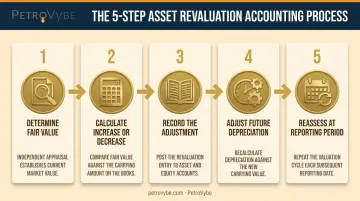
Here's how that plays out numerically using the facility example from earlier:
| Item | Original Cost | Carrying Amount (Pre-Revaluation) | Fair Value | Revaluation Reserve |
|---|---|---|---|---|
| Processing Facility | $2,000,000 | $1,600,000 | $2,400,000 | $800,000 |
Going forward, depreciation calculates off the $2,400,000 figure over the remaining useful life, not the original $2,000,000. That single change shifts future depreciation expense upward, even though no cash moved.
What Happens to the Revaluation Reserve When the Asset Is Sold?
Disposal is where a lot of confusion creeps in.
When the asset is finally sold, retired, or otherwise derecognized, any remaining reserve balance tied to it may be transferred directly to retained earnings. IAS 16.41 makes this transfer optional, not mandatory. The transfer happens within equity, never through profit or loss.
This is where a common accounting error surfaces: running the reserve balance through the income statement as part of the "gain on sale." Doing so artificially inflates reported profit for the period, making operating performance look stronger than it actually was.
The actual gain or loss on disposal is a separate calculation entirely:
- Net sale proceeds minus the asset's carrying value at the date of sale equals the recognized gain or loss.
- The existing revaluation reserve is not added into that figure.
- Any reserve amount simply moves to retained earnings as a direct equity transfer, if the company elects to make that transfer at all.
Keeping the disposal gain/loss separate from the reserve transfer is one of the clearest signals that a company's financial reporting is being handled correctly.
Why Asset Revaluation Reserves Matter for Oil & Gas and Natural Resource Investors
Reserve-based industries like oil, gas, and real estate carry substantial fixed and mineral assets whose fair value can diverge sharply from historical cost. That makes ARR concepts directly relevant reading for anyone evaluating these financials, even though IAS 16 itself excludes mineral rights and reserve quantities from its scope.
Independent reserve valuations function similarly to asset revaluations. Third-party engineering firms reassess proved reserves and produce reports (often labeled PV-10 or, in some cases, PV-9, depending on the discount rate applied) that investors should scrutinize before committing capital. These figures represent a discounted cash flow estimate of future net revenue from proved reserves, not a formal "fair value" under accounting standards.
That distinction is worth sitting with. As one SEC-filed PV-10 disclosure example makes clear, PV-10 is explicitly labeled a non-GAAP measure and reconciled to the standardized GAAP measure; neither one claims to represent the reserve's market fair value.
PetroVybe determines its proved reserves valuation (currently $48MM on a PV-09 basis) through an independent, licensed third-party engineering firm rather than an internal estimate, reflecting the same transparency principle that underpins sound revaluation accounting: outside verification, not self-reported numbers. That reserve report ties directly to the company's Lavaca County acreage, giving investors a documented trail to review rather than a single unverified figure.
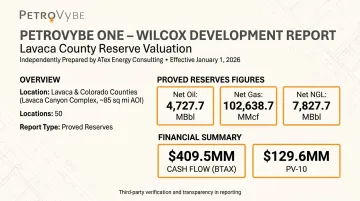
When you're looking at a private placement that reports rising asset or reserve values, ask the sponsor directly:
- How often is the valuation updated, and what triggers a re-assessment?
- What methodology and discount rate were used, and does the report define them clearly?
- Who performed the valuation, and are they independent of the sponsor?
- Is there an accessible audit trail, including engineering reports, effective dates, and assumptions?
Inflated or stale valuations without regular independent review are a red flag. It ties back to the same principle covered earlier: revaluations need to stay materially current, not sit untouched for years while the sponsor keeps citing the original number.
Common Mistakes and Best Practices in Managing Revaluation Reserves
Getting revaluation accounting wrong usually comes down to a handful of repeat offenders.
Frequent errors include:
- Offsetting gains and losses across an entire asset class instead of tracking them per individual asset
- Applying the revaluation model to some assets in a class while leaving similar ones at historical cost
- Running reserve balances through the income statement at disposal (covered above)
- Letting carrying values drift materially out of date between formal valuations
Best practices worth adopting:
- Commission periodic independent valuations rather than relying on internal estimates or outdated appraisals.
- Document valuation assumptions in detail, including discount rates, methodology, and effective dates.
- Track reserves per asset within a fixed asset register, not at the aggregate class level.
- Keep valuation gains separate from operating profit metrics in investor reporting, so performance isn't misread.
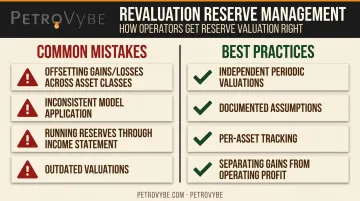
Stakeholders need to trust that a rising balance sheet reflects a real, independently verified change in value, not internal optimism dressed up as accounting.
Frequently Asked Questions
What is asset revaluation reserve?
It's an equity account that records unrealized gains from restating fixed assets to fair value. The gain stays separate from operating profit and flows through other comprehensive income instead.
Is revaluation reserve a real asset?
No. It's an equity/reserve line item, not a tangible or liquid asset. The balance can't be spent or distributed until the underlying asset is sold or transferred.
What to do with revaluation reserve when asset is sold?
The balance may be transferred directly to retained earnings, but that transfer happens within equity. It must never be recycled through profit or loss as part of the reported gain on sale.
Can a revaluation reserve go negative?
No. The reserve only holds accumulated gains for a specific asset. Any loss beyond that existing balance gets charged to profit or loss instead of pushing the reserve negative.
How often should assets be revalued?
Standards require revaluation with "sufficient regularity," without one universal fixed rule. Older frameworks like the UK's FRS 15 suggested revaluing at least every five years, with earlier reviews if values shifted materially.
Does an asset revaluation reserve affect taxes?
Typically not immediately. Unrealized revaluation gains recorded in equity generally don't trigger current tax liability, though they often create a deferred tax temporary difference until the asset is actually sold.