

Congress created GILTI (Global Intangible Low-Taxed Income) as part of the 2017 Tax Cuts and Jobs Act to stop US companies from parking profits in low-tax countries. If you own 10% or more of a Controlled Foreign Corporation (CFC), this rule likely applies to you, whether you're an individual investor, a small business owner, or part of a larger holding structure.
This guide breaks down what GILTI actually is, how the math works, who has to pay it, the 2026 rule changes taking effect now, and a few legal strategies to manage a rising tax bill.
Key Takeaways
- GILTI taxes foreign CFC income above a 10% return on tangible business assets, even without a cash distribution
- Corporate tax rates run 10.5%–12.6% before credits, rising under the 2026 NCTI rules
- Individuals pay ordinary rates (10%–37%) on GILTI unless they file a Section 962 election
- Starting in 2026, GILTI is renamed "Net CFC Tested Income" (NCTI), with QBAI eliminated entirely
- Domestic tax strategies, like oil and gas IDC deductions, can offset the burden GILTI creates
What Is GILTI?
GILTI is a US tax on income earned by foreign affiliates (Controlled Foreign Corporations) tied to intangible assets like patents, trademarks, copyrights, and licenses. The IRS treats any CFC profit above a routine 10% return on tangible assets as "intangible" income, and that excess gets pulled into your US tax return every year.
Two ownership thresholds matter here: the foreign company must be a CFC, meaning US persons own more than 50% of its vote or value, and you personally must own 10% or more of that CFC's stock, directly or through attribution rules, to trigger a GILTI inclusion.
Own less than 10%? You're off the hook for GILTI, though other reporting rules may still apply.
Why Congress Created GILTI
The TCJA shifted the US from a worldwide tax system to something closer to territorial taxation. Under Section 245A, qualifying domestic corporations can now deduct 100% of foreign-source dividends from certain 10%-owned foreign corporations. Congress worried this new participation exemption would tempt companies to shift patents, trademarks, and other mobile intangible assets into low-tax jurisdictions.
GILTI was the backstop. According to the Joint Committee on Taxation's 2019 overview, Section 951A was designed to tax that intangible income currently. It functions as a kind of global minimum tax, so US shareholders can't avoid paying anything on foreign earnings just by moving IP offshore.
Is Global Income Taxable in the US?
Not automatically, but not automatically exempt either. Active foreign business earnings can largely avoid additional US tax once repatriated as a qualifying dividend under Section 245A. GILTI breaks that pattern by requiring an annual inclusion of certain foreign earnings, distributed or not.
There's one notable escape hatch: the high-tax exception. If a CFC's income is already taxed abroad at a rate greater than 90% of the top corporate rate (currently above 18.9%), that income can be elected out of GILTI entirely. Per Treasury's final regulations, this is an election applied at the tested-unit level, not a blanket exemption based on a country's headline rate.
How Is GILTI Calculated?
The pre-2026 formula looks like this:
Net CFC Tested Income − (10% of QBAI − Interest Expense) = GILTI
Breaking down the pieces:
- Net CFC tested income: your CFC's total tested income minus tested losses
- QBAI (Qualified Business Asset Investment): the average adjusted basis of depreciable tangible property the CFC uses to generate tested income — think factories, equipment, machinery
- The 10% return: treated as a "normal" return on that tangible asset base; anything earned above it counts as intangible income subject to GILTI

A Simplified Example
Say your CFC group has $80 in tested income from one subsidiary and a $25 tested loss from another, netting $55. QBAI across the group totals $500, generating a $40 deemed tangible return after subtracting interest expense.
| Step | Amount / Effect |
|---|---|
| Net CFC tested income | $55 |
| Deemed tangible return (10% QBAI − interest) | $40 |
| GILTI inclusion | $15 |
| Section 250 deduction (50% pre-2026) | ~$7.50 |
| Foreign tax credit (80% of foreign taxes paid) | Often reduces US tax to near $0 |
Two more pieces shape the final bill:
- Section 250 deduction: Corporations could deduct 50% of GILTI through 2025, producing a 10.5% effective rate before credits. That deduction permanently drops to 40% starting in 2026.
- Foreign tax credit limitation: Corporations could offset GILTI with 80% of foreign taxes paid, rising to 90% under the 2026 rules. Less residual US tax is owed once the foreign country has already taxed the income.
Here's the catch most individual investors miss: these reduced rates are corporate benefits. Individual shareholders owe GILTI at full ordinary income rates unless they make a Section 962 election to be taxed more like a corporation.
GILTI vs. FDII and Subpart F Income
These three provisions often get lumped together, but they answer different questions.
FDII (Foreign-Derived Intangible Income) is GILTI's mirror image. Instead of taxing foreign intangible income, it rewards US companies that keep intangible assets and IP onshore by taxing income earned from foreign customers at a reduced domestic rate.
Together, GILTI and FDII create a two-sided incentive: don't move your IP overseas, and you'll get a break on foreign sales generated from US soil.
Subpart F income is older and narrower. It covers specific categories like foreign personal holding company income, dividends, interest, rents, royalties, and certain sales or services income. Unlike GILTI, Subpart F income doesn't get the Section 250 deduction, so it's taxed at the full 21% corporate rate before credits.
| Provision | What It Taxes | Corporate Rate Before FTC |
|---|---|---|
| GILTI (through 2025) | CFC intangible-type income above QBAI return | 10.5% |
| NCTI (2026+) | CFC tested income, no QBAI subtraction | 12.6% |
| FDII (through 2025) | US-earned income from foreign customers | 13.125% |
| Subpart F | Specific passive/sales/services categories | 21% |
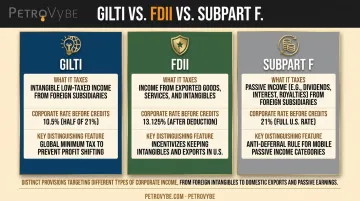
This overlap matters: if your CFC income already falls under Subpart F, it's excluded from tested income, so it won't get taxed twice under GILTI.
Who Pays GILTI, How Is It Reported, and What's Changing in 2026
Any US shareholder owning 10% or more of a CFC must include GILTI in gross income annually. That means filing:
- Form 5471 to register your CFC ownership and report tested income, QBAI, and interest details
- Form 8992 to calculate and report your actual GILTI inclusion based on that data
The Section 962 Election
Individual shareholders can elect under Section 962 to be taxed on GILTI at corporate rates instead of ordinary rates, gaining access to the Section 250 deduction and deemed-paid foreign tax credits. It's not automatic, and it comes with tradeoffs: later distributions of that income can trigger a second layer of tax. Talk to a qualified tax professional before making this election.
What Changes in 2026
The One Big Beautiful Bill Act (OBBBA) rewrites the rules for tax years beginning after December 31, 2025. According to the Congressional Research Service, GILTI is renamed Net CFC Tested Income (NCTI), and:
- QBAI is eliminated entirely, no more deemed tangible return subtracted from tested income
- Section 250 deduction permanently drops to 40%
- Foreign tax credit limitation rises to 90%
- Effective corporate rate before credits becomes 12.6%, not the 13.125% some earlier proposals cited
One more wrinkle: most states don't conform to GILTI or NCTI the same way the federal government does. As of late 2024, 21 states plus DC taxed at least part of GILTI, often with their own deduction rules. Check your state's specific treatment separately — don't assume federal rules apply at the state level.
Beyond GILTI: Legal Ways to Reduce Your Tax Burden
GILTI adds real complexity for anyone with international holdings — extra forms, elections to weigh, and often a higher effective rate than domestic income alone would generate. Many business owners and investors carrying this burden also look for complementary domestic strategies to bring their overall tax bill back down.
One option worth knowing: Intangible Drilling Cost (IDC) deductions through oil and gas development investments. Unlike real estate deductions, which are typically restricted to passive income under passive-loss rules, IDC deductions can offset active income directly: W-2 wages, capital gains, and ordinary income alike.
PetroVybe, a Texas-based natural gas development company, structures its investment offerings around exactly this mechanism:
- Roughly 70% of invested capital deducted in year one against active income
- Up to 100% total deduction over the life of the investment when combined with depletion and depreciation
- No restriction limiting the deduction to passive income only
- A 10-year target MOIC of 2.2x–5.8x with projected monthly passive distributions once production begins
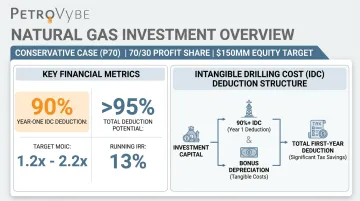
This works alongside proper GILTI planning rather than replacing it. Accredited investors with $100,000 or more in liquidity can use this domestic strategy to offset a high-income year while building long-term, tangible asset exposure alongside their international tax structuring.
Frequently Asked Questions
What are FDII and GILTI?
GILTI taxes US shareholders on certain foreign CFC earnings annually, while FDII gives US companies a reduced tax rate on foreign-derived income earned domestically. Both aim to discourage moving intangible assets offshore.
Is global income taxable in the USA?
The US uses a modified territorial system where active foreign business income is largely exempt from further tax once repatriated. GILTI is the major exception, taxing certain foreign earnings annually regardless of distribution.
What is the GILTI tax rate for individual shareholders?
Individuals owe GILTI at ordinary income rates, ranging from 10% to 37%, unless they make a Section 962 election to be taxed similarly to a corporation.
What is a Section 962 election and when should I consider it?
It lets individual shareholders apply corporate tax rates and certain deductions and credits to their GILTI inclusion instead of full ordinary rates. Review this decision with a tax professional first, since it affects how later distributions are taxed.
Do I need to file Form 8992 if I own a CFC?
Yes. Any US shareholder owning 10% or more of a CFC must file Form 8992 to report GILTI, alongside Form 5471 to register CFC ownership.
Are there other legal ways to reduce my overall tax burden besides managing GILTI exposure?
Yes. Beyond managing GILTI, some investors offset their overall tax burden through domestic tax-advantaged vehicles, such as oil and gas development programs offering intangible drilling cost (IDC) deductions against active income. These structures can complement international tax planning for accredited investors with significant W2 or capital gains exposure.