That confusion isn't accidental. Terms like assets, asset classes, and asset products get used interchangeably in financial media, even though they mean different things. This gets especially murky as more investors look past traditional stocks and bonds toward inflation protection and tax efficiency, including alternative options like direct energy development.
This guide breaks down what an asset product actually is, walks through the major categories, and shows real examples, including how alternative products like direct oil and gas development fit into a modern portfolio.
Key Takeaways
- Asset products are investment vehicles built on assets that generate income, appreciate in value, or both
- These products serve four portfolio roles: growth, income, inflation protection, and defense
- Stocks and bonds differ from tangible assets like real estate and direct energy interests in liquidity, tax treatment, and risk
- Knowing assets from liabilities is the foundation for evaluating any new asset product
What Are Asset Products? Definition and Core Characteristics
An asset product is a financial or tangible vehicle structured around an underlying asset, one that investors can buy into to gain exposure to its value, income, or growth potential.
That's different from just an "asset." According to Investor.gov's glossary, an asset is "any tangible or intangible item that has value in an exchange," such as a bank account, a home, or shares of stock.
In other words: the asset is the thing with value. The asset product is the structure built to let you invest in that value.
What Makes Something an "Asset Product"?
Three traits separate an asset product from a plain asset:
- Value: Either intrinsic (a piece of land) or derived, such as a share representing a claim on a company
- Transactability: Can be bought, sold, or allocated within a portfolio
- Benefit: Delivers income, appreciation, tax advantages, or a combination of the three
A house is an asset. A real estate investment trust is the asset product built around housing assets.
Financial vs. Physical Asset Products
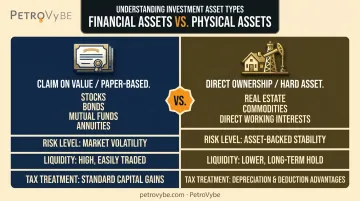
Financial asset products, such as stocks, bonds, mutual funds, and annuities, represent a claim on value. You don't own the underlying company or debt directly; you own a security that tracks it.
Physical asset products work differently. Real estate, commodities, and direct working interests in oil and gas wells give you direct ownership of a hard asset. No intermediary security sits between you and the thing itself.
This distinction matters because physical products typically carry different risk, liquidity, and tax characteristics than paper-based financial products. That's exactly why they play a distinct diversification role rather than duplicating what stocks and bonds already do.
Types of Asset Products: Breaking Down the Major Categories
Asset products get grouped two ways: by their underlying nature (tangible vs. intangible, liquid vs. illiquid) or by the job they do in a portfolio (growth, income, inflation protection, defensive).
Tangible vs. Intangible Asset Products
Tangible examples:
- Real estate
- Commodities (gold, oil, agricultural products)
- Direct working interests in producing wells
Intangible examples:
- Stocks
- Bonds
- Intellectual property-backed securities
Liquid vs. Illiquid Asset Products
Liquid products convert to cash quickly. Publicly traded stocks, mutual funds, and money market funds fall into this bucket.
Illiquid products require patience:
- Private real estate
- Direct energy development interests
- Retirement accounts (technically liquid, but penalized for early withdrawal)
Illiquid products often demand longer holding periods, but they frequently deliver stronger potential returns as compensation for that trade-off.
The Four Portfolio Roles of Asset Products
Wealth managers commonly sort products by the role each plays:
| Role | Function | Example |
|---|---|---|
| Growth | Long-term appreciation, highest volatility | Diversified equities |
| Income | Steady payments, moderate stability | Corporate/municipal bonds |
| Inflation protection | Preserves purchasing power | TIPS, commodities, hard assets |
| Defensive | Stability during downturns | Cash, U.S. Treasuries |
Demand for that third category, inflation protection, has climbed sharply. Cerulli estimated $1.4 trillion in U.S. advisor-intermediated illiquid alternative assets in 2024, with that figure projected to reach $2.4 trillion by 2029. That growth shows advisors treating inflation protection as a core allocation decision, not a peripheral hedge.
Common Examples of Asset Products Across a Portfolio
Most portfolios blend several product types, each doing a different job.
Financial asset products:
- Stocks — ownership stake in a company, growth-oriented
- Bonds — loan-based income with fixed payments
- Mutual funds — pooled diversification managed professionally
- ETFs — exchange-traded flexibility with intraday pricing
- Annuities — insurance-backed income stream, often for retirement
Tangible asset products:
- Real estate — appreciation plus rental income
- Precious metals — inflation hedge, store of value
- Commodities — exposure to raw materials pricing
- Direct energy interests — working interest in oil and gas production, often tax-advantaged
PetroVybe, for instance, offers accredited investors direct partnership equity in Texas natural gas projects instead of publicly traded stock.
Certificates of deposit and money market funds round out the list as lower-risk, highly liquid options for capital preservation. They won't make you rich, but they won't surprise you either.
Asset Products vs. Liabilities
A liability is any debt or obligation you owe. Investor.gov defines it as an amount owed for borrowed funds, including loans, notes, bonds, and mortgages, with repayment typically requiring principal and interest by a set date.
Asset products sit on the opposite side of the ledger. They're designed to build value, not draw it down.
Common liabilities:
- Credit card balances
- Mortgages
- Personal or auto loans
Common offsetting asset products:
- Income-producing investments (dividend stocks, bonds)
- Appreciating tangible assets (real estate)
- Direct-participation energy interests, such as oil and gas development stakes
Tracking assets against liabilities on a personal balance sheet shows whether a new asset product genuinely strengthens your net worth or simply adds risk dressed up as opportunity.
Why Alternative Asset Products Like Direct Oil & Gas Development Are Gaining Ground
Rising inflation and heavy tax burdens have pushed accredited investors toward alternative asset products that combine tangible ownership, passive income, and tax efficiency—benefits public markets rarely offer together.
Direct participation in oil and natural gas development sits squarely in this category. Instead of buying a paper claim like an energy stock or ETF, investors hold an actual working interest in a producing asset. You own a piece of the well itself, not a security that tracks it.
The Tax Advantage Most Investors Miss
The standout feature here is the Intangible Drilling Cost (IDC) deduction. Unlike real estate deductions, which are typically restricted to passive income unless you qualify as a real estate professional, IDC deductions can offset active income, including W-2 wages and capital gains.
That's a meaningful structural difference, and one most investors never encounter in traditional markets.
How PetroVybe Applies This Model
PetroVybe, a private Texas-based natural gas development company, gives accredited investors direct access to early-stage NGL (natural gas liquids) development assets in Lavaca County, part of the Gulf Coast Basin. A few specifics worth noting:
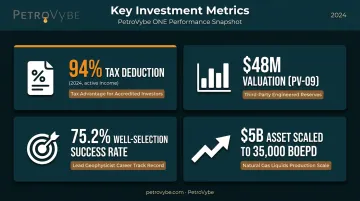
- Partners received a 94% tax deduction against active income in 2024, followed by 91% in 2025
- Proved reserves carry a $48 million valuation (PV-09), determined by a licensed third-party engineering firm
- Chief Geophysicist Michael Stamatedes brings a 75.2% well-selection success rate over a 48-year career, well above the sub-40% industry peer average
- President Blaine Yeary previously scaled a $5 billion asset from zero to 35,000 BOEPD in eight years
Participation requires $100,000 in liquidity and verified accredited investor status, meeting SEC income or net-worth thresholds.
Why This Combination Matters
Third-party validated reserves and transparent reporting give investors a way to evaluate credibility before committing capital, something that's genuinely hard to verify with many alternative offerings.
Long-term tangible asset growth, inflation-resistant passive income, and upfront tax deductions against active income round out the case. Direct energy development earns a serious look alongside traditional holdings, adding a genuine diversification layer to an accredited investor's portfolio.
Frequently Asked Questions
What is an asset product?
An asset product is a financial or tangible vehicle built around an underlying asset, letting investors access its income, appreciation, or tax benefits. Examples range from mutual funds to direct real estate to energy working interests.
What are the types of assets?
Assets fall into three groupings: tangible vs. intangible, liquid vs. illiquid, and personal vs. business. Most portfolios blend multiple types to balance growth, income, and risk.
What is the difference between an asset and an asset product?
An asset is the underlying item with value, like a home or a barrel of oil in the ground. An asset product is the investable structure built around it, such as a REIT or a working interest partnership.
Are oil and gas investments considered asset products?
Yes. Direct working interests in oil and gas development qualify as tangible, alternative asset products, offering both income potential and notable tax advantages like IDC deductions against active income.
What are the safest asset products for beginners?
Cash equivalents, CDs, and government bonds are typically the lowest-risk entry points. They won't generate outsized returns, but they preserve capital while you learn the landscape.
Can asset products generate passive income?
Many can. Dividend stocks, bonds, REITs, and direct energy development interests are all structured to produce ongoing passive income, though the amount and consistency vary by product type.