
She's not alone. The phrase gets used loosely across finance — for IPO timing, retirement account features, and private placement raises — and misunderstanding it can cost real money. A missed window can mean a lost tax deduction, a smaller allocation, or no access at all.
This article breaks down what an investment window actually is, the different forms it takes, and why the concept carries extra weight in tax-advantaged, capital-intensive sectors like oil and gas development.
Key Takeaways
- Investment windows are limited periods to deploy capital into a specific opportunity, fund, or account feature.
- They fall into three types: regulatory (retirement plans), market-driven (IPOs), or sponsor-driven (capital-capped raises).
- Missing one can cost you a tax deduction, a discounted entry price, or access entirely.
- In oil and gas, windows often align with the tax year and a project's pre-drill funding stage, heightening the stakes.
What Is an Investment Window?
An investment window is a specific, often finite period during which an investor can commit capital to a particular opportunity, fund, or vehicle before it closes to new participants. Once it shuts, that door is gone — either permanently or until the next cycle opens.
The term carries formal weight beyond marketing copy. EU Regulation 2021/947 defines an investment window as "a targeted area for support by the External Action Guarantee...to portfolios of investments in specific regions, countries or sectors." Structured finance and guarantee programs use this concept as a legal mechanism, not just a sales tactic.
Different Contexts, Same Core Concept
The mechanics shift depending on where you encounter the term:
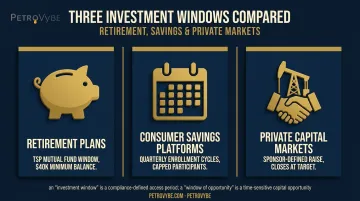
- Retirement plans: The Thrift Savings Plan's mutual fund window gives federal employees access to thousands of outside funds beyond the core lineup, requiring a $40,000 minimum balance and a $10,000 initial transfer capped at 25% of holdings.
- Consumer savings platforms: Some enrollment models open quarterly windows that close within weeks, capping how many participants can join a given cycle.
- Private capital markets: A sponsor, such as an oil and gas development partnership, keeps a funding period open to raise a defined capital amount, closing once that target or deadline is reached.
One clarification worth making here: an "investment window" (a defined capital period) is different from a "window of opportunity" (a fleeting market condition, like a favorable IPO price or an M&A premium). The two phrases often get used interchangeably, but they aren't interchangeable in meaning: an investment window is a structured mechanism, while a window of opportunity is a fleeting market moment.
Why Investment Windows Matter for Your Returns
Timing isn't a minor detail. It directly shapes your Multiple on Invested Capital (MOIC) and Internal Rate of Return (IRR). Entering a project early, before value gets priced in, typically produces a higher multiple than buying in later at a premium.
Here's the part most investors miss: MOIC and IRR aren't the same measurement, and timing affects them differently.
- MOIC tells you how much money came back relative to what you put in.
- IRR accounts for when that money came back.
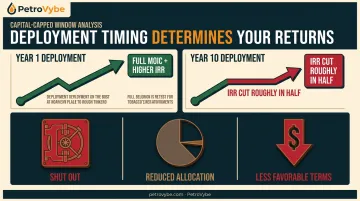
According to CFA Institute's analysis of private market performance, shifting a distribution from year one to year ten can roughly cut IRR in half, while the total multiple stays unchanged. Two deals can show identical MOIC numbers on paper and produce very different annualized outcomes depending on when the cash actually moved.
Compounding adds another layer. Capital deployed earlier has more time to grow. A dollar invested this quarter simply has more runway than the same dollar invested a year from now, assuming the underlying opportunity performs similarly.
In tax-advantaged deals, the window often aligns with the calendar tax year. Capital typically must be deployed before December 31 to claim deductions like Intangible Drilling Costs against that year's active income (PetroVybe partners, for example, claimed 91-94% deductions in 2024 and 2025). Miss that date, and the deduction doesn't roll forward; it's gone for that tax year.
Sponsor-driven windows add a second constraint: capacity. A drilling program might only have room for a fixed budget or acreage position, so missing the window carries real consequences:
- Late investors risk getting shut out entirely once capacity fills
- Remaining spots may come as a smaller allocation than requested
- The next raise cycle often arrives with less favorable terms
Common Types of Investment Windows You May Encounter
Not all windows work the same way. Here are three you're likely to run into:
- IPO/underwriting windows: A short period before a stock trades publicly when institutional and select retail investors can buy at the offering price. Most individual investors get no allocation here.
- Retirement plan windows: Features like the TSP's mutual fund window that open access to outside funds beyond the standard lineup. These typically require proactive enrollment: nobody defaults into them.
- Private placement/fund windows: Capital raises for real estate syndications or natural resource development, like PetroVybe's Texas gas projects, that close once a target raise amount or well count is reached.
Each type closes on a different trigger: a calendar date, a dollar cap, or a regulatory rule. Know which one applies before assuming you have flexibility.
The Investment Window in Oil & Gas Development
Upstream oil and gas development runs on its own version of the investment window. It's one of the more consequential examples because two forces close it at once: capital capacity and the tax calendar.
A window typically opens when a sponsor begins raising funds for a specific drilling program or lease acquisition. It closes once the program is fully funded or the tax-deduction deadline passes, whichever comes first.
Why Pre-Drill Timing Drives MOIC
Capital deployed during the pre-drill or early-development stage funds the wells directly. That's a different position than buying into already-producing assets, where much of the upside has already been captured and you're paying a premium for reduced risk. Entering early is where the multiple gets made.
The IDC Deadline Is a Hard Line
The IDC deduction creates a genuine "use it or lose it" event. Under IRS Publication 925, a working interest held directly, or through an entity that doesn't limit the holder's liability, isn't treated as a passive activity, regardless of material participation.
That removes the passive-activity barrier that blocks many other investments from offsetting W-2 income or capital gains. But the deduction still depends on costs being paid or incurred within that specific tax year, tied to actual drilling activity, not just a wire transfer commitment.
How PetroVybe Structures Its Window
PetroVybe opens defined capital windows for its South Texas and Gulf Coast Basin development projects, giving accredited investors direct entry at the pre-drill stage, the point where value gets created.
The company backs that entry point with verifiable numbers:
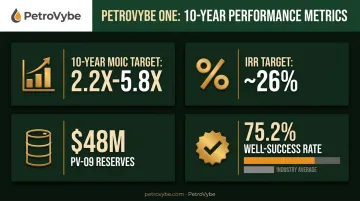
- 10-year MOIC target of roughly 2.2x–5.8x
- IRR target near 26%
- $48 million PV-09 proved reserves valuation from third-party engineering
- 75.2% career well-success rate from Chief Geophysicist Michael Stamatedes, nearly double the industry peer average of below 40%, built over a 48-year career that included leadership roles at ExxonMobil
Every prospect gets evaluated before a window opens to investors, which reduces (though never eliminates) the risk of capital going toward a low-probability project.
How to Evaluate an Investment Window Before Committing
Before you wire any funds, get specific answers to a few questions:
- What actually closes this window? A hard capital cap, a calendar or tax deadline, or both? Don't assume you have flexibility until you know the actual constraint.
- What's the sponsor's track record? Look for third-party validation (engineering reports, independent audits, verified reviews) rather than relying solely on the sponsor's own marketing materials.
- Is the paperwork realistic given the timeline? Tax-driven windows require signed subscription documents and funded wires before year-end, not just a verbal commitment. A rushed signature after December 20 leaves little margin for error.
Work with a tax advisor early, and request the sponsor's compliance documentation (private placement memorandum, limited partnership agreement, subscription agreement) as soon as you're seriously considering the deal. If a sponsor can't produce that paperwork quickly, that's a signal worth paying attention to.
Frequently Asked Questions
What is an investment window?
It's a limited period during which capital can be committed to a specific fund, account feature, or opportunity before it closes or the terms change. The trigger can be a calendar date, a capital cap, or both.
How much will $10,000 invested be worth in 10 years?
It depends on your rate of return and compounding period. At 10% annually, $10,000 grows to about $25,937 in 10 years, while a targeted alternative asset with a 2.2x–5.8x MOIC could return $22,000 to $58,000.
How much money would I need to invest to make $1,000 a month?
That depends on the annual yield you're assuming. At a 6% annual cash yield, you'd need roughly $200,000 invested; passive income-focused alternative assets often target specific annual cash yields worth confirming directly with the sponsor.
How long does an investment window typically stay open?
Duration varies widely, from a few weeks for consumer savings platforms to several months for private placements. It largely depends on capital caps and the sponsor's fundraising timeline.
What happens if I miss an investment window?
You typically lose that year's tax deduction and any early-stage pricing or allocation, then face a wait until the next raise cycle—often with less favorable terms.
Do I need to be an accredited investor to access private investment windows like oil and gas development deals?
Most private placement windows, including PetroVybe's, require SEC accredited investor status. That generally means a net worth over $1 million (excluding your primary home) or income above $200,000 individually ($300,000 with a spouse) for two years.