

This happens more often than most investors realize. Many business owners, analysts, and even seasoned investors overlook or misclassify non-operating interest income, which can quietly distort how profitable a business actually looks.
This article breaks down what non-operating interest income is, how it differs from operating income, and why the distinction matters, whether you're reading a Fortune 500 income statement or evaluating a private natural gas development project.
Key Takeaways
- Non-operating interest income comes from activities outside core operations
- Common sources include idle cash, marketable securities, notes receivable, and related-party loans
- Most companies report it below operating income; banks count it as revenue
- Separating it out helps investors judge whether profit is sustainable or artificially inflated
What Is Non-Operating Interest Income?
Non-operating interest income is interest earned on cash, investments, or receivables that fall outside a company's primary revenue-generating activity. If a retailer earns interest on excess cash parked in a bank account, that interest didn't come from selling merchandise. It's incidental to the business rather than a core driver of revenue.
The classification hinges on what accountants call the "principal purpose" test: revenue only counts as operating if it results from a company's main activity. A software company selling code is operating revenue. That same company earning interest on its cash reserves is not.
Typical sources of non-operating interest income include:
- Interest on bank savings, checking accounts, or certificates of deposit
- Returns on bonds, treasury bills, or other marketable securities
- Earnings from notes receivable
- Income from loans to subsidiaries or related parties
On the income statement, this shows up below operating income, often under a heading like "Other Income (Expense)" or "Interest and Other, Net."
A Real Example: Alphabet's 10-K
Alphabet's 2024 annual filing shows exactly how this works in practice. The company reported $112,390 million in income from operations. Tucked separately inside Note 7, interest income of $4,482 million fed into a total "Other income (expense), net" line of $7,425 million, pushing pretax income to $119,815 million, according to Alphabet's 2024 10-K filing.

Notice that interest income sits apart from the operating result. It never touches the core Search, Cloud, or advertising performance that investors actually care about.
Non-Operating Interest Income vs. Operating Income
Why the Distinction Matters
Operating income reflects what a company does repeatedly, day in and day out. Non-operating interest income doesn't work that way. It rises and falls with market interest rates, cash balances, and treasury decisions that have nothing to do with selling products or services.
Consider a hypothetical example from Investopedia: a technology company earning $1 billion annually sells off a division for $400 million. That one-time, non-operating gain inflates reported earnings by 40%, according to Investopedia's breakdown of non-operating income, without any improvement in the company's actual operations.
The same logic applies to interest income. A company with flat or declining sales can still post rising net income simply because interest rates went up and its cash balance earned more. Analysts strip this out precisely because it doesn't repeat reliably.
When Interest Income IS Considered Operating
There's a major exception: banks, credit unions, and finance companies. For these institutions, lending money is the business. The lending spread is the primary product, not an incidental byproduct of holding cash.
Regulatory guidance for depository institutions confirms this classification: bank call report instructions require financial statements to present interest and fees on loans, interest on investment securities, and net interest income as core operating figures.
Here's the contrast in plain terms:
| Entity | $10,000 in interest income | Classification |
|---|---|---|
| Community bank | Core lending revenue | Operating income |
| Retailer or manufacturer | Incidental treasury return | Non-operating income |
Same dollar amount, completely different meaning, depending on what the company actually does for a living.
Examples of Non-Operating Interest Income
Non-operating interest income shows up in a handful of recognizable forms across almost every non-financial company:
- Idle cash interest - Interest earned on excess cash parked in a savings or money market account while waiting to be deployed
- Marketable securities income - Returns from bonds, treasury bills, or short-term investments held by a company with no financial services operations
- Notes receivable interest - Interest earned on seller-financed sales, where a business extends credit terms to a customer
- Related-party loan interest - Interest income from loans made to subsidiaries, joint ventures, or affiliated entities
- Consistent small-line items - Some companies report modest but steady non-operating interest year after year
Costco's recent filings illustrate that last example well. Across fiscal years 2023 to 2025, the company reported "Interest income and other, net" ranging from $533 million to $624 million, per Costco's fiscal 2025 10-K. This steady band bridged operating income to pretax income each year.
In FY2025, operating income of $10,383 million, minus $154 million in interest expense, plus $589 million in interest income and other, netted out to $10,818 million pretax. Costco doesn't fully disaggregate pure interest income from the "other" component on the statement face, a reminder that these captions aren't always perfectly clean.
How to Calculate and Locate Non-Operating Interest Income
Finding this figure takes a bit of digging, but the process is straightforward once you know where to look.
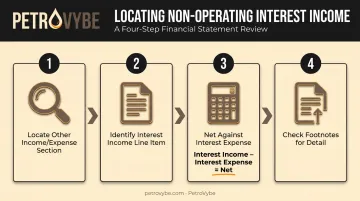
Step-by-step approach:
- Locate the "Other Income (Expense)" section, usually positioned between operating income and pretax income on the income statement
- Identify interest income specifically, either on the statement face or in the accompanying notes
- Net it against interest expense to determine the true non-operating position:
net interest income = interest income - interest expense - Check the footnotes if the statement only shows a combined figure. Smaller companies frequently disclose interest income only in the notes, not the main statement
Analysts use this same process when calculating adjusted EBIT or EBITDA. Non-operating interest income gets excluded to isolate core operating performance. For example, a company with $2 million in interest income and $500,000 in interest expense would report $1.5 million in net non-operating interest income for this calculation.
One caution here: the SEC hasn't prescribed a single universal method for this netting process. When a company labels a figure "Adjusted EBITDA," it should reconcile back to GAAP net income rather than standing alone.
Why This Distinction Matters for Investors
Whether you're reading a public company's 10-K or reviewing a private investment memorandum, the underlying question is the same: is this return sustainable, or is it incidental?
Ordinary non-operating interest income, the kind earned on a savings account or a bond, is taxed as ordinary income with no special deductions available. There's no way to shelter it or offset it against other income sources. It simply gets added to your taxable income for the year.
Contrast that with active income strategies like direct working-interest natural gas development. At PetroVybe, accredited investors participating in projects like PetroVybe ONE can access Intangible Drilling Cost (IDC) deductions that work fundamentally differently:
- IDC deductions are **not restricted to passive income** the way real estate losses typically are
- They can offset active income, including W-2 wages and capital gains
- In 2024, PetroVybe partners received a 94% first-year tax deduction against active income; in 2025, that figure was 91%
- Investors can take the full deduction in year one or spread it evenly across five tax years, depending on their planning needs

This is a meaningfully different structure than passive interest-bearing accounts. A savings account generates a modest, fully taxable return with no offsetting mechanism.
An IDC-eligible investment in a tangible asset works differently. PetroVybe's Lavaca County, Texas development program, backed by a third-party-engineered $48 million proved reserves valuation, offers both a large upfront deduction and long-term production income tied to real hydrocarbon output.
Understanding these distinctions matters when you're reading financial statements, K-1s, or project reports. It helps you tell the difference between profit that repeats and profit that just happened once. That distinction holds whether you're looking at a Fortune 500 income statement or comparing a bond fund to a direct energy investment.
Frequently Asked Questions
Is interest income non-operating income?
Generally, yes. Interest income is non-operating unless the company's core business is lending or financing, such as a bank, in which case it's classified as operating revenue.
How do you calculate non-operating income?
Total all income from outside core operations, including interest, investment gains, and asset sale proceeds, then report it separately from operating income on the income statement.
What counts as non-operating income?
Common categories include interest income, dividend income, gains on asset sales, and foreign exchange gains. Classification depends on whether the activity is central to the business.
What are examples of non-interest income?
Non-interest income refers to revenue other than interest, such as fees, service charges, or trading gains. This is different from non-operating income; a bank fee can be non-interest but still operating revenue.
Where does non-operating interest income appear on financial statements?
It typically appears below operating income, often within an "Other Income/(Expense)" section, with further detail sometimes disclosed in the notes to financial statements.
Can interest income ever be considered part of core operations?
Yes. For banks, credit unions, and lending businesses, interest income is a primary revenue source and is classified as operating income rather than non-operating income.