

Inflation is still running hot, interest rates remain elevated, and tax burdens on active income continue to squeeze business owners and high earners alike. Add in tariff-driven input costs and the capital scramble around AI infrastructure, and cash flow management has stopped being a back-office exercise. It's survival.
This guide breaks down the fundamentals: what cash flow actually is, the three (plus one) types every business and investor should track, how to read a cash flow statement without a finance degree, the golden rules that prevent most cash crunches, and why more accredited investors are diversifying into passive, cash-generating alternative assets to hedge everything above.
Key Takeaways
- Net Cash Flow = Total Cash Inflow minus Total Cash Outflow, a simple formula with high stakes for solvency
- Cash flow statements break into three GAAP categories: operating, investing, and financing
- A profitable business can still run out of cash when funds sit in receivables or inventory
- Forecasting, tightening receivables/payables, and building reserves prevent most cash crises
- Passive, tax-advantaged assets outside stocks and real estate are gaining traction for 2026 diversification
What Is Cash Flow? (And Why It's the Lifeblood of Every Balance Sheet)
Cash flow is the total movement of money into and out of a business (or personal balance sheet) over a given period. The formula is straightforward:
Net Cash Flow (NCF) = Total Cash Inflow (TCI) - Total Cash Outflow (TCO)
Cash Inflow includes:
- Sales revenue from customers
- Financing proceeds from loans or equity
- Money from asset sales
Cash Outflow includes:
- Operating expenses like payroll and rent
- Debt repayment
- Capital expenditures on equipment or facilities
Here's where it gets tricky: cash flow and profit are not the same thing. A company can post strong net income and still be starving for cash if that money is tied up in receivables or inventory instead of the bank account.
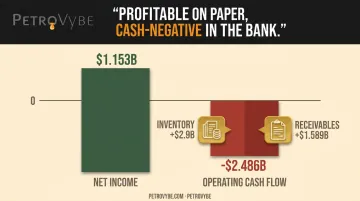
Super Micro Computer's fiscal 2024 filing is a textbook case. The company reported $1.153 billion in net income but burned through $2.486 billion in operating cash, driven largely by a $2.9 billion increase in inventory and a $1.589 billion jump in receivables. On paper, the business was profitable. In the bank, it was cash-negative.
Explain It Like I'm 5: Cash Flow in Plain English
Think of your personal checking account. Money that lands in your account (paycheck, a refund, a gift) is inflow. Money that leaves (rent, groceries, that impulse buy) is outflow. Cash flow is simply the difference between the two at the end of the month. Businesses run on the exact same logic, just with more zeros.
Why Cash Flow Matters More in 2026
The macro backdrop is making this harder. CPI-U rose 3.5% in the 12 months through June 2026, with energy costs up 15.7%, per the Bureau of Labor Statistics.
Meanwhile, capital demands tied to AI infrastructure are reshaping how companies deploy cash. UBS estimates, reported by Reuters, project hyperscaler capex will jump 76% to $673 billion in 2026. That's a forecast, not a guarantee, but it signals how much competition there is for capital right now, and that competition trickles down to every business trying to secure financing or manage supplier terms.
The 3 (Plus One) Types of Cash Flow Explained
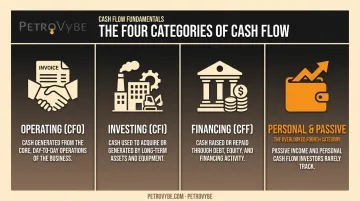
Every cash flow statement reports three GAAP-recognized categories. FASB Statement No. 95 established this framework in November 1987, with the requirement taking effect for fiscal years ending after July 15, 1988 — now codified under ASC 230.
Operating Cash Flow (CFO)
CFO measures cash generated from core business operations: collecting from customers, paying suppliers, covering payroll. It answers one blunt question: can this business pay its bills without borrowing or raising equity? Consistently negative CFO, even alongside reported profit, is one of the clearest warning signs in finance. A retailer posting $2M in net income while burning $500K in operating cash each quarter is heading for trouble.
Investing Cash Flow (CFI)
Unlike CFO, CFI reflects cash used for or generated by long-term investments, think equipment purchases, acquisitions, or asset sales. Negative CFI isn't automatically bad news. A company plowing cash into R&D or new equipment may be reinvesting for future growth rather than signaling distress.
Financing Cash Flow (CFF)
Beyond investments, CFF captures cash movement tied to debt issuance, equity raises, and dividend payments. It reveals how a company funds itself and rewards shareholders, offering a window into its overall capital strategy.
Personal & Passive Cash Flow: The Overlooked Fourth Category
The three categories above cover corporate accounting, but individual investor cash flow extends well beyond a paycheck. Distributions from investments, royalties, and passive income streams all count. This fourth category matters more each year as high earners look for cash flow that doesn't depend on a single job or employer, a theme we'll come back to below.
How to Read a Cash Flow Statement (Plus the Metrics That Matter in 2026)
A cash flow statement reconciles the balance sheet and income statement, ending in the net increase or decrease in cash and cash equivalents. A simplified version might look like this:
| Section | Example Amount |
|---|---|
| Operating Activities | +$500,000 |
| Investing Activities | -$200,000 |
| Financing Activities | -$100,000 |
| Net Change in Cash | +$200,000 |
Add the three sections together, and you get the bottom-line change in cash for the period. Simple in structure, but the details inside each line matter enormously.
Ratios Worth Knowing (and Their Limits)
Analysts commonly reference these measures. The SEC has stated that free cash flow has no single, uniform definition and must be reconciled to a GAAP measure when disclosed:
- Free Cash Flow (FCF) — typically operating cash flow minus capital expenditures; shows discretionary cash available
- Unlevered Free Cash Flow (UFCF) — cash flow before debt obligations, useful for comparing companies with different capital structures
- Cash Flow-to-Net Income Ratio — flags divergence between reported profit and actual cash generated
- Current Liability Coverage Ratio — gauges ability to cover near-term obligations with operating cash
- Price-to-Cash Flow Ratio — a valuation lens, similar to P/E but based on cash rather than earnings
Spotting Red Flags
Netflix's own 10-K filings from 2017 through 2019 show the pattern clearly: net income climbed from $559 million to $1.867 billion, while operating cash flow stayed deeply negative, from -$1.79 billion to -$2.89 billion.
The company attributed this to upfront cash payments for content that outpaced amortization expense on the income statement. Profitable on paper, cash-negative in reality, and it took years for the model to flip.
What's New for 2026
FASB is actively drafting a proposed Accounting Standards Update addressing how certain digital assets, including some stablecoins, might qualify as cash equivalents under ASC 230. As of mid-2026, no final rule has been issued, so treat this as an evolving area rather than settled guidance.
The Golden Rules of Cash Flow Management for 2026
Four habits separate businesses that survive cash crunches from those that don't.
- Forecast early and often. Model best-case, worst-case, and likely-case cash positions to catch shortfalls before they hit. PwC's 2025 Global Treasury Survey found 74% of treasurers are already using or expanding AI in their forecasting.
- Tighten receivables and payables. Offer early-payment discounts, automate invoicing, and negotiate longer supplier terms to reduce Days Sales Outstanding (DSO), the average time it takes to collect after a sale.
- Build reserves before you need them. Automate transfers into a cash buffer account. Seasonal dips and unexpected downturns hit far softer when reserves are already in place.
- Diversify your income sources. A single revenue stream, or a single paycheck, is a fragile foundation. Many high earners now add non-correlated assets, such as private energy or real-asset partnerships, to their portfolios instead of relying solely on stocks, bonds, and real estate.

Building Passive Cash Flow Through Alternative Investments
Rule four deserves its own spotlight. It marks the biggest shift among accredited investors heading into 2026: a search for tax-advantaged, cash-flowing assets that sit outside conventional markets and help offset both inflation and heavy active-income tax bills.
Natural gas and oil development has become one such asset class. PetroVybe, a private Texas-based natural gas developer operating in Lavaca County and the Gulf Coast Basin, offers accredited investors direct positions in early-stage development projects through its PetroVybe ONE partnership.
The Structural Appeal
- First-year tax deduction — new investors can typically project a ~70% deduction against active income (W-2 wages or capital gains) under standard Intangible Drilling Cost (IDC) treatment.
- PetroVybe's actual track record — partners exceeded that baseline, with verified deductions of 94% in 2024 and 91% in 2025.
- Return targets — a 10-year projected MOIC range of roughly 2.2x to 5.8x, with a target IRR near 26%.
- Monthly passive distributions projected to peak above $10,000/month during peak production, after a typical 2-to-3-year ramp-up before first distributions.
- Proved reserves — $48 million in third-party engineered reserves (PV-09), independently validated.
Who Qualifies and What to Verify
This isn't an entry-level play. Participation requires accredited investor status and a minimum of $100,000 in liquidity.
Before committing capital to any operator in this space, look for independently verified track records:
- PetroVybe's Chief Geophysicist carries a 75.2% well-selection success rate over a 48-year career, well above the industry peer average below 40%.
- The company holds a 5.0 rating across 8 verified reviews on Invest Clearly.
- Third-party engineering validation and public reviews are the due diligence markers worth demanding from any sponsor before wiring six figures into a private partnership.
Frequently Asked Questions
How do I explain cash flow to a beginner?
Think of your bank account: money coming in is inflow, money going out is outflow. Cash flow is just the difference between the two over a period of time.
What are the golden rules of cash flow?
Forecast regularly, tighten receivables and payables, and build cash reserves before you need them. Diversifying income sources adds a fourth layer of protection.
What is the difference between cash flow and profit?
Cash flow tracks actual money moving in and out of your accounts. Profit is revenue minus expenses on paper, which can look strong even while cash is tight.
What is free cash flow, and why does it matter?
Free cash flow is the money left after covering operating expenses and capital expenditures. It signals how much cash a business can reinvest, use to pay down debt, or return to owners.
How can passive income investments improve my cash flow in 2026?
Assets like natural gas development can add distributions and tax deductions on top of salary income, reducing your dependence on a single paycheck or revenue stream.
What's changing in cash flow reporting for 2026?
Standard-setters are reviewing whether certain digital assets could qualify as cash equivalents in future reporting frameworks. No final rule exists yet, so treat this classification as tentative until formal guidance is issued.