

Understanding this concept goes beyond an economics classroom. It shapes how households budget during inflation, how businesses forecast demand, and how investors think about the true value of tax savings. This article breaks down what the income effect is, how it differs from the substitution effect, and what it looks like in real financial decisions, including tax strategy.
Key Takeaways
- The income effect shows how real purchasing power, not nominal income, shifts demand.
- Demand rises for normal goods as income grows, and falls for inferior goods.
- Price changes create an indirect income effect by changing what your paycheck buys.
- Tax deductions create a personal income effect by freeing up spendable income.
What Is the Income Effect?
The income effect refers to the change in quantity demanded for a good or service that results from a change in a consumer's real income, meaning actual purchasing power rather than the dollar figure on a paycheck.
This distinction matters more than most people realize. Nominal income is the raw number: your salary, your hourly wage, the figure on your paystub.
Real income is what that number can actually buy after accounting for prices. A $75,000 salary today doesn't stretch as far as it did three years ago, even if the number hasn't changed at all.
Bureau of Labor Statistics data illustrates this gap directly: real average hourly earnings rose just 0.1% from June 2025 to June 2026, even as nominal wages moved differently.
In the single month between May and June 2026, nominal hourly earnings climbed 0.3%, but CPI-U fell 0.4% that same month, pushing real earnings up 0.8%. Small price shifts can swing purchasing power more than paychecks do.
Positive Income Effect and Normal Goods
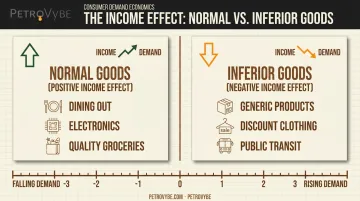
When income rises and people buy more of something, that's a positive income effect, and the item in question is a normal good.
Picture someone landing a promotion with a $10,000 raise. Their grocery cart shifts:
- Swaps store-brand pasta for name-brand pasta
- Bumps weekly takeout from once to three times
- Upgrades a planned laptop purchase from used to new
Dining out, electronics, and higher-quality groceries are classic normal goods. Demand rises right alongside income.
Negative Income Effect and Inferior Goods
The opposite pattern applies to inferior goods. When income rises, demand for these goods actually falls. Economists call this a negative income effect.
Generic canned vegetables, discount clothing brands, off-brand cleaning supplies, and public transit in cities with strong car culture all behave this way. People buy more of them when money is tight and less once income improves, not because the goods are lower quality by definition, but because better-preferred alternatives become affordable.
The technical measure separating the two is income elasticity of demand: positive values (below 1) signal normal goods, while negative values signal inferior ones. No heavy math required to grasp the pattern, just watch what happens to demand when income moves.
How the Income Effect Works: Price, Real Income, and Demand
Here's the mechanism in plain terms: a price decrease works like a raise you never asked for. If gas drops from $3.80 to $3.20 a gallon, your monthly budget suddenly has more breathing room, even though your paycheck stayed exactly the same.
That extra breathing room increases demand for other goods. A price increase does the reverse, shrinking your effective budget.
This is one reason economists point to the income effect when explaining why demand curves slope downward. As price falls, real purchasing power rises, which pushes demand up, reinforcing the basic law of demand alongside substitution behavior.
Direct vs Indirect Income Effects
- Direct income effect: Your income itself changes, like a raise, bonus, or layoff.
- Indirect income effect: Prices change, which alters your effective spending power without your paycheck moving at all.
A promotion is direct. A drop in grocery prices that leaves you with extra monthly cash is indirect.
Income Effect vs Price Effect
These two terms get mixed up constantly. The price effect looks purely at how a price change alters buying behavior for that specific good. The income effect looks at the broader purchasing-power shift that price change creates across your entire budget. The price effect is narrow, isolated to one good. The income effect is broader, touching your entire spending pattern.
Inflation's Quiet Erosion
This same mechanic plays out at the macro level through inflation, which reduces real income even when your paycheck never changes. CPI-U ran 3.5% higher in June 2026 than the same month a year earlier. A household with an unchanged nominal budget effectively lost purchasing power without a single line item on their pay stub shifting. That's the income effect operating in reverse, across millions of households at once.
Income Effect vs. Substitution Effect
The substitution effect describes something different: when a good's price rises or falls relative to alternatives, consumers shift toward whichever option is now relatively cheaper. This reflects comparison shopping driven by relative price changes, not total buying power.
Here's the contrast in one line:
| Factor | Income Effect | Substitution Effect |
|---|---|---|
| Focus | Overall purchasing power | Relative price comparison |
| Trigger | Change in real income (direct or price-driven) | Change in one good's price versus substitutes |
| Normal goods | Reinforces demand increase | Reinforces demand increase |
| Inferior goods | Can work against the substitution effect | Still favors the cheaper good |
For normal goods, both effects push in the same direction. For inferior goods, they can pull against each other, making demand harder to predict when prices shift.
Worked Example: Both Effects in Action
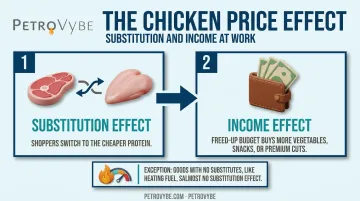
Say the price of chicken drops 20% while beef prices hold steady.
- Substitution effect kicks in first. Households that were buying beef start buying more chicken because it's now the cheaper protein option.
- Income effect follows. The money saved on cheaper chicken frees up cash elsewhere in the budget, so the same household might also buy more vegetables, snacks, or even upgrade to a nicer cut of chicken.
Both effects move demand upward for chicken here, one through comparison, the other through freed-up spending power.
One key exception: goods with no real substitutes, like essential heating fuel in winter, show almost no substitution effect. Consumers can't meaningfully swap it for something else, so any demand change comes almost entirely from the income effect alone.
Real-World Examples of the Income Effect
Example 1: The Promotion Effect
A mid-career professional gets bumped from $85,000 to $105,000. Within months, their spending patterns shift toward normal goods: a nicer apartment, name-brand groceries, a gym membership instead of home workouts. This is the positive income effect playing out in real time, not a hypothetical.
Example 2: The Price Shock Response
Fuel and grocery spikes hit household budgets hard and fast. During the 2022 inflation surge, households responded quickly, according to the Federal Reserve's 2022 household survey:
- 66% of U.S. adults used less of a product or stopped buying it entirely
- 64% switched to a cheaper alternative
- Nearly half delayed a major purchase outright
That's a negative income effect showing up across tens of millions of households simultaneously.
Example 3: The Macro Picture
Broad inflation doesn't just hit gas and eggs. It dampens demand for discretionary purchases economy-wide. Federal Reserve Beige Book reports from 2022 documented households trading down toward private-label goods and reducing spending on luxury and high-end items as elevated prices ate into real incomes across the board. Even shoppers who weren't personally struggling adjusted behavior as the overall economic mood shifted.
What the Income Effect Means for High Earners and Investors
Here's an angle most people miss: lowering your tax burden functions exactly like a personal income effect. You didn't get a raise, but you have more real, spendable income to work with, which changes what you can afford and how you invest.
This isn't theoretical for high-W2 earners facing significant tax liability. Upfront deductions on active income, like the ones available through natural gas development investments, can meaningfully boost real disposable income without requiring a single dollar more in salary.
Consider how this plays out mechanically:
- A structure offering deductions against active income (W-2 wages, capital gains) reduces what you owe the IRS this year
- That reduction increases your real disposable income, identical in effect to a raise
- You can redirect that freed-up capital into other wealth-building vehicles
This is the same demand-for-better-goods logic behind the positive income effect, just applied to long-term financial decisions instead of grocery carts. Extra real income doesn't just buy nicer dinners. It can fund reinvestment into passive income streams, diversify a portfolio beyond stocks and bonds, or build toward a longer-term wealth goal.
For investors who want to apply this principle directly to their own finances, PetroVybe's natural gas development opportunities are one example worth exploring. The structure combines tax efficiency on active income with long-term passive distributions, turning a tax strategy into a legacy wealth-building tool rather than just an annual write-off.

Frequently Asked Questions
What exactly is the income effect?
The income effect is the change in demand for a good or service caused by a change in real income or purchasing power. It's distinct from behavior driven purely by a good's own price change.
What is an example of substitution and income effect?
When chicken prices drop relative to beef, shoppers switch to chicken (substitution effect) and also have leftover budget to buy more overall, including better cuts or extra sides (income effect). Both effects can move in the same direction for normal goods.
What is the difference between the income effect and the price effect?
The price effect looks narrowly at how a single good's price change affects demand for that good. The income effect looks at how that same price change alters your total purchasing power across your entire budget.
What are normal and inferior goods in relation to the income effect?
Normal goods see demand rise as income rises, producing a positive income effect. Inferior goods see demand fall as income rises, producing a negative income effect, since consumers shift toward preferred alternatives.
How does the income effect affect the demand curve?
It's one reason demand curves slope downward. A price drop increases effective purchasing power, which increases demand for that good, reinforcing the basic law of demand alongside the substitution effect.
Can the income effect apply to tax savings or investment income?
Yes. Tax deductions and investment income increase real disposable income the same way a raise does, freeing up capital for reinvestment or higher-quality purchases without requiring additional earned income. PetroVybe's natural gas partnerships illustrate this directly: partners have claimed 91-94% deductions against active income, producing the same income-effect boost as a raise without extra work hours.