
Investment planning is the process of aligning your money, your goals, your risk tolerance, and your time horizon into one coherent strategy. It's the difference between hoping your portfolio works out and knowing why it's built the way it is.
This guide covers the full picture: what investment planning actually means, the step-by-step process behind it, how risk and diversification fit in, the types of investments available (including tax-advantaged alternatives), and the mistakes that quietly sabotage even well-intentioned plans.
Key Takeaways
- Investment planning turns financial goals into a strategy covering risk, allocation, and monitoring
- It's part of financial planning, which also covers budgeting, insurance, and estate matters
- Strong plans blend stocks and bonds with tax-advantaged alternatives like direct investments
- Regular review and rebalancing separate a real plan from a one-time purchase
What Is Investment Planning?
Investment planning is the ongoing process of determining your financial goals, assessing your resources and risk tolerance, and selecting a mix of investments designed to reach those goals within a specific time horizon.
Note the word ongoing. This isn't a single transaction you complete and forget. It's a continuous cycle:
- Set or revisit goals
- Execute a strategy built around those goals
- Adjust as circumstances, markets, or tax laws change
Who needs this most? Investment planning matters for almost anyone with savings, but it becomes essential as income and complexity grow:
- Working professionals building toward retirement or a home purchase
- High-income earners facing significant tax exposure
- Business owners managing irregular income and concentrated wealth
- Retirees who need to convert assets into sustainable income
The higher your income and the more assets you accumulate, the more a haphazard approach costs you in taxes, missed diversification, and unnecessary risk.
Investment Planning vs. Financial Planning: What's the Difference?
This is one of the most common points of confusion in financial services. Financial planning is the umbrella; investment planning is one piece underneath it.
| Aspect | Financial Planning | Investment Planning |
|---|---|---|
| Scope | Entire financial life | Investable assets only |
| Focus | Budgeting, insurance, debt, retirement, estate | Capital growth and asset allocation |
| Tools used | Cash flow analysis, insurance review, estate documents | Portfolio construction, risk assessment, rebalancing |
| Governing body | CFP Board's broader planning process | A component within that same process |
The CFP Board treats investment planning as a formal part of the larger financial-planning body of knowledge, not a standalone discipline. In practice, you can't build a smart investment plan in isolation from your broader financial picture. Your emergency fund, debt load, and insurance coverage all determine how much risk your portfolio can actually absorb.
Core Components of an Investment Plan
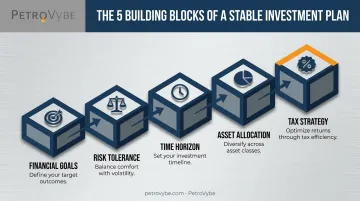
Every solid plan rests on five building blocks:
- Financial goals – What you're investing toward (retirement, a home, education, business capital)
- Risk tolerance – How much volatility you can stomach without abandoning the plan
- Time horizon – How long until you need the money
- Asset allocation – How capital is divided across stocks, bonds, cash, and alternative assets like direct real estate or energy partnerships
- Tax strategy – How account types and investment vehicles affect what you actually keep
Skip any one of these, and the plan tends to unravel the first time markets get rocky.
The Investment Planning Process: A Step-by-Step Framework
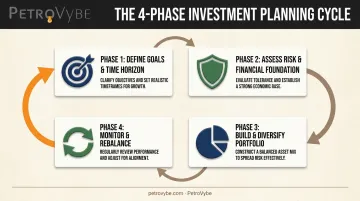
The process typically breaks down into three to four core phases: define your goals, assess your risk and financial foundation, build your portfolio, and monitor it over time. Here's how each phase works in practice.
Step 1: Define Your Financial Goals and Time Horizon
Not all goals deserve the same treatment. Separate them by timeline:
- Short-term (0-2 years): An emergency cushion, a wedding, a down payment next year
- Medium-term (3-5 years): A home purchase, a business investment
- Long-term (5+ years): Retirement, a child's education, legacy wealth
Your time horizon shapes nearly every decision that follows. Money needed in 18 months has no business sitting in volatile stocks. Money you won't touch for 20 years can absorb short-term swings in exchange for higher long-term growth.
Step 2: Assess Your Risk Tolerance and Financial Foundation
Before a single dollar goes into the market, secure the basics:
- Build an emergency fund covering three to six months of expenses
- Pay down high-interest debt, especially credit cards
- Only then evaluate how much investment risk you can genuinely handle
Risk tolerance isn't just a feeling. According to FINRA, it depends on your objectives, how much you rely on the funds, your net worth, your spending needs, and how you actually react when your portfolio drops in value. Someone in their 30s with stable income and no near-term cash needs can typically absorb far more volatility than someone nearing retirement.
Step 3: Build and Diversify Your Portfolio
Asset allocation means splitting your capital across categories (stocks, bonds, cash, real assets) to match your goals and risk profile. There's no universal formula here. A 28-year-old saving for retirement and a 60-year-old five years from retiring need entirely different mixes.
Here's why this decision matters more than most people realize: strategic asset allocation explains more than 90% of a broadly diversified portfolio's return variability over time, according to Vanguard's research building on the landmark Brinson, Hood, and Beebower study. In other words, how you divide your money across categories matters far more than which individual stocks you pick.
Step 4: Monitor, Rebalance, and Adjust
Markets drift. A portfolio that started 70% stocks and 30% bonds can quietly shift to 80/20 after a strong equity run, exposing you to more risk than you signed up for. Rebalancing restores your target allocation.
Investor.gov recommends two approaches: a calendar-based review, checking your allocation every six or 12 months, or a threshold-based review, rebalancing whenever an asset class drifts a set percentage from target. Either method works. What matters is doing it consistently, and revisiting the entire plan after a job change, inheritance, marriage, or major market shift.
Understanding Investment Risk and Diversification
Every investment carries risk. Understanding the specific types helps you build a portfolio that matches what you're actually willing to tolerate.
- Market risk – Losses driven by broad economic or market conditions
- Inflation risk – Returns that fail to keep pace with rising costs, steadily eroding purchasing power
- Liquidity risk – The inability to sell an asset quickly, or without accepting a lower price
- Concentration risk – Amplified losses from putting too much into one security, sector, or asset class
Greater potential return generally comes paired with greater risk of loss. There's no way around this trade-off. If someone pitches you an 8% "guaranteed" return when 10-year Treasury bonds pay roughly half that, treat it as a red flag, not a bargain. The SEC's investor alerts consistently identify guaranteed returns and pressure to act immediately as classic signs of investment fraud.
Diversification is how you manage this without eliminating upside. Spreading capital across asset classes, sectors, and even non-correlated alternative assets smooths returns over time. FINRA is clear that diversification reduces risk; it doesn't eliminate it. A broad market downturn can still affect a well-diversified portfolio; it just won't be as brutal as concentrating in one company or sector.
Types of Investments: Building a Diversified Portfolio
Most portfolios draw from four core categories:
- Cash and cash equivalents – Savings accounts, CDs, money-market funds; safety and liquidity, minimal growth
- Fixed income (bonds) – Debt issued by governments or companies; steadier returns via interest payments
- Equities (stocks) – Ownership shares in companies; higher growth potential paired with more volatility
- Real assets – Real estate and commodities; tangible holdings that behave differently than paper assets
Traditional Asset Classes at a Glance
| Asset Class | Typical Risk Level | Liquidity | Return Potential |
|---|---|---|---|
| Cash equivalents | Very low | Very high | Low |
| Fixed income (bonds) | Low to moderate | Varies by issuer | Moderate |
| Equities (stocks) | Moderate to high | High (public markets) | High, long-term |
| Real estate | Moderate | Low | Moderate to high |
| Commodities | High | Varies | Variable, cyclical |
Alternative and Tax-Advantaged Investments
Sophisticated and accredited investors increasingly look past the standard stock-bond mix toward alternatives: private equity, commodities, and direct energy development. The appeal is straightforward.
These assets often respond to different forces than public markets, which can smooth a portfolio's overall return pattern. That said, they come with their own tradeoffs in liquidity, transparency, and fees.
PetroVybe is a working example of this category. As a private natural gas development company, PetroVybe offers accredited investors direct equity participation in early-stage gas assets across South Texas and the Gulf Coast Basin, rather than shares in a publicly traded energy company.
That distinction matters. Investors take a position in the reserves themselves, at the point where value is created, instead of buying into an asset that's already matured.
The structure carries meaningful tax mechanics. Through Intangible Drilling Cost (IDC) deductions, PetroVybe partners who joined in 2024 received a 91% deduction against active income, including W-2 earnings and capital gains.

That benefit isn't typically available through real estate or public securities, where deductions are usually limited to passive income.
A few practical notes for anyone considering this path:
- Participation requires accredited investor status, verified through a CPA, tax attorney, or licensed financial advisor
- PetroVybe's minimum investment is $100,000
- Distributions typically begin within a few years of investment, with the project structured around a 10-year hold designed to build toward peak monthly passive income
Direct energy development carries a different liquidity profile than public stocks or bonds. It's illiquid by design and suited to investors with a long time horizon, which is exactly why professional guidance, both tax and investment, matters before committing capital.
Common Investment Planning Mistakes to Avoid
Even well-funded portfolios get undermined by predictable errors.
Investing before securing the basics. Skipping an emergency fund or carrying high-interest debt forces you to sell investments at the worst possible time, whenever an unexpected expense hits.
Chasing returns and reacting emotionally. This is the costliest mistake on the list. Vanguard modeled $100,000 invested in the S&P 500 from 1988 through 2024, and the results make the case:
- Staying fully invested: roughly $4.9 million, an 11.1% annualized return
- Missing the 10 best market days: about $2.3 million, an 8.9% annualized return
- Missing the 30 best days: just $0.9 million
Trying to time the market is a bet against the calendar, and the calendar usually wins.
Under-diversifying. Concentrating too heavily in one stock, sector, or asset class ties your portfolio and your paycheck to the same company's fate. Employer stock is the classic example.
Vanguard's 2024 data across nearly 5 million retirement plan participants found that 11% of employees with access to company stock held more than 20% of their account in that single position. If that employer stumbles, both your job and your nest egg take the hit simultaneously.
Frequently Asked Questions
What are the three steps to investment planning?
The core process breaks down to three steps:
- Set goals and assess your financial situation.
- Determine risk tolerance and asset allocation.
- Select investments, then monitor and rebalance over time.
What's the difference between investment planning and financial planning?
Financial planning is the broader umbrella, covering budgeting, insurance, and retirement. Investment planning is the narrower piece focused specifically on growing capital through asset allocation and selection.
What does investment plan mean?
An investment plan is a personalized strategy outlining your financial goals, risk tolerance, time horizon, and the specific mix of assets you'll use to reach those goals.
What are the 4 types of investments?
The four core categories are cash equivalents, fixed income (bonds), equities (stocks), and real assets like real estate and commodities. Sophisticated investors often add private or alternative assets, such as direct energy development, for further diversification.
How much money do I need to start investment planning?
Investment planning applies at any asset level, from a first retirement account contribution upward. Certain alternative or accredited-investor opportunities, like PetroVybe's natural gas partnerships, typically require a minimum of $100,000 in investable liquidity.
How often should I review my investment plan?
Review your plan at least annually, with additional check-ins after major life events, tax law changes, or significant market shifts. Some investors prefer semiannual or quarterly reviews depending on portfolio complexity.