Many accredited investors underestimate how tightly these risks are woven together. A price swing doesn't just hit revenue, it ripples into capital budgets, hiring decisions, and litigation exposure all at once. This article breaks down the five biggest challenges facing the industry today and what forward-looking companies are doing to stay ahead of them.
Key Takeaways
- Commodity price volatility remains the single largest risk factor for operators and public-market investors alike.
- Labor shortages and equipment cost inflation are compounding operational expenses across the sector.
- Regulatory scrutiny and jury verdicts are rising fast, demanding stronger compliance and risk-transfer strategies.
- Natural gas and NGLs are emerging as the transition's bridge fuel, boosted by surging AI-driven electricity demand.
Challenge 1: Market Volatility and Commodity Price Swings
Oil prices don't move because of one thing. OPEC+ production quotas, geopolitical flare-ups, and shifting global demand all pull in different directions at once, and the result is a market that can swing hard in either direction within a single quarter.
The numbers back this up. WTI crude's monthly average ranged from $57.97 to $89.43 per barrel between 2023 and late 2025, according to EIA spot price data, a 35% spread. Henry Hub natural gas was even more volatile, with monthly averages swinging from $1.49 to $4.26 per MMBtu, according to EIA Henry Hub spot price data, nearly a threefold range.
Why this hits smaller operators hardest:
- Capital expenditure planning becomes guesswork when next quarter's realized price is a coin flip
- Mid-sized companies without deep cash reserves often delay or shelve drilling programs mid-cycle
- Public equities and energy ETFs react instantly to OPEC headlines and inventory reports, exposing shareholders to daily sentiment swings
How Operators Manage the Swings
Experienced operators lean on a few proven tools:
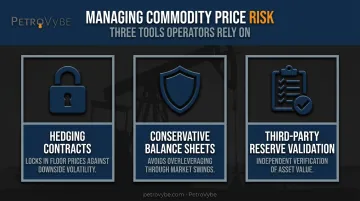
- Hedging contracts that lock in a floor price on a portion of production
- Conservative balance sheets that avoid overleveraging during price peaks
- Third-party reserve engineering validation, which grounds asset value in verified production data rather than speculative pricing
Private development structures offer another layer of insulation. Because there's no daily ticker price attached to a private partnership unit, investors aren't reacting to headline-driven volatility the way public shareholders do. Returns get anchored to actual production cash flow instead of what the market thinks an asset is worth on any given Tuesday.
Challenge 2: Supply Chain Disruptions and Rising Costs
Drilling equipment, steel, and specialized materials all got more expensive after the pandemic, and the effects are still working through the system. The Dallas Fed's oilfield input-cost index hit a record 77.1 in Q1 2022, with costs rising for five straight quarters before easing. Supplier delivery times didn't turn positive again until early 2023.
That kind of pressure doesn't just raise costs. It stretches timelines.
Practical impacts on new wells:
- Tariffs on imported steel and components extend lead times on drilling programs
- Material shortages squeeze margins on workovers that were budgeted months earlier
- Projects delayed even a single quarter can miss favorable pricing windows entirely
Operators managing this well tend to lean on a few core tactics:
- Supplier diversification, so no single vendor disruption stalls a project
- Inventory quality checks before materials reach the wellsite
- Strategic bulk purchasing timed to periods of lower input-cost pressure
None of these tactics eliminate the risk, but they compress the margin for error considerably.
Challenge 3: Workforce Shortages and Talent Retention
The oil and gas workforce has been shrinking for a decade. Seasonally adjusted BLS data show employment in oil and gas extraction fell from 202,700 workers in January 2015 to 119,800 in January 2025, a 40.9% contraction.
That decline isn't evenly distributed. Veteran engineers and geologists are retiring faster than the industry can replace them, while remote, physically demanding field conditions push new hires out the door before they build real expertise.
BLS data show workers aged 55 and older still make up roughly a quarter to nearly a third of the industry's core workforce.
Why this matters beyond headcount:
- Reduces the experienced workforce, raising the risk of turnover-driven safety incidents
- Erodes institutional knowledge about which prospects actually produce with every retirement
- Elevates rare, high-performing technical talent into a genuine competitive advantage
Companies that retain and empower that kind of talent gain an edge that's hard to replicate. PetroVybe's Chief Geophysicist, Michael Stamatedes, brings a 75.2% well-success rate across a 48-year career, nearly double the sub-40% industry peer average. That kind of prospect-selection accuracy directly reduces dry-hole risk for every project he touches.
Challenge 4: Regulatory, Litigation, and Compliance Risk
Jury verdicts against corporate defendants, including energy companies, have grown sharply in recent years. Swiss Re estimates that litigation costs drove a 57% increase in U.S. liability claims over the decade ending in 2023, a trend often called "social inflation."
Median nuclear verdicts (jury awards of $10 million or more) climbed from $21 million in 2021 to $44 million in 2023 across corporate defendants broadly. Meanwhile, state and federal rules on emissions, permitting, and taxation keep shifting. That compliance burden never fully resolves itself.
How operators reduce this exposure:
- Maintaining licensed operator status through bodies like the Texas Railroad Commission, verifiable on public record
- Building a genuine safety culture that reduces incident frequency before it ever reaches a courtroom
- Using contractual risk transfer, insurance structuring, and clear documentation
- Publishing transparent, third-party validated reporting for regulators and investors alike
PetroVybe, for example, holds an active Texas Railroad Commission operator's license through PetroVybe OpCo LLC, publicly searchable alongside its API well numbers. Reserve valuations also undergo review by licensed third-party engineering firms rather than relying on internal estimates. That independent scrutiny matters to regulators and investors alike.

Challenge 5: The Energy Transition and Surging Electricity Demand
Renewables are growing fast. The IEA projects renewable electricity generation climbing from 32% of the global mix in 2024 to 43% by 2030. Every operator strategy has to account for that trajectory now, not eventually.
But total energy demand tells a different story. Fossil fuels are still projected to supply 71% of total global energy demand by 2035 in the IEA's main policy scenario. Electricity generation share and total energy demand are two different measures, and conflating them leads to bad forecasting.
Natural Gas as the Bridge Fuel
Natural gas generates roughly 58% less CO2 per kilowatt-hour than coal, based on EIA combustion data (0.96 lb versus 2.31 lb per kWh). That's a meaningful emissions reduction without sacrificing grid reliability, which is exactly why utilities keep leaning on it as renewables scale up.
The AI Demand Wildcard
Here's where the picture gets more interesting for gas developers specifically. U.S. data centers consumed 176 TWh in 2023, about 4.4% of national electricity use. Projections from Lawrence Berkeley National Laboratory put 2028 consumption at 325 to 580 TWh, potentially 6.7% to 12% of total U.S. electricity demand. That's a doubling or tripling in five years, driven almost entirely by AI infrastructure buildout.
Beyond data centers, policy uncertainty around EV subsidies and adoption timelines adds another wildcard to the forecast. One thing stays clear regardless: dispatchable power is the piece renewables can't fully solve on their own, and gas fills that gap.
Gas developers positioned in strategic basins near this demand curve stand to benefit rather than get disrupted. PetroVybe's projects in Lavaca County and the broader Gulf Coast Basin sit within one of the most infrastructure-rich gas corridors in the country. Three engineering reports have identified 264 development locations here, feeding directly into a grid under mounting AI-driven pressure.
What These Challenges Mean for Oil and Gas Investors
Understanding these five challenges isn't optional homework. It's the core of proper due diligence before committing capital to any oil and gas opportunity.
What separates resilient investments from risky ones:
- Operator track record: A team that's scaled assets successfully before is far less likely to stumble on execution.
- Independent engineering validation: Reserve figures verified by a licensed third-party firm carry weight that internal projections don't.
- Tax-advantaged structuring: Intangible Drilling Cost (IDC) deductions can offset a significant share of taxable active income, softening the blow of any single bad year in the commodity cycle.
PetroVybe's leadership team illustrates what navigating these challenges looks like in practice:
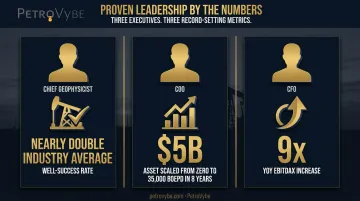
- Chief Geophysicist Michael Stamatedes brings a well-success rate nearly double the industry average.
- COO Blaine Yeary scaled a $5 billion asset from zero to 35,000 BOEPD in eight years.
- CFO Clayton Riddle led a 9x year-over-year EBITDAX increase and grew EBITDA 900% at a prior company.
Together, that's a team built for the risks outlined above, not one learning them on the fly.
On the tax side, PetroVybe partners received a 94% deduction against active income in 2024 and 91% in 2025. That deduction applied directly against W2 earnings and capital gains, a benefit not available through most passive real estate structures.
If you're an accredited investor looking to understand how natural gas development in South Texas and the Gulf Coast Basin fits into a portfolio built for these five challenges, PetroVybe's team can walk through the specifics.
Frequently Asked Questions
What are the biggest challenges facing the oil and gas industry?
The five biggest challenges are commodity price volatility, supply chain and equipment cost inflation, workforce shortages, rising regulatory and litigation risk, and the ongoing energy transition. Each compounds the others, making integrated risk management essential.
How does the energy transition affect oil and gas investment opportunities?
Renewables are growing, but natural gas remains critical for grid reliability, especially with AI data centers driving new electricity demand. Gas developers positioned near that demand curve are well placed to benefit rather than get displaced.
Why is natural gas considered a bridge fuel amid these industry challenges?
According to U.S. Energy Information Administration data, natural gas emits roughly 58% less CO2 per kilowatt-hour than coal, while still providing dispatchable, reliable power that intermittent renewables can't match on their own. That combination makes it a critical bridge fuel during the transition.
How can investors protect against oil and gas market volatility?
Diversifying across commodities, partnering with operators who hedge and use third-party reserve validation, and considering tax-advantaged private development structures all help reduce direct exposure to daily price swings.
What tax benefits are available for oil and gas investments despite industry headwinds?
Intangible Drilling Cost (IDC) deductions can offset a large share of active income, including W2 earnings and capital gains, unlike passive real estate deductions restricted to passive income only. PetroVybe partners, for instance, received 91-94% deductions against active income in 2024 and 2025.
Is now a good time to invest in oil and gas given current industry challenges?
Challenges create opportunity for well-positioned operators, particularly those serving rising electricity demand from AI infrastructure. Due diligence on an operator's track record and third-party validation remains the deciding factor.