
Long project timelines, heavy upfront costs, and clients who pay on their own schedule make this industry uniquely vulnerable to cash crunches that other businesses rarely face. A contractor can finish a job at a healthy margin and still miss payroll because the money hasn't arrived yet.
This article covers what construction cash flow actually is, how to calculate it, the problems that drain it fastest, and 15 proven strategies to keep it positive.
Key Takeaways
- 43% of subcontractors lack enough working capital to cover surprise costs, per a 2025 Construction Dive survey
- Cash flow and profitability aren't the same - a profitable job can still collapse from a cash crunch
- Slow-paying clients, retainage, underbilling, and weak forecasting are the biggest cash flow killers
- Fixing cash flow takes smarter contracts, faster billing, and tighter cost control
- Consistent cash flow also frees up capital to reinvest in equipment, crews, and bigger bids
What Is Cash Flow in Construction (and Why It's Different)?
Cash flow is the money moving in and out of your business over a set period. It's tracked through a cash flow statement broken into three buckets: operating, investing, and financing activities.
That sounds straightforward on paper. In the field, it's anything but.
Cash Flow vs. Profit vs. Working Capital
Net profit is revenue minus expenses, calculated on paper. Cash flow is what's actually sitting in your bank account. A contractor can book a profitable job and still be cash-poor for months while waiting on payment.
Working capital (current assets minus current liabilities) is the fuel for day-to-day operations. When cash flow turns negative, working capital shrinks fast, leaving less room to cover payroll, materials, or the next project's mobilization costs.
Why Construction Is Especially Cash Flow-Sensitive
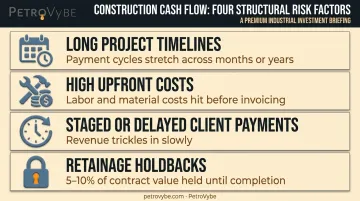
Several structural realities put construction at higher risk than most industries:
- Long project timelines stretch payment cycles across months or years
- High upfront labor and material costs hit before a single invoice gets paid
- Staged or delayed client payments mean revenue trickles in instead of arriving in one lump sum
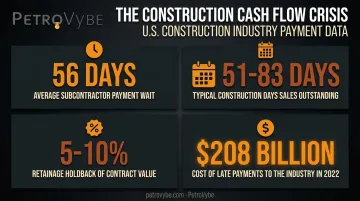
- Retainage holdbacks lock up 5-10% of contract value until the very end
The cost of this exposure isn't small. Late payments cost the construction industry an estimated $208 billion in 2022 alone, up 53% from the year before.
How to Calculate Cash Flow in Construction
The basic formula is simple: cash inflows minus cash outflows. The complexity comes from tracking that across three distinct categories.
Operating Cash Flow
This is calculated as net income plus non-cash expenses plus changes in working capital. It reflects the cash generated (or consumed) by actual construction operations, meaning the work you're billing and getting paid for. This is the number that tells you whether your core business is self-sustaining.
Investing Cash Flow
Capital spent or recovered on equipment, property, and other long-term assets falls into this category. For equipment-heavy contractors, a single $150,000 excavator purchase can swing this number significantly. Tracking it separately keeps big asset decisions from muddying your read on day-to-day operations.
Financing Cash Flow
Debt, equity, and any dividend or owner distribution activity fall under this category. Reviewing it regularly often surfaces opportunities you'd otherwise miss, such as refinancing a 12% equipment loan for a lower rate or renegotiating a line of credit before you actually need it.
Common Cash Flow Problems That Drain Construction Businesses
Before fixing cash flow, it helps to understand what breaks it. Think of this as the "before" picture that makes the 15 strategies below far more actionable.
Underbilling and Overbilling
When billing falls out of sync with actual work completed, cash gaps appear. Underbilling means you've done the work but haven't invoiced for it, effectively giving the client an interest-free loan. Overbilling can mask a shortfall that surfaces later, right when you can least afford it.
Slow-Paying Clients and Retainage
Subcontractors report waiting an average of 56 days for payment, while general contractors often believe payment lands within 30 days of a pay application. Studies place construction Days Sales Outstanding anywhere from 51 to 83 days, roughly two to three months after invoicing.
Add retainage on top: 5-10% of contract value held back until project completion, and that holdback can equal or exceed a contractor's entire net margin on the job.
Uncontrolled Change Orders, Inventory, and Forecasting Gaps
Unmanaged change orders delay billing because work happens before paperwork catches up. Meanwhile, overstocked inventory ties up cash that should be funding payroll or the next mobilization, sitting in a yard instead of earning a return.
Poor forecasting makes both problems worse. Without a rolling forecast, contractors often front project costs out of pocket with no clear plan for when that cash gets replenished. This pattern repeats project after project, and each repetition compounds the strain.
15 Ways to Manage & Improve Cash Flow in Construction
These strategies span forecasting, contracts, billing, cost control, financing, and technology. Some work well on their own; most work best combined.
1. Build a Rolling, Project-by-Project Cash Flow Forecast
Forecast each project's expected inflows and outflows, then update it weekly or biweekly. A rolling forecast catches shortfalls while there's still time to act, instead of discovering them the day payroll is due.
2. Set Clear Payment Terms in Every Contract
Spell out payment schedules, documentation requirements, and dispute resolution timelines before work begins. Ambiguity is what causes payment delays; a tightly written contract removes the excuse.
3. Invoice Promptly and Bill in Line With Progress
Send invoices the moment a milestone is hit, not at the end of the month. Keep billing matched to actual costs incurred so you're never quietly underbilling or overbilling without noticing.
4. Request Deposits and Progress/Milestone Payments
Negotiate a mobilization fee upfront and structure payments around milestones instead of waiting for one lump sum at completion. This keeps cash flowing throughout the job rather than all at the finish line.
5. Offer Multiple Payment Methods and Early-Payment Incentives
Give clients more ways to pay: cards, ACH transfers, payment apps. Pair that with a small early-payment discount, and you'll often see invoices clear days or weeks faster.
6. Manage Change Orders Proactively
Start the change order and billing process the moment scope changes are identified. Waiting until the end of the job to formalize changes creates a backlog of unbilled work; software tools can speed approvals considerably.
7. Negotiate Smarter Terms With Suppliers and Subcontractors
Push for shorter payment terms from clients and longer terms from your vendors. Negotiate volume discounts where you can. The gap between when you collect and when you pay is where your working capital lives.
8. Avoid Paying Bills Too Early
Pay invoices right up to (not before) their due date. Every dollar paid early is a dollar that could've stayed in your account earning flexibility, unless an early-pay discount clearly beats the cost of holding that cash.
9. Control Inventory and Reduce Waste
Buy only what a specific project needs. Overstocking materials ties up cash in storage and inventory that could otherwise be funding payroll or the next job's mobilization.
10. Speed Up Project Closeout
Organized punch lists, lien waivers, and inspection documentation accelerate final payment and the release of retainage. Disorganized closeout paperwork is one of the most common reasons final payment drags on for months.
11. Enforce Payment Schedules and Late Payment Penalties
Build late fees and collections language directly into contracts. When clients face a real financial cost for paying late, on-time payment suddenly becomes a priority instead of an afterthought.
12. Use Construction Accounting or ERP Software
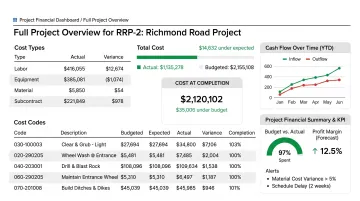
Real-time job costing, automated invoicing, and cash flow dashboards give contractors an earlier warning of shortfalls than a spreadsheet updated once a month ever could.
This matters more than it might seem. Rework alone costs the U.S. construction industry an estimated 5% of total project costs, or roughly $65 billion annually, according to PlanGrid's Construction Disconnected report. Much of that waste ties back to poor project data and miscommunication. Real-time visibility catches these issues before they eat into cash.
13. Establish a Cash Reserve or Line of Credit
A dedicated emergency fund or a pre-approved line of credit prevents a seasonal slowdown or one late-paying client from turning into a crisis. Set it up before you need it, not during the shortfall.
14. Choose Financing Wisely for Equipment and Assets
Weigh leasing against financing for major equipment purchases. Paying cash outright for a large asset can drain reserves you'll need later; smarter financing preserves flexibility without sacrificing the equipment you need to operate.
15. Plan for Taxes Year-Round - and Put Surplus Cash Flow to Work
Proactive tax planning, including deferrals and available deductions, prevents a large unexpected tax bill from disrupting cash flow during a slow stretch. Waiting until March to think about taxes is a habit worth breaking.
Construction owners who've built strong, consistent cash flow and carry a meaningful active income tax burden often look for ways to redeploy that surplus efficiently. This is where some business owners explore alternative assets outside real estate or the stock market.
PetroVybe's natural gas development offering, for example, applies the Intangible Drilling Cost deduction against active income, including W-2 wages and business profit, rather than passive income only. It's a niche fit limited to accredited investors with a $100,000 minimum, so it's worth raising with your tax advisor if that describes your situation.
Managing Cash Flow With the Right Tools and Technology
Spreadsheets worked fine when you had one project running. They fall apart fast once you're juggling multiple jobs, contract types, and a steady stream of change orders.
Look for platforms that combine:
- Real-time job costing tied to actual field activity
- Automated billing and invoicing that triggers at milestones
- Contract and retainage tracking so nothing gets missed at closeout
- Cash position dashboards that show where you stand today, not last month
Connecting your accounting system directly to field and project management data eliminates duplicate entry and sharpens forecast accuracy. That's the difference between reacting to a cash shortfall and seeing it coming three weeks out.
Frequently Asked Questions
How do you calculate cash flow in a construction business?
Cash flow equals total cash inflows minus total cash outflows over a given period. It breaks down into three components: operating cash flow (from core construction work), investing cash flow (equipment and assets), and financing cash flow (debt and equity activity).
What is the difference between cash flow and profit in construction?
Profit is revenue minus expenses on paper. Cash flow tracks actual money moving through your bank account. A project can show a healthy profit margin and still be cash-negative if payments are delayed or retainage is tied up.
What causes negative cash flow on construction projects?
The most common causes are slow-paying clients, retainage holdbacks, underbilling relative to work completed, and weak or nonexistent forecasting. Uncontrolled change orders and overstocked inventory add to the strain.
How much cash reserve should a construction company keep?
General small-business guidance suggests keeping roughly three months of operating expenses in reserve for unforeseen costs. Construction's longer payment cycles and retainage exposure make a reserve on the higher end of that range a reasonable target.
Does construction accounting software really improve cash flow?
Real-time job costing and automated invoicing shorten the lag between work completed and cash collected. A single missed billing cutoff can delay payment by an entire 30-day cycle, which software is built to prevent.
What financing options help bridge cash flow gaps in construction?
Lines of credit, invoice factoring, and short-term equipment loans are the most common tools for bridging the gap between costs incurred and payments received. The right choice depends on the size of the gap and how quickly you expect payment.