

Introduction
Two partners open a firm. One puts in $500,000. The other puts in $200,000. Yet they agree to share profits equally. Is that fair to the partner who locked up more money?
This is exactly the gap interest on capital is designed to close. It's the accounting mechanism that compensates partners for the capital they've tied up in the business, before the remaining profit gets split.
That mechanism raises a common student question: is it an expense, an indirect expense, or something else entirely? The confusion is understandable, since it behaves differently from rent or salaries.
This guide breaks down the meaning, the conditions that must be met, the exact journal entries, where it lands in final accounts, and how it compares to interest on drawings. We'll also look at how modern capital partnerships reward investors in ways that go well beyond a fixed accounting rate.
Key Takeaways
- Interest on capital is an appropriation of profit, not a business expense.
- Interest is payable only when the partnership deed allows it and profits are available.
- The entry debits Interest on Capital A/c, then transfers it to the P&L Appropriation A/c.
- Interest gets reduced proportionately if profits fall short, and skipped entirely in a loss year.
What is Interest on Capital?
Interest on capital is the compensation paid to a partner for the capital they've invested in the firm. It's usually calculated as a fixed percentage of the partner's capital balance, agreed upon in advance.
This concept mostly shows up in partnership firms, and for good reason. Partners frequently contribute unequal amounts of capital but choose to share profits in a completely different ratio, perhaps because one partner brings more skill or time to the table instead of money. Interest on capital rebalances that arrangement.
Conditions for Allowing Interest on Capital
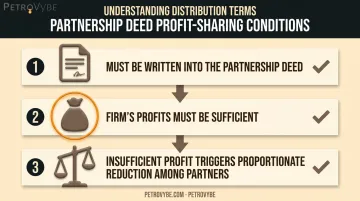
Three conditions govern whether interest on capital gets paid at all:
- It must be written into the Partnership Deed. Section 13(c) of the Indian Partnership Act, 1932 confirms interest is payable only out of profits, and only when agreed upon. Without that agreement, NCERT's Accountancy textbook confirms no interest is payable at all.
- Profits must be sufficient. A partner cannot claim interest as a guaranteed payout independent of what the firm actually earns.
- Insufficient profit triggers proportionate reduction. When net profit is less than the total interest due, the available profit gets distributed among partners in the ratio of their respective interest entitlements, not their capital ratio.
Formula and Calculation Method
The standard formula is straightforward:
Interest on Capital = Capital Amount × Rate of Interest × Time
When a partner adds capital mid-year, the time factor needs adjusting proportionately.
Worked example: Partner A starts the year with ₹4,00,000 in capital and introduces an additional ₹1,00,000 on 1 October. The agreed rate is 10% per annum, with the accounting year ending 31 March.
- Interest on opening capital: ₹4,00,000 × 10% = ₹40,000
- Interest on additional capital (6 months only): ₹1,00,000 × 10% × 6/12 = ₹5,000
- Total interest on capital for Partner A: ₹45,000
Treatment When the Firm Incurs a Loss
No interest on capital is provided in a year of loss. This follows directly from its classification. It's an appropriation of profit, not a debt the firm owes its partners regardless of performance. Without profit to appropriate, the firm has no basis for allowing the interest at all.
Accounting Treatment in Final Accounts
A partnership firm's final accounts include the Trading Account, Profit and Loss Account, Profit and Loss Appropriation Account, and Balance Sheet. Interest on capital only touches the last two.
Journal Entries for Interest on Capital
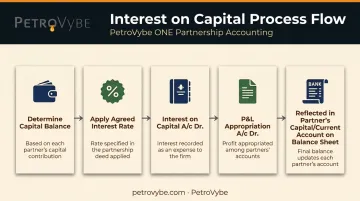
Two entries are needed, and they always happen in this order. This sequence keeps the ledger accurate: the interest is first recognized against the firm's profit, then absorbed into the appropriation account before profits are divided among partners.
Step 1: Recording the interest
Interest on Capital A/c   Dr.
    To Partner's Capital/Current A/c
Step 2: Closing the account
Profit and Loss Appropriation A/c   Dr.
    To Interest on Capital A/c
Treatment in the Profit & Loss Appropriation Account
Interest on capital appears on the debit side of the P&L Appropriation Account, deducted before whatever profit remains gets divided among partners according to their profit-sharing ratio.
Treatment in the Balance Sheet
Here's a common source of confusion: interest on capital never shows up as its own line item in the Balance Sheet. Instead, it gets folded into each partner's Capital or Current Account, increasing the total capital shown under liabilities at year-end.
Fixed Capital vs Fluctuating Capital Method
Where the credit lands depends on which capital system the firm uses:
| Method | Interest Credited To | Balance Sheet Effect |
|---|---|---|
| Fixed Capital | Partner's Current Account | Fixed capital stays unchanged; current account balance shown separately |
| Fluctuating Capital | Partner's Capital Account | Interest directly increases the capital account balance |
Worked Example Tying the Concepts Together
Say Partner B has a capital balance of $300,000 and the deed allows 8% annual interest.
- Interest on Capital = $300,000 × 8% = $24,000
- Journal Entry 1: Interest on Capital A/c Dr. $24,000; To Partner B's Capital A/c $24,000
- Journal Entry 2: P&L Appropriation A/c Dr. $24,000; To Interest on Capital A/c $24,000
- In the Balance Sheet, Partner B's capital account now reflects this $24,000 addition, folded into the closing balance.
Is Interest on Capital an Expense, Income, or Appropriation?
Here's the direct answer: interest on capital is neither a routine business expense nor income for the firm. It's an appropriation of profit.
The distinction comes down to when and how it hits the books:
- Not an expense: it never touches the Profit and Loss Account, unlike rent or salaries, which reduce net profit directly
- Not firm-level income: the firm doesn't "earn" this interest; it's simply profit being redirected
- An appropriation: it's calculated and recorded only after net profit is finalized, in the separate Appropriation Account
That distinction matters for one practical reason: a genuine expense can push a firm into a loss. Interest on capital can't, because it's carved out of profit that already exists.
One nuance worth flagging: from the receiving partner's personal perspective, interest on capital functions as income. They can spend it, save it, or reinvest it, but it's never recorded as an expense in the firm's books, which is where most students trip up.
Interest on Capital vs Interest on Drawings
Interest on drawings is the direct counterpart. It's interest charged to partners on amounts they withdraw from the firm during the year, functioning as a mild deterrent against pulling out too much cash too early.
The two items sit on opposite sides of the ledger:
| Aspect | Interest on Capital | Interest on Drawings |
|---|---|---|
| Effect on partner | Credited (added) | Debited (deducted) |
| Effect on distributable profit | Reduces it | Increases it |
| P&L Appropriation side | Debit | Credit |
| Purpose | Rewards capital invested | Discourages excess withdrawal |
Both items pass through the P&L Appropriation Account, but they work in opposite directions to arrive at the final distributable profit.
Beyond the Classroom: How Real Capital Partnerships Reward Investors
Everything above describes a fixed, book-entry interest rate set by a partnership deed. It's a controlled academic model. Real-world capital partnerships often work differently.
Take PetroVybe, a Texas-based natural gas development company. Instead of crediting investors with a fixed interest rate on their capital, PetroVybe structures its partnerships around direct equity participation in producing assets across South Texas and the Gulf Coast Basin. Investors don't earn a set percentage; they own a stake in the underlying wells.
PetroVybe's flagship offering targets:
- A 10-year MOIC of roughly 2.2x to 5.8x
- A target IRR near 26%
That's a return structure built on production performance, not a fixed formula.
There's a second layer that has no equivalent in traditional partnership accounting: tax treatment. Under Intangible Drilling Cost provisions, PetroVybe investors have claimed substantial deductions against active income, including W-2 earnings and capital gains.
Partners who joined in 2024 received a 94% deduction against active income; 2025 partners saw that adjust to 91%. That's fundamentally different from a classroom interest-on-capital credit, which never touches a partner's personal tax bill.

Understanding how interest on capital works in traditional accounting gives investors a useful reference point. It clarifies what a "guaranteed" return actually means.
That clarity makes it easier to evaluate alternative structures, like direct oil and gas partnerships, where compensation comes through equity ownership and tax efficiency rather than a fixed book entry.
FAQs
Is interest on capital an expense or income?
Neither, from the firm's standpoint. It's an appropriation of profit recorded in the P&L Appropriation Account. For the partner receiving it, though, it functions as personal income.
Is interest on capital an indirect expense?
No. It never appears in the Profit and Loss Account. It's recorded only after net profit is determined, in the separate Appropriation Account, unlike operating expenses such as rent or salaries.
What is the entry for interest on capital?
First: Interest on Capital A/c Dr. To Partner's Capital A/c. Second: P&L Appropriation A/c Dr. To Interest on Capital A/c, which closes the account.
Is interest on capital allowed if the firm incurs a loss?
No. Interest on capital can only be appropriated out of available profits. In a loss-making year, none is given, regardless of what the deed states.
How is interest on capital treated when profit is insufficient?
The available profit is distributed among partners in the ratio of their respective interest entitlements, not their capital balances, as confirmed in ICAI's Foundation Course materials.
Is interest on capital shown separately in the Balance Sheet?
No. It isn't listed as its own line item. It gets added into the partner's capital or current account balance under the Capital heading instead.