
Introduction
For decades, a paycheck landed in your account every two weeks, whether you thought about it or not. Retirement changes that overnight. The moment you stop working, you become responsible for turning decades of savings into income that has to last as long as you do.
That shift raises hard questions: When can I actually retire, and will my money outlast me? What happens if inflation spikes or the market drops the week after I stop collecting a salary?
This guide breaks down the income sources, withdrawal strategies, tax moves, and risk-management tactics that turn a lump sum into a paycheck you can count on for the rest of your life.
Key Takeaways
- Turn savings, Social Security, and pensions into a steady paycheck for life.
- Guaranteed income (pensions, Social Security) and portfolio withdrawals work best combined, not alone.
- A written plan curbs panic decisions during market drops or health scares.
- Diversifying into tax-advantaged, passive-income assets beyond stocks and bonds boosts resilience.
- Regular professional reviews keep your plan current as tax laws, inflation, and life change.
What Is Retirement Income Planning?
Retirement income planning is the process of converting everything you've saved, Social Security benefits, pension credits, investment accounts, into a reliable stream of money that covers your expenses for the rest of your life.
It's a different discipline than the accumulation phase you spent your career on. Accumulation asks: how do I grow this pile as large as possible? Income planning asks a harder question: how do I draw it down without running out, regardless of how long I live or what the market does?
Probability-Based vs. Guaranteed Income Approaches
Retirement income generally falls into two categories.
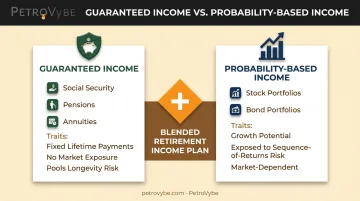
Probability-based income comes from a portfolio of stocks and bonds. You withdraw a percentage each year based on historical market performance. It offers growth potential, but it's exposed to sequence-of-returns risk, meaning a bad market in your first few retirement years can do lasting damage.
Guaranteed income comes from Social Security, defined-benefit pensions, and annuities. These pool longevity risk across large groups of people and promise income for life no matter what markets do.
Most solid retirement plans blend both: guaranteed income covers the essentials, while market-based investments provide growth and flexibility for everything else.
Why a Written Plan Beats "Hoping for the Best"
A written plan spells out your withdrawal rate, account sequencing, and cash reserves before you need them. Without one, three things tend to happen to retirees:
- Outliving their savings
- Panic-selling during market downturns
- Leaving Social Security benefits unclaimed at the optimal age
In EBRI's 2025 Retirement Confidence Survey, only 54% of workers said they or a spouse had tried to calculate how much they'd need to save for retirement. That means roughly 46% never ran the numbers at all.
That's nearly half of future retirees walking into the biggest financial transition of their lives without a map.
Identifying Your Retirement Income Sources
A resilient income plan blends multiple income streams, so risk never rests entirely on one source, whether market performance, an employer, or government policy. Here's how to inventory what you likely already have, and where to look for more.
Guaranteed and Semi-Regular Income
Guaranteed sources require little ongoing management once claimed:
- Social Security, including spousal benefits worth up to 50% of a worker's full-retirement-age benefit, according to the Social Security Administration
- Defined-benefit pensions, though access has shrunk to just 14% of private-industry workers as of March 2025, per the Bureau of Labor Statistics
- Annuities purchased to create a personal pension
Semi-regular sources are reliable but not fully guaranteed:
- Dividends from stocks
- Interest from bonds and CDs
- Rental income from property
- Required Minimum Distributions once you reach age 73 or 75, depending on your birth year
Market-Based Investment Income
Stock portfolio returns, bond price appreciation, and real estate gains round out most retirement plans. They're also the least predictable piece of the puzzle.
A market downturn in your first retirement years, combined with ongoing withdrawals, can permanently shrink the capital you have left to recover. That's sequence-of-returns risk, and it's why cash reserves matter more than most retirees expect.
Alternative and Passive Income Streams for Diversification
High-income earners and accredited investors increasingly look past traditional stocks, bonds, and real estate to diversify retirement income and hedge against inflation and market cycles.
Direct participation in natural gas and oil development is one such alternative. Companies like PetroVybe give accredited investors access to early-stage natural gas development projects. These projects are structured to generate passive monthly income, long-term tangible asset growth, and meaningful tax advantages against active income.
PetroVybe's flagship project, PetroVybe ONE, operates in Lavaca County, Texas, part of the Gulf Coast Basin. Distributions are projected to peak above $10,000 a month per unit during peak production, though a hold period of roughly 2-3 years typically precedes the first payout.

This kind of investment fits a specific profile:
- Accredited investors with $100,000+ in liquidity
- Investors seeking diversification, tax efficiency, and inflation-resistant passive income
- Complements, rather than replaces, core guaranteed income sources
It's not for everyone, and it shouldn't be your only income plan. But for the right investor, it adds a stream that doesn't move in lockstep with the stock market.
Building a Sustainable Withdrawal and Tax-Efficient Strategy
Once your income sources are mapped, the next question is how much to withdraw, and in what order, so the money actually lasts.
The Floor-and-Buckets Approach
Cover essential, non-discretionary expenses with guaranteed income first: housing, food, insurance, basic utilities. Then layer in two buckets:
- A cash bucket holding 2-4 years of expenses, insulating you from forced selling during downturns
- A long-term growth bucket invested for the decades ahead
This structure means a bad market year doesn't force you to sell stocks at the bottom just to pay the electric bill.
Choosing a Withdrawal Rate
The 4% rule, from William Bengen's 1994 research, remains the most-cited starting benchmark: withdraw 4% of your portfolio in year one, then adjust for inflation annually. It was built around a roughly 30-year retirement using historical U.S. market returns, not a guarantee.
Advisors now treat that number as a starting point, not gospel. Morningstar's 2025 research puts the safe starting withdrawal rate closer to 3.9% for retirees who want fully inflation-adjusted spending over 30 years.
Depending on how much of your budget is essential versus discretionary, that range can run anywhere from roughly 3% up to 7%.
Inflation adjustments matter too. Some retirees fully adjust withdrawals for inflation every year; others follow a natural "spending decline" pattern, spending more in active early retirement and less later on. Either approach works, as long as it's intentional rather than accidental.
Sequencing Withdrawals for Tax Efficiency
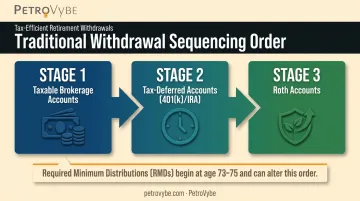
The traditional order draws from taxable accounts first, then tax-deferred accounts, then Roth accounts last, preserving tax-free growth as long as possible. But this isn't universal. If you expect to land in a higher tax bracket later, proportional withdrawals or partial Roth conversions earlier can reduce lifetime taxes.
Required Minimum Distributions complicate the picture. RMDs currently start at age 73 for those born 1951-1959, and age 75 for those born after 1959, per IRS guidance. These distributions count as taxable income whether you need the cash or not. Two strategies help manage the impact:
- Continue part-time work to smooth out the tax bracket your RMD lands in
- Reinvest excess RMD income you don't need to spend right away
Run these numbers through a retirement withdrawal calculator, or with an advisor, against your actual expense timeline. Generic rules of thumb rarely match your real life.
Managing Key Retirement Risks
Three risks show up in almost every retirement plan, and each deserves specific attention.
Longevity Risk
Retirement can easily last 20 to 30+ years, especially for couples where one spouse may live well into their 90s. Plans built around "average" life expectancy leave a real chance of running out of money in your final decade. Build in margin, not just an average.
Sequence-of-Returns Risk
A market downturn in your first few retirement years does more damage than the same downturn a decade in, because you're withdrawing from a shrinking balance the whole time. Cash reserves and flexible spending help you avoid selling into a falling market.
Inflation and Healthcare Costs
Healthcare is one of the biggest wildcards in retirement budgeting. Fidelity estimates that a 65-year-old retiring in 2025 may need $172,500 in after-tax savings just to cover healthcare and medical expenses through retirement, and that figure is for an individual, not a couple.
Inflation compounds this risk over time, eroding the purchasing power of fixed income sources like pensions and annuities that don't include cost-of-living adjustments. Budget for healthcare separately from everyday living expenses, and stress-test your plan against a higher-than-expected inflation scenario.
Reducing Your Tax Burden Before and During Retirement
Tax planning doesn't start the day you retire. The moves you make during your working years set the stage for how much of your retirement income actually stays in your pocket.
Laying the Groundwork During Your Working Years
Maximizing 401(k) and IRA contributions while you're earning lowers your current taxable income and builds the tax-deferred balance you'll draw from later. Understanding which marginal bracket you sit in, and how close you are to the next one, helps you decide whether traditional or Roth contributions make more sense each year.
Tax-Advantaged Alternatives for High Earners
High-income W-2 earners and business owners with capital gains often carry a heavier tax load than most retirement accounts alone can offset. That's where tax-advantaged alternative investments can help.
Intangible Drilling Cost (IDC) deductions, available through direct participation in oil and gas development, are one example. Unlike most passive investments, IDC deductions aren't restricted to passive income; they can offset active income directly, including W-2 wages and capital gains.
PetroVybe's investor partners have seen this play out firsthand:
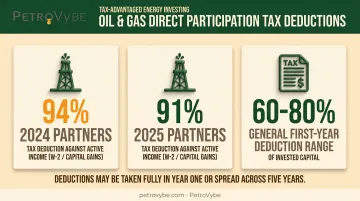
- Partners who joined in 2024 received a 94% tax deduction against active income
- 2025 partners saw that shift to 91%
- A $100,000 investment can generate a first-year deduction in the range of 60-80% of invested capital, taken in full the first year or spread over five
This isn't a strategy for everyone. It requires accredited investor status, real due diligence, and a long-term mindset. But for someone facing a large tax bill from a bonus, stock sale, or high W-2 income, it's worth a conversation.
Get Personalized Guidance
Before retirement, sit down with a CPA or tax advisor to model Roth conversions, quarterly estimated tax payments, and account withdrawal sequencing specific to your situation. Generic advice can only take you so far; your tax picture is yours alone.
Frequently Asked Questions
What is the 50/30/20 rule for income?
It's a budgeting framework allocating 50% of income to needs, 30% to wants, and 20% to savings or debt repayment. Retirees often adjust these ratios once paychecks stop and savings become the primary income source.
What is the $1,000 a month rule for retirement planning?
It estimates you need roughly $240,000 saved for every $1,000 of desired monthly retirement income, based on a 5% withdrawal assumption. It's a rough planning shortcut, not a precise formula for your situation.
When should I start retirement income planning?
Most experts recommend starting 5-10 years before retirement, but earlier is better. More lead time gives you flexibility to adjust savings, tax strategy, and diversification before you need the income.
Is the 4% withdrawal rule still relevant today?
It remains a useful starting benchmark, but most advisors now adjust it based on market conditions and personal risk tolerance—lower for tight, non-discretionary budgeters and higher for those with more spending flexibility.
How much income do I need in retirement?
Rather than relying on a flat percentage of pre-retirement income, project your essential plus discretionary expenses against your expected income sources. That gives a far more accurate number than any generic rule.
Can alternative investments like oil and gas development help diversify retirement income?
Direct participation in natural gas or oil development can offer accredited investors passive income and substantial tax deductions, along with long-term, inflation-resistant asset growth. It works best alongside core guaranteed income sources rather than replacing them.